Tag: mindset

  • What Is Fatigue?

    What Is Fatigue?

    Original article By Alex Hutchinson, New Yorker Magazine, December 12, 2014. Includes links to Podcast interviews.
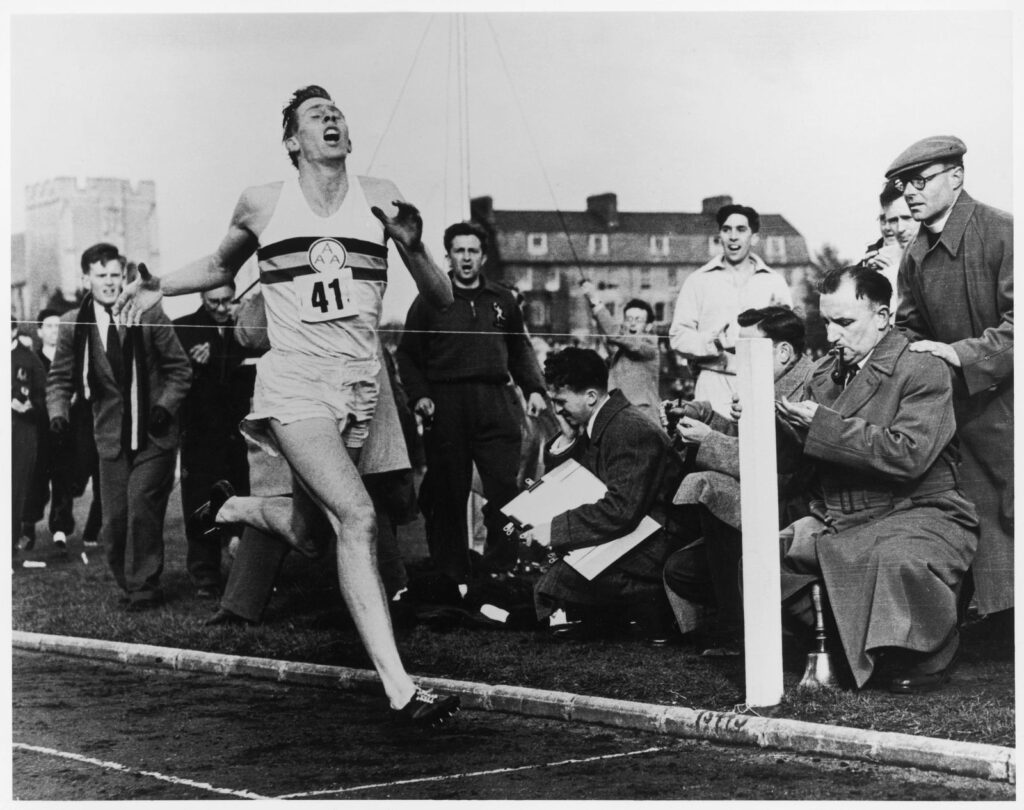
    Roger Bannister at the end of his record-breaking mile run at Oxford, in 1954.
    Photograph by Norman Potter

    When, on a blustery day in Oxford in 1954, Roger Bannister ran the first sub-four-minute mile, measuring out the full capacity of his lungs and legs and collapsing across the finish line, he felt, as he later wrote, “like an exploded flashlight.” That was the feeling researchers were trying to evoke, recently, when they paid thirteen volunteers at Bangor University, in Wales, to pedal a stationary bike at a predetermined pace for as long as they could. Such “time to exhaustion” trials are a well-established method of measuring the limits of physical endurance, but in this case the experiment also had a hidden psychological component. As the cyclists pedalled, a screen in front of them periodically flashed images of happy or sad faces in imperceptible sixteen-millisecond bursts, ten to twenty times shorter than a typical blink. The cyclists who were shown sad faces rode, on average, twenty-two minutes and twenty-two seconds. Those who were shown happy faces rode for three minutes longer and reported less of a sense of exertion. In a second experiment, the researchers demonstrated that subliminal action words (go, lively) could boost a subject’s cycling performance by seventeen per cent over inaction words (toil, sleep).

    The study, which was published last month (2013) in the journal Frontiers in Human Neuroscience, by Samuele Marcora, who heads the University of Kent’s Endurance Research Group, and two of his colleagues at Bangor, Anthony Blanchfield and James Hardy, is the latest salvo in an ongoing debate about the very nature of fatigue. According to one study, fatigue is “the inability of the contracting muscles to maintain the desired force.” But what causes it? Physiologists in the early twentieth century studied exhaustion by cutting off the hind legs of frogs and electrically stimulating the muscles over and over until they couldn’t contract anymore. In 1907, the Nobel Laureate Frederick Hopkins and one of his colleagues showed that the depleted frog muscles were bathed in lactic acid. Their experiment gave rise to an enduring-and incorrect-explanation for muscle failure; scientists now know that lactate, the form in which lactic acid occurs in the body, actually fuels muscular contraction rather than inhibiting it. Nevertheless, the view of fatigue as a mechanical breakdown has persisted. You max out your ability to pump oxygen, the acidity of your blood creeps up, and the neuromuscular signalling between your brain and your muscles gets weaker: one way or another, you hit a limit.

    Marcora believes that this limit is probably never truly reached-that fatigue is simply a balance between effort and motivation, and that the decision to stop is a conscious choice rather than a mechanical failure. This, he says, is why factors that alter a person’s perception or motivation (monetary rewards, for example) can affect performance, even without any change in muscle capacity. In the subliminal experiments, the cyclists’ heart rates and lactate levels rose at the same rate no matter which faces they saw, indicating that nothing had changed from the neck down. Considerations like heat, hydration, and muscle conditioning, Marcora says, “are not unreal things, but their effect is mediated by perception of effort.” In other words, they don’t force you to slow down, as happens with the failing frog muscles in the petri dish; they cause you to want to slow down-a semantic difference, perhaps, but a significant one when it comes to testing the outer margins of human capability.

    Marcora calls his theory the “psychobiological model.” It’s one of several attempts, in the past decade, to incorporate the brain into the understanding of endurance. This isn’t to say that previous generations of scientists discounted the mind’s influence on physical performance; as Michael Joyner, a physiologist at the Mayo Clinic, in Minnesota, told me, “There were people talking about this stuff in the eighteen-eighties, and coming up with very good thought experiments.” The Italian scientist Angelo Mosso, for instance, showed that the muscular endurance of two of his fellow physiology professors was diminished after they had given a series of lectures and oral exams to students. In the more than a century since, researchers have tried everything from hypnosis to curare toxin to alter the correspondence between mental effort and muscular output. But only recently have brain-imaging tools such as functional magnetic resonance imaging and electroencephalography become advanced enough to allow observation of the brain during intense exercise.

    Consider, for example, the sub-two-hour marathon, which is starting to look like the contemporary equivalent of the four-minute mile. Back in 1991, Joyner published an influential paper in which he combined the upper observed limits of several aspects of running performance into a calculation of the fastest possible marathon time. He settled on 1:57:58, almost nine minutes faster than the world record at the time; a discrepancy that suggested, Joyner wrote, that “our level of knowledge about the determinants of human performance is inadequate.” At the Berlin Marathon, this September, a thirty-year-old Kenyan man named Dennis Kimetto, a former subsistence farmer who started competing internationally just three years ago, set a new world record, completing the race in a time of 2:02:57-still almost five minutes short of Joyner’s prediction.

    Why does fatigue prevent athletic wonders like Kimetto from closing the five-minute gap? One possibility, proposed by Tim Noakes, a professor at the University of Cape Town, is that the brain has a subconscious safety mechanism that kicks in to prevent the body from getting too close to dangerous limits. Noakes calls this mechanism the “central governor.” In his view, fatigue is a protective emotion rather than a reflection of the body’s physiological state; its action is preëmptive and involuntary. That’s why, if you go for a run on a hot day, your pace is slower right from the start-not because you’re already overheating but because you might do so later. It’s possible, Noakes might argue, that what holds Kimetto back from a 1:57:48 marathon is hardwired self-preservation.

    Some clues about how this protective circuitry may work are beginning to emerge. A study published in November by researchers at the University of Utah showed that leg exercise makes the arms tired, a brain-mediated phenomenon known as nonlocal fatigue-unless you inject the painkiller fentanyl into the spine to block nerve signals travelling upward from the legs, in which case the arms are unaffected. Other studies have shown that acetaminophen, the pain inhibitor that is used in Tylenol, can boost cycling performance by some two per cent. Last year, a group of Brazilian and international scientists used a weak electric current, directed at a region of their subjects’ brains that monitors effort and pain, to produce an improvement of around four per cent in cycling endurance. In each case, altering the brain’s ability to monitor distress signals from the body seemed to increase the level of fatigue that the central governor was willing to tolerate.

    Marcora views the idea of a subconscious governor as unnecessarily complicated. He cites his subliminal-messaging study as a counterargument. Seeing a smiling face for a fraction of a second doesn’t change the fact that your pulse is, say, a hundred and eighty beats per minute and your blood-lactate concentration is seven millimoles per litre. It simply alters your conscious perception of those physiological extremes. In previous studies, Marcora has used caffeine gum, motivational self-talk, and what he calls “brain endurance training”-daily doses of cognitively challenging computer tasks-to tinker similarly with the feeling of exertion. (His initial interest in fatigue research was sparked by his mother’s struggles with unexplained fatigue after a kidney transplant, a common clinical occurrence in which perception is out of synch with physiology.)

    As laboratory demonstrations of the brain’s role in endurance have accumulated, the sports world has begun its own experiments. In May, Red Bull brought four élite cyclists and triathletes and two dozen researchers, led by a team of neuroscientists from Weill Cornell Medical College and Burke Medical Research Institute, in New York, to its Santa Monica headquarters. There they explored the endurance-boosting potential of transcranial direct-current stimulation, the technique used in the Brazilian study. Members of the U.S. national BMX team are testing a program that was developed by neuroscientists at the University of California, San Diego, to encourage mindfulness. Marcora, meanwhile, is in discussion with Recon Instruments, which bills its Recon Jet as “the first heads-up display for sports”-a Google Glass-like contraption that is ideal for flashing subliminal encouragement.

    Of course, coaches and athletes have long known to focus their efforts on the brain. I contacted Steve Magness, a cross-country coach at the University of Houston and the author of “The Science of Running: How to Find Your Limit and Train to Maximize Your Performance,” to ask him about Marcora’s study. It was the eve of the N.C.A.A. championships, and he was at a hotel in Indiana. “It’s intriguing that a seemingly subliminal cue could impact performance,” he told me in an e-mail. But he wasn’t surprised. “That’s what coaching is all about.” For months, Magness had been preparing his runners for the critical point in a race, the moment at which fatigue threatens to eclipse motivation. He planned to look his star runner in the eye the next morning and tell him that he was ready for the challenge. “That reinforcement from a coach, if it is genuine, I’m sure has a bigger psychological effect both consciously and subconsciously than presenting smiley faces,” he said.

  • Cracking the Athlete’s Brain

    Cracking the Athlete’s Brain

    Researchers are showing everyday athletes how to train their brains to perform like the pros


    Original article by Alex Hutchison, Outside magazine, Dec 30, 2013

    It goes without saying that Olympic athletes need to be strong, fit, and tough. But none of that matters if they aren’t capable of adapting quickly to unexpected circum-stances. Take former Slovenian swimmer Sara Isakovic. During the 2008 Beijing Olympics, with one length remaining in the 200-meter freestyle final, disaster struck. Isakovic misjudged her final flip turn, and as she uncoiled her legs to explode off the wall, she could feel her toes just barely graze it.

    “I remember thinking, This is not happening! Why now?” Isakovic, 25, recalls. “Then, in a split second, I was able to refocus.” Riding on a surge of adrenaline, she tore down the last length to nab a silver medal, breaking the previous world record and missing gold by just 0.15 seconds.

    Isakovic is now a research assistant in psychiatry at the University of California at San Diego, where she works with Martin Paulus, a leading player in the search for brain–training techniques that will enable the rest of us to develop elite-level mental agility. Says Isakovic, “What we’re interested in is how you build resilience, how you train your brain to be as tough as your body.”

    For the past five years, Paulus and his team have employed advanced imaging tools to understand the difference between normal and ultra-resilient brains. They’ve discovered that the distinction often resides in the interplay between two areas: the insular cortex and the medial prefrontal cortex, or MPC. The insular cortex monitors data from the outside world and from within the body—muscle tension, glucose levels, blood pressure, blood-oxygen levels. The MPC, meanwhile, decides how strongly to respond to those signals.

    The goal, then, is to train your brain to anticipate, and not overreact, to unexpected stress. For a whitewater kayaker, that means staying calm and making the right strokes after getting caught in a hole; for a runner, it means pushing through the pain to stay on pace late in a race.

    In a series of studies starting in 2009, Paulus and his colleagues put hardened Marines, elite adventure racers, and regular Joes through various cognitive tasks while monitoring their brain activity in real time with an fMRI scanner. To provide an “aversive stimulus”—a scaled-down version of the stress they’d experience when coming under enemy fire or taking a wrong turn during a multi-day race—the researchers occasionally interfered with subjects’ breathing, restricting airflow to masks they were wearing.

    The subjects knew the sensation was coming but not always when. Some members of the control group panicked and had to be removed from the scanner, but the Marines and the adventure racers handled the scenario with ease. In the fMRI scanner, they showed higher activation in the insular cortex immediately before the restricted breathing started. They had, essentially, prepared themselves for the unpleasant sensation. Then, while it was happening, the same region of the brain showed lower activ-ity and carried on with business as usual. “That kind of anticipation and preparation is critical,” Paulus says.

    The goal, then, is to train your brain to anticipate, and not overreact, to unexpected stress. For a whitewater kayaker, that means staying calm and making the right strokes after getting caught in a hole; for a runner, it means pushing through the pain to stay on pace late in a race. Paulus believes that neurofeedback training, in which subjects try to alter their resiliency-related brain patterns based on real-time data from an fMRI scanner, is not far off.

    For now, the most promising technique is one that’s already familiar to many professional athletes: meditation. Paulus’s latest study put 30 Marine recruits through a program in mindfulness, an approach to self-awareness with roots in Buddhist teachings. “You learn to monitor how your body actually feels while suspending judgment about it,” Paulus explains.

    In the study, subjects followed an eight-week course that taught simple breathing exercises, sitting and walking meditation, yoga, and techniques like “body scans,” in which they focused awareness on each part of their bodies, progressing from head to toe.

    Brain scans before and after revealed that the trainees acquired some of the same brain patterns that the Marines and adventure racers had shown in the earlier experiments. More surprising, the changes persisted a year later. The biggest effects were in the MPC, which moderates knee-jerk responses to external stimuli.

    Of course, there are many routes to the same goal. “There are similarities between mindfulness and the state of focus that athletes achieve through long hours of repetitive training,” says Christopher Bergland, a triple-Ironman champion who covered 153.8 miles to set a 24-hour treadmill world record in 2004. That state of mindfulness helped him push his endurance to new levels, he says.

    Isakovic, too, certainly honed her ability to listen closely and dispassionately to her body’s feedback during the many years and countless hours spent staring at the bottom of a practice pool. But with the tools of neuro-science, the process can be made more efficient and accessible, Paulus believes. “We can’t all be Olympic athletes, that’s clear,” he acknowledges. “But if our brains are trained properly, we can do amazing things beyond what most people imagine.”

    You may want to try out the Head Space or Calm apps to get an easy introduction to meditation.

    https://www.calm.com

    https://www.headspace.com

  • How the brain regulates performance – Faster Podcast

    How the brain regulates performance – Faster Podcast

    Conversation with Prof Tim Noakes MD

    Prof Tim Noakes, is well known in the world of sports science and considered an expert in this subject. Originally born in Harare, Zimbabwe, he grew up in South Africa, studying Medicine and Exercise Science. 

    He is the author of several books on exercise and nutrition, including the Lore of Running and Challenging Beliefs and has over 750 scientific articles, being cited over 19,000 times. 

    In 2008, he was elected an Honorary Fellow of the Faculty of Sports and Exercise Medicine (UK), and in 2015, he was made an Honorary Fellow of the Faculty of Sports and Exercise Medicine, Royal College of Physicians of Ireland in recognition of his involvement in the field of Sports and Exercise Medicine. 

    His book, Lore of Running, is considered the “bible of the sport”. Among his other published works are: Rugby without Risk; Bob Woolmer’s Art and Science of Cricket co-written with the late Bob Woolmer; his scientific autobiography, Challenging Beliefs; Waterlogged: The Serious Problem of Overhydration in Endurance Sports; Real Meal Revolution; Raising
    Superheroes; The Banting Pocket Guide and Lore of Nutrition.

    In this episode, Prof Noakes explains his Central Governor theory. How the brain regulates performance, as well as strategies the world’s best use, to tap into their pure potential.

    Books recommended by Prof Noakes

    • The Big Fat Surprise, by Nina Teicholz
    • Boat race: The Oxford revival, by Daniel Topolski 
    • The White Spider, written by Heinrich Harrer

    YouTube Links

    The Noakes Foundation

    Link to website

    https://anchor.fm/s/1f7219c8/podcast/rss
  • How the brain limits performance. Strategies & Tactics for Masters Rowers.

    How the brain limits performance. Strategies & Tactics for Masters Rowers.

    Latest podcast episode with Prof Samuele Marcora. 

    In this episode, I talk with Prof Samuele Marcora about how the brain regulates performance, and what we can do about this to go Faster.Prof Marcora is well known in the world of sports science and considered an expert in this subject.He has a Bachelor in Physical Education from the Higher Institute of Physical Education of Lombardy (Italy). A MSc in Human Performance at the University of Wisconsin-La Crosse (USA), and a PhD in Exercise Physiology at the University of Wales-Bangor (UK). He has taught at the Bangor University (UK) and the University of Kent (UK) , where he was made an honorary Professor.Prof Marcora’s research integrates exercise physiology with motivation psychology and cognitive neuroscience to better understand fatigue, endurance performance and physical activity behaviour. He is the author of Sport and the Brain: The science of preparing, enduring and winning, and has over 185 scientific articles, being cited over 10,000 times. He has been a consultant for many organisations including British Ministry of Defence, Juventus, MAPEI Sport and ASICS, and in 2018 he began his post at the University of Bologna, where he teaches applied physiology and training methodology.

    What we cover in depth

    • How the brain regulates performance
    • What is the difference between pain and fatigue
    • How his model differs from the classic understanding of fatigue, e.g central governor theory 
    • What’s going on ‘inside’ when we are racing at the limit and we ‘hear’ the voice inside saying counter productive messages
    • Recommendations for masters rowers to prepare to do their best in a maximum test/race
    • Interventions to maintain/increase performance when feeling fatigued
    • How would you incorporate the application and training plan design
    • How to integrate brain endurance training with traditional training sessions
    • Advice to masters rowers looking to integrate this… a lot of science
    • How brain endurance ties into recovery strategy, role of sleep and the role of meditation
    • The most effective primers to ward off fatigue
    • Recommended visual and audible cues
    • Fatigue mediation/mitigation strategies, any good stories from power/endurance sports?

    Samuele recommends the following books

    • Endure by Alex Hutchinson
    • Sport and the Brain: The science of preparing, enduring and winning
  • In Pursuit of Excellence – Insights from the America’s Cup challenger series

    In Pursuit of Excellence – Insights from the America’s Cup challenger series

    After demolishing Team INEOS, 7-1 in the Prada Cup Challenger series, Luna Rossa’s James Spithill wasn’t gloating in the victory, he came across humble and focussed.

    “No doubt going through real racing, I think we’ve taken a good step forward. But it’s not enough…”

    Sharing this short article I came across, to inspire and challenge you with insights from the world’s very best competitors.

    Original article published in the New Zealand Herald, 22 February 2021.

    America’s Cup 2021: Luna Rossa co-helmsman Jimmy Spithill’s surprising claim ahead of Team New Zealand showdown.

    Jimmy Spithill admits Luna Rossa have a lot of work to do before being able to compete with Team New Zealand in the America’s Cup match – a daunting task he equates to facing the All Blacks in a Rugby World Cup final.

    The Luna Rossa co-helmsman was relatively understated in his celebrations following the Italian syndicate’s 7-1 demolition of Ineos Team UK last Sunday, perhaps looking ahead to his toughest challenge of his America’s Cup campaign in the shape of the defenders Team NZ.

    Spithill was pleased with the progress made by his team – from middling challengers early in the Prada Cup round robins to a near sweep in the final – but says they’re still behind the defenders.

    “No doubt going through real racing, I think we’ve taken a good step forward. But it’s not enough,” Spithill told NZME. “We’ve really got to utilise this time now between the match to try and bridge that gap. Because those guys (Team NZ), in my mind, are ahead at the moment.

    “I think the whole package is very, very good. I think we’ve got a great package at the bottom end for the wind conditions, but we need to improve in the middle and upper end of the ranges.”

    To do that, Spithill says he will be enlisting all the help he can get from his friends among the fallen challengers.

    “We spoke to the American guys after racing them in the semifinals. I’ll definitely be touching base with Ben [Ainslie] and Giles [Scott]. We’ve got a lot of friends in Ineos Team UK; a lot of guys who worked with Oracle in the last couple of campaigns. We’ll be looking for knowledge and ways to grow stronger from here from amongst all the challengers.”

    When asked how he’s going to wind up New Zealanders – like he did when Oracle came from behind to beat Team NZ in 2013 – Spithill laughed it off and simply spoke about the “privilege” of being able to challenge the Kiwis on home soil.

    “I think they seem to do a really good job of that themselves,” he said in jest. “I’m just really honoured to get a shot at the best team in the world. To be able to race Team New Zealand on home waters, it’s a lot like a rugby player getting to go on the rugby field against the All Blacks at Eden Park at a Rugby World Cup final. What an incredible privilege that is.”

    Spithill also made sure to pay tribute to his co-helmsman and partner in crime Francesco Bruni, who unlike the Australian, showed significantly more emotion after clinching the Prada Cup.

    “I’m so proud of ‘Ceco’. What an incredible journey he’s had. I know that Sicilian blood, that energy has just been bubbling there waiting. Man he’s just done an amazing job. An incredible series he’s raced. I was really pumped that we could get it done.”

    The two-time America’s Cup winner also praised the unique culture of the team, something he hopes will help them shock the world against the Kiwis next month.

    “The Italian culture is really amazing. It’s a really big family type of culture: very passionate, very emotional, a lot of energy and very hard workers.

    “One thing we’ve really worked on a lot is composure – just trying to sort of regulate, whether it’s been a good day or a bad day, we’re just trying to learn as much as we can.

    “I’ve been so impressed with the team from where we’ve come from. We’ve developed a fantastic culture in the team. It’s something now we’ve got to put in to play over this next week or two.”

  • Keeping Faith & Keeping It Real. The Stockdale Paradox

    Keeping Faith & Keeping It Real. The Stockdale Paradox

    As all around the world, lives are turned upside down by Corona Virus, and as families around the world are hunkering down to stand-firm in the face of the second wave, I was reminded of the mindset, and approach of Admiral Stockdale. Brilliantly codified and shared by Jim Collins in his best seller, From Good to Great.

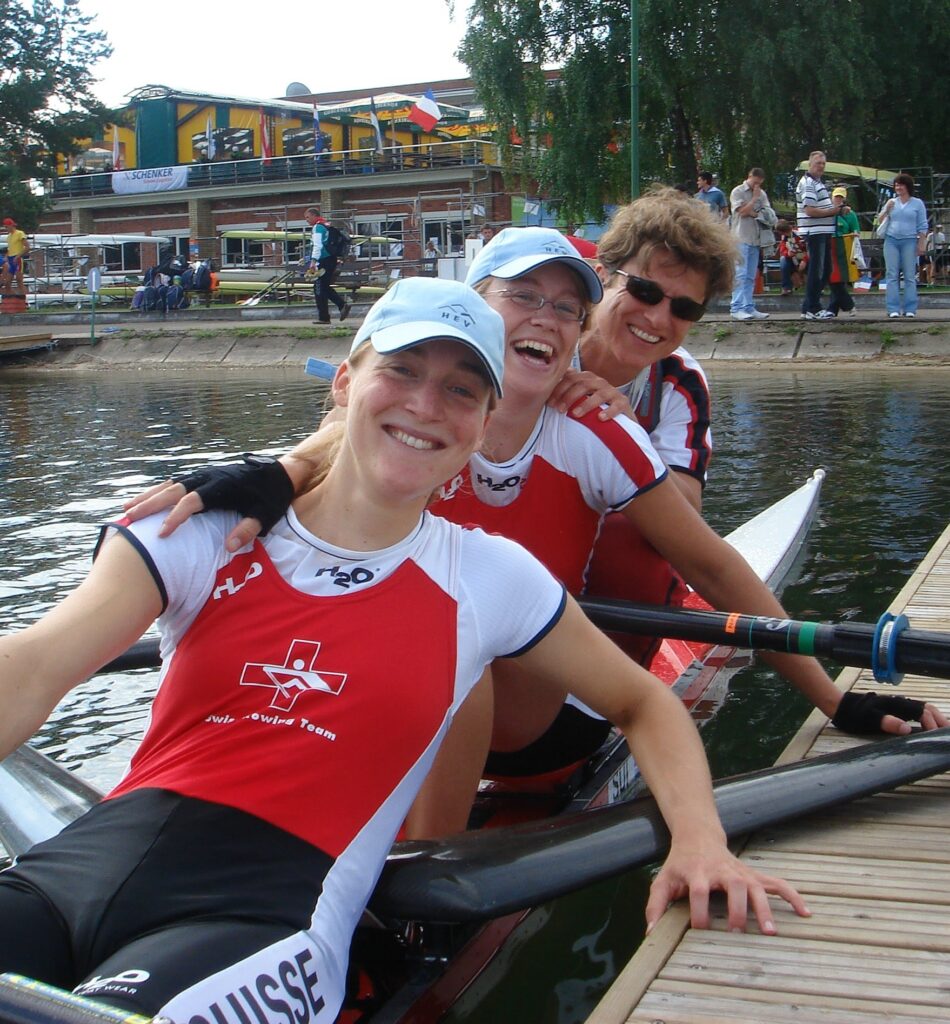
    The Stockdale Paradox was first published by Jim Collins. Copyright © 2017 Jim Collins, All rights reserved. Link to article can be found at the bottom of this post. Photo image, Forward Rowing Club, Switzerland.

    The Stockdale Paradox

    Admiral Jim Stockdale was the highest-ranking military officer in the Hanoi Hilton. He was there for, I think, seven years, from 1968 to 1974. He was tortured over twenty times. And by his own account, Stockdale came out of the prison camp even stronger than he went in.  

    In preparation for a day I got to spend with Jim Stockdale, I read his book In Love and War. As I read this book, I found myself getting depressed because it seemed like his systemic constraints were so severe, and there was never going to be any end to it. His captors could come in any day and torture him. He had no sense of whether, or if, he would ever get out of the prison camp. Absolutely depressing situation. It’s like we can all survive anything as long as we know it will come to an end, we know when, and we have a sense of control. He had none of that.  

    Then all of a sudden it dawned on me, “Wait a minute, I’m getting depressed reading this book, and I know the end of the story. I know he gets out. I know he reunites with his family. I know he becomes a national hero. And I even know that we’re going to have lunch on the beautiful Stanford campus on Monday. How did he not let those oppressive circumstances beat him down? How did he not get depressed?” And I asked him.  

    He said, “Well, you have to understand, it was never depressing. Because despite all those circumstances, I never ever wavered in my absolute faith that not only would I prevail—get out of this—but I would also prevail by turning it into the defining event of my life that would make me a stronger and better person. Not only that, Jim, you realize I’m the lucky one.”  

    I said, “No, I don’t.”  

    He said, “Yes, because I know the answer to how I would do, and you never will.”

    A little later in the conversation, after I’d absorbed that and said nothing for about five minutes because I was just stunned, I asked him who didn’t make it out of those systemic circumstances as well as he had.

    He said, “Oh, it’s easy. I can tell you who didn’t make it out. It was the optimists.”

    And I said, “I’m really confused, Admiral Stockdale.”  

    He said, “The optimists. Yes. They were the ones who always said, ‘We’re going to be out by Christmas.’ Christmas would come and it would go. And there would be another Christmas. And they died of a broken heart.” Then he grabbed me by the shoulders and he said, “This is what I learned from those years in the prison camp, where all those constraints just were oppressive. You must never ever ever confuse, on the one hand, the need for absolute, unwavering faith that you can prevail despite those constraints with, on the other hand, the need for the discipline to begin by confronting the brutal facts, whatever they are. We’re not getting out of here by Christmas.”

    Remembering another great leader and the inspiration he gave to the world in a time of great darkness. “Now this is not the end. It is not even the beginning of the end. But it is, perhaps, the end of the beginning”. Winston Churchill (1942)

    Original article found at www.jimcollins.com

    https://www.jimcollins.com/media_topics/TheStockdaleParadox.html

  • Anne-Marie Howald – Swiss Rowing Team Coach

    Anne-Marie Howald – Swiss Rowing Team Coach

    Anne-Marie Howald is well know in the rowing world, having represented Switzerland at the 1987 & 88 World Championships as a lightweight, and now as the Head Coach of the U23 and Junior Squad.

    In 2018, Anne-Marie was awarded the “Swiss Olympic Coach Award” for the impressive achievements of the junior national team at the European Championships in Krefeld and the World Championships in Trakai.

    Anne-Marie leads the talent identification of young rowers in Switzerland, with the ‘Future Rowers’ programme that takes promising young athletes through to the Elite level. In this episode, Anne-Marie covered how she first started in rowing and how that love for rowing, and high performance, has taken her on her own journey to coaching and inspiring others. Plenty of inspiration for the listener, some ideas and tips on how to move the boat faster, along with some nice insights into her time training with the legendary coach, Harry Mahon.

    You can connect with Anne-Marie via email: annemarie.howald@swissrowing.ch

    This podcast is supported by, Precision Hydration, Bont Rowing, Filippi Boats and Citius Remex seat pads. For more information about our supporters, please ensure you subscribe to my newsletter to gain access to exclusive bonus offers.

    https://anchor.fm/s/1f7219c8/podcast/rss
  • Conversation with Mick Miller – 6 x Olympic Strength & Performance Coach

    Conversation with Mick Miller – 6 x Olympic Strength & Performance Coach

    “I believe in challenging people so that they can grow and evolve, and change the world for the better.”

    Mick has seen it all. He’s worked with elite athletes chasing Olympic glory, world champions, professional Rugby League teams, America’s Cup campaigns, and up-and-coming youth champions. He’s seen athletes through good times and bad, through victory and meltdown, through triumphant euphoria and heart-breaking despair. He’s brought athletes back from career-threatening injury, rebuilt teams that were crumbling under pressure, and mentored his junior athletes through the challenges of growing up. Then in 2013, at age 49, he discovered a lump in his neck that turned out to be cancer. He then discovered more about himself that he could ever have imagined.

    Mick’s cancer survival journey started in a bed at the Oncology ward at Royal North Shore Hospital Sydney, then took him on a journey of recovery and discovery  around and  to the heart of Australia in a ‘68 VW Beetle. Only then was he able to listen to his own heart, let go of everything he was preconditioned to be, and discovered who he really was.

    In my conversation with Mick, we cover our mutual friendship and our passion for rowing and helping others to achieve high performance. We cover Mick’s journey of discovery on what it took, for Mick to find his right path and how through this experience, Mick is helping others to find their Right Path.

    https://anchor.fm/s/1f7219c8/podcast/rss