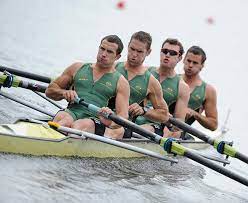
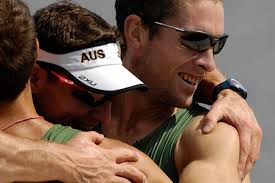
Excited to share with you my latest podcast episode, where I interview the dual Olympian and 776BC co-founder Cameron McKenzie-McHarg.
Cameron has a great story to tell. From growing up in a small country town, to discovering rowing at school. The attraction of other sports like Australian Football and being so good he was recruited by the Western Bulldogs in 1999.
Cameron returned to rowing in 2001 with the goal of representing Australia at the Olympic Games, and rowed for Victoria and Australia for over 12 years, winning multiple World Cup and World Championships medals. Cameron has also represented Australia at two Olympic Games; Beijing 2008 and London 2012, with his career highlight claiming Silver in the Men’s Four at the Beijing Olympics.
Now an entrepreneur and co-founder 776BC Cameron shares some great insights and lessons learnt from high performance sport that translate to business and life.
Rowing Career Highlights
2012 London Olympic Games: 6th Men’s Eight
2010 World Championships: Bronze Medal Men’s Eight
2009 World Championships: Silver Medal Men’s Four
2008 Beijing Olympic Games: Silver Medal Men’s Four
This weeks workout is aimed at those that want to improve their aerobic base. Improving your aerobic base, requires spending time exercising at or just below your aerobic threshold. For most rowers, this will be at 75% of peak heart rate.
90 minute endurance session
15 minutes on the erg bike
30 minutes on the ergo. Alternate between 5 min at SR 18 & 5 min at SR 20
15 minutes on the erg bike
30 minutes on the ergo. Alternate between 5 min at SR 18 & 5 min at SR 20
Focus on generating as much power and acceleration whilst getting enough recovery at the low rate to keep the heart rate at 75%. Alternate on the bike erg to break up the session. Maintain the heart rate on the bike. No bike? Do something else like a short jog outside.
Strength & Conditioning
This week’s workout from James Goodwin, is the kneeling overhead press with a resistance band. This will strengthen your shoulders, back and core. Can be done easily at home with a rubber band.
James is the head of performance sport for Swiss Rowing.
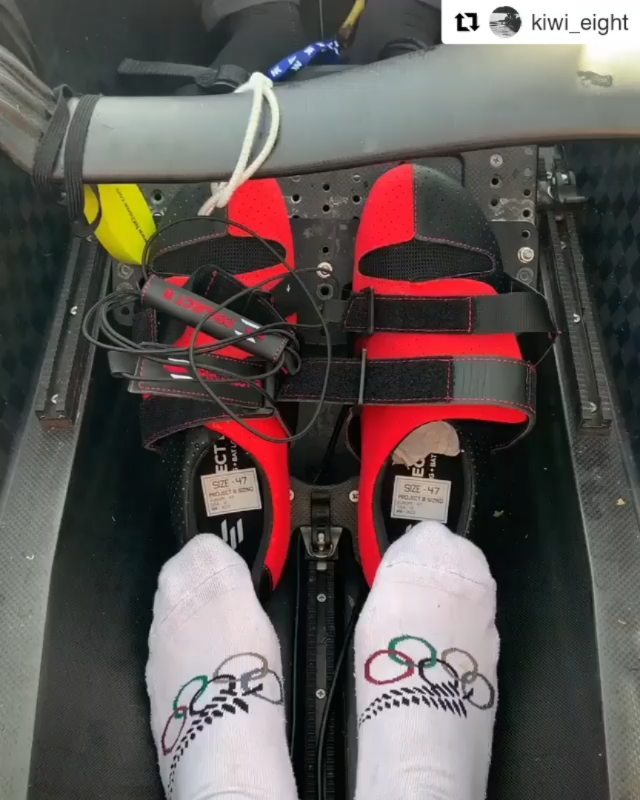
Listen to my conversation with Istvan Nemeth, Managing Director of Bont Shoes and Bont Rowing, as we discuss the importance of having the right fit and connection through the feet, from the drive and through the recovery. Istvan will cover some of the key points you need to pay attention to when choosing your shoe along with the latest developments from Bont Rowing.
Istvan and the team at Bont have a long history in creating shoes for cycling and rowing. With top World Tour Cycling, Olympic cycling and National Rowing crews using Bont shoes.
This episode is a recording of the exclusive Live event for the Masters Rowing Group and my newsletter subscribers. For more information and to subscribe to my newsletter, go to www.whchambers.com and subscribe.
The workout of the week is from Anne-Marie Howald. Head junior & U23 coach for the Swiss Federation. When Ian Wright was the head coach of Switzerland, apparently the Ladder Of Death (LOD) was one of the squads favourites. Word of advice. Make sure you are well warmed up, and don’t do this every day.
The Ladder of Death
8 x 30 on 10 off at SR 36
6 x 40 on 15 off at SR 34
3 x 60 on 20 off at SR 32
1 x 100 on 20 off at SR 30
3 x 60 on 20 off at SR 32
6 x 40 on 15 off at SR 34
8 x 30 on 10 off at SR 36
Strength & Conditioning
This week’s S&C workout from James Goodwin, is the shoulder press. The shoulder press is one of the best exercises for strengthening your shoulders and upper back.
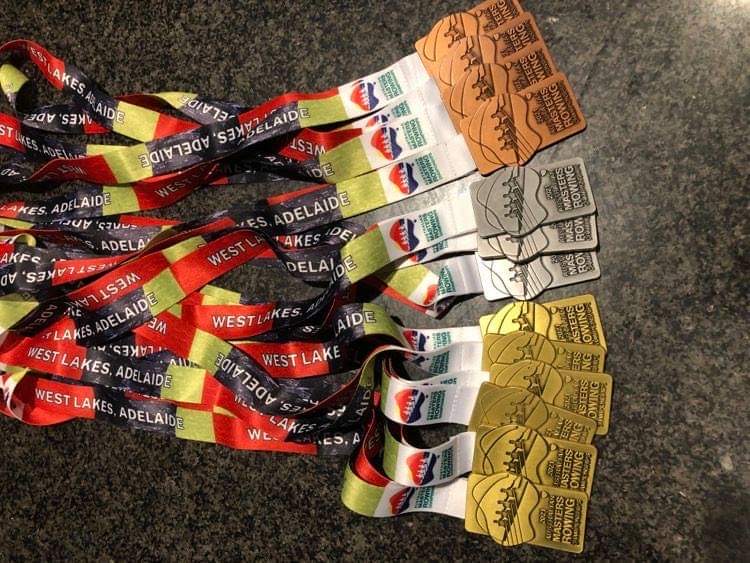
Craig is the head of rowing at Caulfield Grammar School, Victoria, Australia, and the holder of the impressive haul of Masters medals from this years Australian Masters Championships.
On the Erg. Aerobic intervals. Sets of 500m on 1 min off at T2. Rate 27-29. Do them in sets of 10 and accumulate 12-15km worth of 500s. I challenge the masters to do 1 for every year of age.
Strength & Conditioning with James Goodwin
James is the head of sports performance for the Swiss Rowing Federation. In this short video, James demonstrates a real favourite of mine, the bent over row.
“Time Contracter” is 60 mins with 6 mins easy pace (e.g. UT2 and 4 mins moderate effort (UT1/AT) until the clock hits zero (so six intervals of 4 mins by the end)….If doing on the erg, during the final 2 mins of both the 6min easy and 4 mins moderate…..flick the monitor to watts and aim to keep a high stroke to stroke consistency such that every stroke is +/- 3 watts of the target value for the section….For example, if the target UT2 pace is 200 watts….then every stroke in the final 2 mins of the 6 min section should be between 197 and 203……It’s easy enough to count the number of missed target strokes …..a goal is to keep this to no more than 3 missed strokes per minute…
Charlie is the Senior Lecturer in Sport and Exercise Science and Global Partnership Lead for Faculty of Health and Life Sciences at Oxford Brooks University, and the co-author of Advanced Rowing and Indoor Rowing.
Strength & Conditioning with James Goodwin
James is the head of sports performance for the Swiss Rowing Federation. In this short video, James demonstrates the goblet squat.
Analysis provided by expert guest contributor, Dr Valery Kleshnev, Biorow.
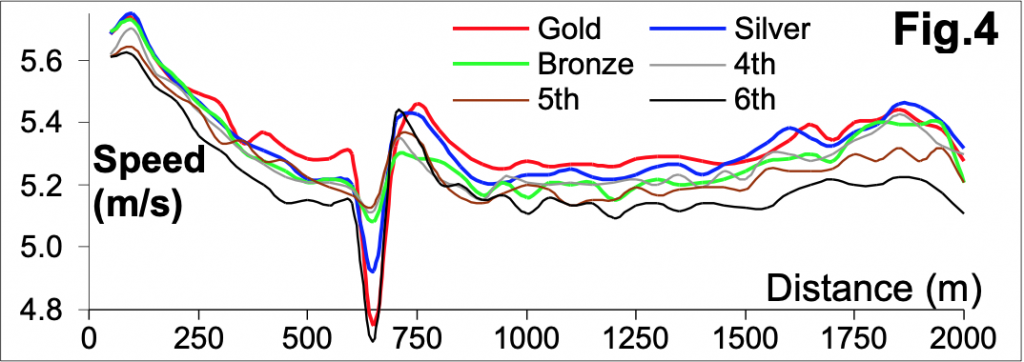
Radical changes were observed in the race strategy, which is now much more even. The winners were among the slowest at the first 100-150m after start, but significantly faster than their competitors during the middle of the race.
A strong cross-tail wind allowed for quick times on Tokyo’s Sea Forest Waterway, despite fairly rough water. Six World best times were set (W8+ ROU, W2- NZL, LW2x ITA, LM2x IRL, W4x CHN in FA, M4x NED in FA), all on Wednesday 28th July. This made it the second fastest World regatta since 1993, only 0.3% slower than Worlds- 2014 (Amsterdam).
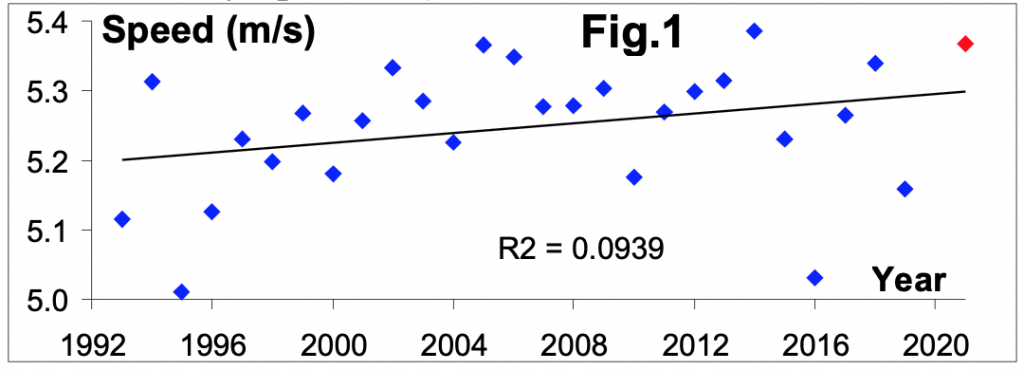
Fig.1, the average speed in 13 consistent Olympic boats. (Kleshnev 2021)
The linear trend during 1993-2021 grows by 0.065 %/year (0.0035 ms-1/y). W8+ continues to show the highest speed increase (0.18%/y), significantly higher than in the next M8+ (0.13%/y) and LW2x (0.10%/y). The lowest trend (Table 1) was found in women sculling boats (0.03%/y).
Table 1. Growth of winners’ speed during 1993-2021 (Kleshnev 2021)
More detailed analysis in scrolling decades (RBN 2020/08) also shows continuous growth during the last two decades (Fig.2) with the latest value +0.045 %/y.
Speed Growth (%/year) (Kleshnev 2021)
The average stroke rate in the 12 Olympic boat types (Table 2) was 39.0spm, which is 0.6spm higher than in the previous Worlds-2019 in Linz and similar to Worlds-2018 in Plovdiv. This is possibly weather-related: faster speed allows for a higher stroke rate.
Table 2. Average stroke rate in finals A in 12 Olympic events in Tokyo-2021 (missing data for M2x and M4-)
The differences in the rate between finalists were insignificant: only ±0.2spm within the first four place- takers, though 8 out of 12 winners showed lower average stroke rate than their silver competitors.
(Kleshnev 2021)
Radical changes were observed in the race strategy, which is now much more even. Two years ago in Linz the average variation of 500m splits in A finals was 2.56% (+3.5%, -1.6%, -2.1%, +0.3%), but now (Tab.3) it is more than two times lower 1.14% (+0.8%,-1.2%,- 0.7%,+1.2%). The first 500m split was the fastest in all previous regattas, but now the last section is the fastest. As before, the winners had the most even distribution of efforts during the race (Tab.3), except the 6th place-takers.
Table 3. Speed at each 500m as % difference to the average over 2000m in finals A in 14 Olympic events. (Kleshnev 2021)
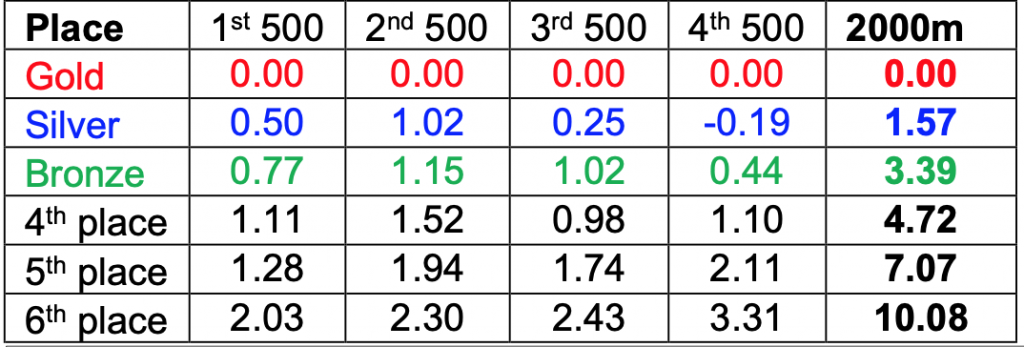
Analysing the absolute splits (Tab.4), the winners were faster than other finalists at each section, except the last 500m, where silver medallists were 0.19s faster. As before, the main advantage was taken by the winners at the second 500m, where they were about 1.0s faster than their closest competitors.
Average margins (s) from the winners in 14 finals A in Tokyo-2021. (Kleshnev 2021)
Fig.4 confirms the above conclusion with average data (12 boats) at each 50m section taken from GPS (the glitch at 650m appears to be the shielding of the GPS signal by the bridge). The winners were among the slowest at the first 100-150m after start, but significantly faster than their competitors during the middle of the race.
Dr Dan was the head physiologist at New Zealand Rowing, and responsible for designing the training sessions for the likes of the Kiwi Pair.
8 x 4 min at 103% to 105% of your Critical Power or in Zone 4 (93-95% of max heart rate) with 2 min recovery between intervals. You want to achieve at least 30 min of work in Zone 4.
Strength & Conditioning with James Goodwin
James is the head of sports performance for the Swiss Rowing Federation. In this short video, James demonstrates the Bulgarian split squat.
Bulgarian split squat, demonstrated by James Goodwin
Over head squats with a bucket of water in each hand. Fill the buckets with water, and do 4 x (8-10) squats without getting wet. Anne-Marie Boule, Swiss Rowing Federation Coach. Check out more from Anne-Marie in our podcast episode together by clicking here.
On the water or ergo
Strength endurance session. Total duration 90-minutes in zone 2 (LT1) with 30-minutes rowing/sculling with a bungee cord for resistance. For this on the ergo, substitute the bungee with fan setting 10.