Excited to share my conversation with Tom Bishop, Olympian (1976) and multiple winner of the Head of The Charles Regatta (2017, 18, 19). Tom shares some amazing stories about his persistence in being selected in the quad, and the challenges he overcame to represent his country. Being coached by Mike Spracklin, and what it takes to prepare for and win the Head of The Charles in the 70+ age group.
Tom has an amazing track record of success, when ever he puts his hands on a boat, no matter what boat class. Tom has paired up with some amazing rowers over the last 15 years, Tom Potts, Colin Cusack, Sean Morris and Charles Parry, to win in all boat classes, from doubles, quad, four and eights that are unstoppable.
I hope you enjoy listening to Tom and hearing his approach to preparing to win and have fun along the way.
Head of The Charles Training Plans
If you are a Masters Rowers, and interested in training for the Head of The Charles Regatta, I have prepared training plans especially for Masters Rowers. Whether you are planning to race in Boston, or compete virtually, these plans will help you to be at your best. The plans are designed by the most successful Masters Rowers, specifically for the Head of The Charles, and for Masters with 6 hours a week all the way to 12 hours of training a week. Click on the link to check out the programs. HOCR Training Plan
Since its inception in 1965, The Head Of The Charles Regatta, also known as HOCR, is a rowing head race held on the penultimate complete weekend of October each year on the Charles River, which separates Boston and Cambridge, Massachusetts. I thought it would be interesting to find out from the organisers, and rowers, what makes the HOCR so special, and what attracted them to fly half way around the world to race on the Charles River. Over the next weeks, I will be releasing episodes where I chat with crews from around the world, to share insights into what makes this regatta so special.
In this first episode, I speak with Blair Crawford (Chair) of the HOCR Board of Directors, to understand more about the regatta, how it all started, and how the regatta has evolved into what it is today.
Head of The Charles Training Plans
If you are a Masters Rowers, and interested in training for the Head of The Charles Regatta, I have prepared training plans especially for Masters Rowers. Whether you are planning to race in Boston, or compete virtually, these plans will help you to be at your best. The plans are designed by the most successful Masters Rowers, specifically for the Head of The Charles, and for Masters with 6 hours a week all the way to 12 hours of training a week. Click on the link to check out the programs. HOCR Training Plan
Faster podcast with Bill Chambers and Dr Charlie Simpson. 29 March 2021.
Charlie is a Senior Lecturer in Sport and Exercise Science at Oxford Brookes University and well known for his publications on Rowing. The Complete Guide to Indoor Rowing and Advanced Rowing.This Master Class, will present attendees with interesting information about the relationship between common rowing training practices and their effects on performance measures (e.g. aerobic function; lean body mass). Any discussion of training responses is incomplete without consideration of the dietary intake of an athlete, but rather than review generic aspects of a healthy diet, the presentation will provide evidence about the potential diet changes known to contribute to health and performance (particularly rowing performance).
The Master Class will use pre-planned interactive opportunities to provide you with opportunity to actively engage with the session content, while also reflecting upon your approaches to training and diet. This approach makes it possible for willing attendees to share their views and practices as active session participants. After completing this session, attendees should be able to make informed decisions about the value of making specific changes to training approaches and diet.
17 April 2021 @ 20:00 Zürich 15:00 Boston
90-minutes Live on Zoom
Interactive presentation
Q&A time with Charlie
Session recorded for playback after Master Class
Reserve your place and purchase your ticket, by clicking here.
Listen to the conversation with Bill & Dr Simpson by clicking here.
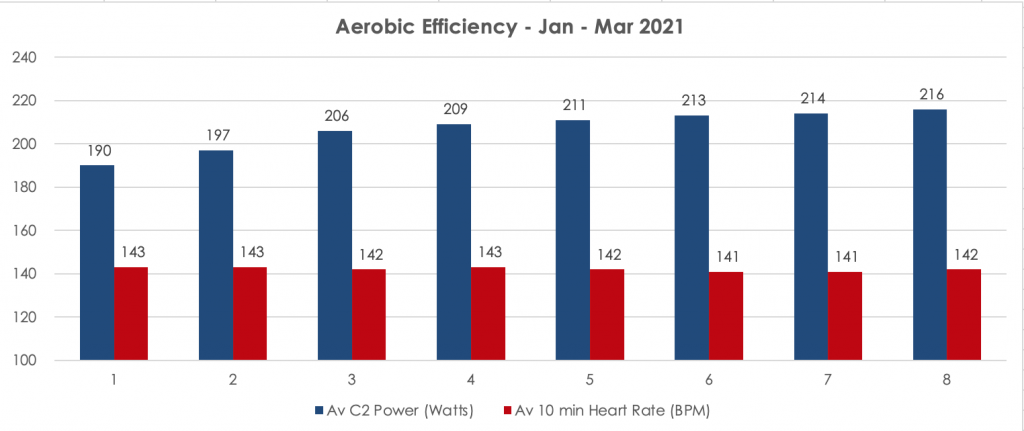
In the preparation period of my annual plan, I focus on building strength and developing my aerobic base. This period starts after a break over November and unstructured training through December. January through February is a big block of aerobic work in zone 2 (70-75% peak heart rate), and in March I start to introduce some longer threshold work at least once a week.
I like to track the development of my aerobic base, and do so with a simple protocol on the Concept2 ergo. Every 2-weeks I ‘check-in’ on how my aerobic base is developing from a duration perspective, and efficiency, through monitoring the power output (watts). I did 8 tests between January and March, and over this period saw an average test to test improvement of +1.6% watts for the same heart rate. Over the 12-week same period, I saw a +13.7% improvement in watts for the same heart rate. See the graphic below.
I have noticed similar improvements in power and efficiency, with Masters Rowers that really focus on developing their aerobic base, and have the discipline to work in their zone 2, progressively over time, before introducing higher intensity work. It is hard work to stay focussed, day in, day out, grinding away on the machine or on the water. Yet the benefits to your health and performance can be amazing. This is the ‘hard work’ that many Masters Rowers don’t do, because it is so easy to be seduced into the high intensity ‘go hard or go home’ approach. Yet if your’e interested in a tried, tested and proven way to build the foundations for a great season, give it a try.
We are running a series of Master Classes this April, with world class instructors to help Masters Rowers to learn more about how to go Faster. Dr Charlie Simpson, and expert in training intensity and nutrition, will be sharing his insights into how to train and eat. Click here to go to the Master Class page to find out more.
In this episode, I talk with Prof Samuele Marcora about how the brain regulates performance, and what we can do about this to go Faster.Prof Marcora is well known in the world of sports science and considered an expert in this subject.He has a Bachelor in Physical Education from the Higher Institute of Physical Education of Lombardy (Italy). A MSc in Human Performance at the University of Wisconsin-La Crosse (USA), and a PhD in Exercise Physiology at the University of Wales-Bangor (UK). He has taught at the Bangor University (UK) and the University of Kent (UK) , where he was made an honorary Professor.Prof Marcora’s research integrates exercise physiology with motivation psychology and cognitive neuroscience to better understand fatigue, endurance performance and physical activity behaviour. He is the author of Sport and the Brain: The science of preparing, enduring and winning, and has over 185 scientific articles, being cited over 10,000 times. He has been a consultant for many organisations including British Ministry of Defence, Juventus, MAPEI Sport and ASICS, and in 2018 he began his post at the University of Bologna, where he teaches applied physiology and training methodology.
What we cover in depth
How the brain regulates performance
What is the difference between pain and fatigue
How his model differs from the classic understanding of fatigue, e.g central governor theory
What’s going on ‘inside’ when we are racing at the limit and we ‘hear’ the voice inside saying counter productive messages
Recommendations for masters rowers to prepare to do their best in a maximum test/race
Interventions to maintain/increase performance when feeling fatigued
How would you incorporate the application and training plan design
How to integrate brain endurance training with traditional training sessions
Advice to masters rowers looking to integrate this… a lot of science
How brain endurance ties into recovery strategy, role of sleep and the role of meditation
The most effective primers to ward off fatigue
Recommended visual and audible cues
Fatigue mediation/mitigation strategies, any good stories from power/endurance sports?
Samuele recommends the following books
Endure by Alex Hutchinson
Sport and the Brain: The science of preparing, enduring and winning
Super excited to announce today, the live sessions with our world-class instructors. More information will be released later this week, so be sure to join the newsletter to be the first to find out.
Training & Nutrion For Masters Rowers
Instructor: Dr Charles Simpson, Author and Senior Lecturer in Sport and Exercise Science. Sport. Faculty of Health and Life Sciences, Oxford Brookes University.
Biomechanics For Fast & Efficient Rowing
Instructor: Dr Valery Kleshnev, Rowing Biomechanist, Author, Inventor, Olmpic Silver medalist and USSR Single Sculls Champion.
Strength & Conditioning For Masters Rowers
Instructor: James Goodwin, Head of Strength & Conditioning and High Performance, Swiss Rowing Federation.
Rowing Technique To Move The Boat Fast.
Instructor: Noel Donaldson, former head of Australian Rowing, New Zealand Rowing. Coach of the Oarsome Foursome & the Kiwi Pair.
After demolishing Team INEOS, 7-1 in the Prada Cup Challenger series, Luna Rossa’s James Spithill wasn’t gloating in the victory, he came across humble and focussed.
“No doubt going through real racing, I think we’ve taken a good step forward. But it’s not enough…”
Sharing this short article I came across, to inspire and challenge you with insights from the world’s very best competitors.
Original article published in the New Zealand Herald, 22 February 2021.
America’s Cup 2021: Luna Rossa co-helmsman Jimmy Spithill’s surprising claim ahead of Team New Zealand showdown.
Jimmy Spithill admits Luna Rossa have a lot of work to do before being able to compete with Team New Zealand in the America’s Cup match – a daunting task he equates to facing the All Blacks in a Rugby World Cup final.
The Luna Rossa co-helmsman was relatively understated in his celebrations following the Italian syndicate’s 7-1 demolition of Ineos Team UK last Sunday, perhaps looking ahead to his toughest challenge of his America’s Cup campaign in the shape of the defenders Team NZ.
Spithill was pleased with the progress made by his team – from middling challengers early in the Prada Cup round robins to a near sweep in the final – but says they’re still behind the defenders.
“No doubt going through real racing, I think we’ve taken a good step forward. But it’s not enough,” Spithill told NZME. “We’ve really got to utilise this time now between the match to try and bridge that gap. Because those guys (Team NZ), in my mind, are ahead at the moment.
“I think the whole package is very, very good. I think we’ve got a great package at the bottom end for the wind conditions, but we need to improve in the middle and upper end of the ranges.”
To do that, Spithill says he will be enlisting all the help he can get from his friends among the fallen challengers.
“We spoke to the American guys after racing them in the semifinals. I’ll definitely be touching base with Ben [Ainslie] and Giles [Scott]. We’ve got a lot of friends in Ineos Team UK; a lot of guys who worked with Oracle in the last couple of campaigns. We’ll be looking for knowledge and ways to grow stronger from here from amongst all the challengers.”
When asked how he’s going to wind up New Zealanders – like he did when Oracle came from behind to beat Team NZ in 2013 – Spithill laughed it off and simply spoke about the “privilege” of being able to challenge the Kiwis on home soil.
“I think they seem to do a really good job of that themselves,” he said in jest. “I’m just really honoured to get a shot at the best team in the world. To be able to race Team New Zealand on home waters, it’s a lot like a rugby player getting to go on the rugby field against the All Blacks at Eden Park at a Rugby World Cup final. What an incredible privilege that is.”
Spithill also made sure to pay tribute to his co-helmsman and partner in crime Francesco Bruni, who unlike the Australian, showed significantly more emotion after clinching the Prada Cup.
“I’m so proud of ‘Ceco’. What an incredible journey he’s had. I know that Sicilian blood, that energy has just been bubbling there waiting. Man he’s just done an amazing job. An incredible series he’s raced. I was really pumped that we could get it done.”
The two-time America’s Cup winner also praised the unique culture of the team, something he hopes will help them shock the world against the Kiwis next month.
“The Italian culture is really amazing. It’s a really big family type of culture: very passionate, very emotional, a lot of energy and very hard workers.
“One thing we’ve really worked on a lot is composure – just trying to sort of regulate, whether it’s been a good day or a bad day, we’re just trying to learn as much as we can.
“I’ve been so impressed with the team from where we’ve come from. We’ve developed a fantastic culture in the team. It’s something now we’ve got to put in to play over this next week or two.”
How to START hydrated and why that’s so important.
Sharing original article from Andy Blow, Precision Hydration. Medically reviewed by Dr Tamara Hew-Butler. Precision Hydration support our newsletter subscribers with 10% off all purchases, when you use the discount code; Faster10 at checkout. www.precisionhydration.com
The benefits of starting exercise hydrated
Much of the literature on hydration has focused on what athletes should drink during exercise, but your hydration status before you start exercising can have a huge impact upon your athletic performance…
When people talk about hydration, most of the time it’s about what and how much athletes should drink during exercise.
These are clearly important questions, but your performance is also massively influenced by how hydrated you are when you start exercising in the first place. Drinking a strong electrolyte drink to optimise your hydration status before long, hot or really hard training sessions and events can significantly improve your performance.
We call this “preloading” and the practice has been widely studied in the last 20 years or so, both with astronauts and athletes. Whilst there’s not a completely bullet proof consensus on the subject – there rarely is – there’s strong evidence that taking in additional sodium with fluids before you start sweating is effective in promoting increased acute fluid retention and in improving endurance performance, especially in the heat.
This blog aims to give you a more solid understanding of what you can do to arrive at the start of your next event optimally hydrated.
What are the benefits of preloading?
Once you begin sweating you’re generally going to be fighting a losing battle against fluid and electrolyte loss, so starting off properly hydrated can be extremely beneficial. When you’re properly hydrated you have a larger reservoir of fluid to draw from over time than if you’re dehydrated.
Starting well hydrated has other benefits too. Optimal hydration maximises your blood volume and this helps general cardiovascular function and your ability to dissipate the heat produced by your working muscles. This reduces fatigue and enables you to maintain your performance for longer.
Despite the relatively obvious benefits of starting exercise well hydrated, a recent study of over 400 amateur athletes showed that around 31% of them were turning up to training sessions (and, in some cases, competitions) dehydrated!
In amongst the data there were strong indications that this was very likely to be compromising their performance. This will probably seem like common sense, especially if you’ve ever tried exercising when you know you’re a bit ‘dry’. Who in their right mind would want to start exercising hard in a dehydrated state if they’re trying to perform at their best?
The problem with starting exercise dehydrated
This study certainly backs up previous work I’ve read on the subject and the kind of things we’ve seen over many years working with athletes in different scenarios. It’s certainly not uncommon to see people only really thinking about hydration once they turn up to a session rather than preparing in advance.
Often this just happens because those of us who are not full time athletes are running around flat out between workouts and aren’t always able to think about preparing properly for them 100% of the time. That’s just life.
But it can also be a problem for full-time athletes when training two or more times a day, or at times when they’re just under a very high total training load. That’s because uncorrected dehydration from a prior training session can make it’s presence felt when the next session gets underway. This blog addresses how to optimise your recovery by hydrating properly.
Although athletes turning up to training a bit low on fluids is relatively common, it’s generally less of an issue before major competitions. That’s not to say that turning up to an event dehydrated never happens, I’m sure it does.
The dangers of overdrinking and hyponatremia
But, because most athletes care a lot about their performance in big events, there’s a tendency to increase fluid intake before the big day because extra priority is placed on all aspects of last minute preparation.
The irony of this extra emphasis on pre-event hydration is that quite a lot of athletes can go from slightly under-drinking before training to significantly over-drinking pre-competition and this can lead to a different set of problems!
I’ve written about the common tendency to over-drink before races in the past and the bottom line is that it’s a very real problem that can potentially lead to hyponatremia (i.e. low blood sodium levels caused by inadequately replacing the sodium lost when sweating and further dilution by drinking plain water or weak sports drinks), something that can be pretty catastrophic for health and performance if it goes unchecked. A recent study found that 10% of athletes tested at the Ironman European Championships had hyponatremia, which shows you the extent to which hydration issues might be impacting performance.
The idea of carb loading – i.e. maximising the amount of glycogen you have stored in your muscles and liver before a strenuous activity – is one that’s well researched and essentially universally accepted as a performance-enhancing tactic.
OK, so sports scientists love to argue over exactly what and how much you should eat, and when exactly to shove it in your cake hole, but few sane athletes would argue with the principle that consuming additional carbohydrate calories (often combined with a tapering off in training load) in the final days before an event is a good idea.
That’s because you can store up and subsequently use a lot of this energy later on when you need to dig deep and burn through large amounts of fuel during a long or hard effort.
With hydration things are less clear cut than with carbs. As we’ve seen, many athletes do tend to increase fluid intake prior to important events or hard training sessions, with the vague notion that having more in the tank should result in better performance. But many unfortunately over do it in the process and this is harming their performance.
The importance of sodium for hydration
But, can you actually store fluid over and above being normally hydrated and, if so, does it help to do so?
The answer has a lot to do with not just how much water you drink, but with how much sodium you consume with that water as it’s this electrolyte that plays a key role in retention of fluid in the body and in the bloodstream in particular. For more on why sodium is crucial to staying hydrated and maintaining your performance, you may want to read this blog.
In a nutshell though, without the right amount of sodium in your pre-exercise drinks, drinking lots of water will do you a fat lot of good. The importance of sodium to hydration and maintaining your performance was further proven by research conducted at NASA at the end of the 20th century.
NASA astronauts hydration study
NASA’s astronauts were commonly found to be suffering with low blood pressure because they were losing bodily fluids (and therefore blood volume) during their time in microgravity. One NASA paper I read suggested that astronauts live with as much as a 3-4% deficit in total body fluid levels during a typical mission. It was causing them to feel weak, light headed and even to black out on re-entry or once they landed back on terra firma. That’s not something you want to be dealing with when you’re trying to land a rather expensive space craft!
To combat this, NASA tested lots of drinks containing different carbohydrates and electrolyte mixtures and found that the more sodium you put in a drink, the more effective the drink would be at being retained in the body and bloodstream and correcting dehydration.
On top of the work by NASA, there have been a number of scientific studies conducted into the idea of athletes ‘preloading’ with sodium and fluids prior to exercise in the last few years and the key findings from this work were summarised in a paper back in 2013.
This review article essentially came to the same conclusion as NASA that sodium preloading with a drink strong enough to stimulate fluid retention in the blood stream, but not so strong that it caused other knock on issues, does seem to improve endurance performance.
As I mentioned, a higher blood volume means an easier time for your cardiovascular system when you’re exercising and also a bigger reservoir of fluids available to ‘lose’ through sweating if you need to cool down, as is the case when working your muscles hard and producing lots of metabolic heat.
However, due to the mechanisms that control fluid and electrolyte balance in the body, any attempt to preload with plain water inevitably just leads to more trips to the bathroom as your body tries it’s best to avoid an excessive dilution of your blood sodium levels, which would lead to hyponatremia if unchecked.
How to preload effectively
It’s about striking a balance between being aggressive enough to drive some extra fluid retention in your blood stream without this leading to gastro-intestinal issues or excessive fluid build-up making you feel bloated and sluggish.
Typical sports drinks – which generally contain ~200 to 500mg of sodium per litre – simply don’t cut it when it comes to preloading as they’re just way too dilute to make a meaningful difference to blood volume. The reality is it’s not vastly different from drinking water.
At the other extreme, most of the scientific studies that have been conducted in this area have looked at using extremely strong electrolyte drinks containing ~3,600mg of sodium per litre. That’s like drinking a bag of saline solution that would normally be put into you via an IV! Whilst this has been shown to be highly effective at boosting blood plasma volume, it’s has a tendency to cause upset stomachs, sickness or diarrhoea – something that is obviously very counterproductive when you’re trying to improve your performance!
One study back in 2014 looked at the effectiveness of 4 drink concentrations – Water, 1,380mg/l, 2,750mg/l and 3,680mg/l – to compare the effect they had on blood volume pre-exercise v how much sickness and diarrhoea they caused.
The athletes drank a set amount (17ml per kg of body weight, so about 1.2l for an average sized 70kg athlete) of each of the drinks and the more sodium that was in it, the more blood volume was increased, as you’d expect. But with the strongest drink, 6 of the 8 athletes experienced diarrhoea compared with zero issues with the 1,380mg/l drink and plain water.
That paper was of real interest to me as at Precision Hydration we’d already been experimenting with different concentrations of drink to use for preloading. I’d had lots of GI problems when trying 3,000mg/l+ drinks, so was already using less strong stuff and I was still finding it beneficial, so it was good to get some scientific confirmation that we were on the right track.
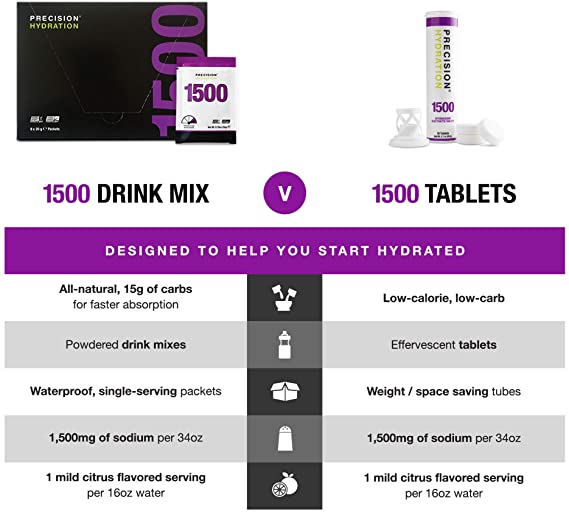
In the end we settled on a strength of 1,500mg/l (32oz) for our preloading drinks and these are available in the all-natural PH 1500 drink mix format as well as low-calorie H2Pro Hydrate 1500 effervescent tablets. 1,500mg/l seemed to be the ‘sweet spot’ in that it’s very palatable and easy on the gut (we never get comments about stomach upsets from using it) whilst still being effective at boosting your blood plasma volumes and getting you optimally hydrated before you start sweating.
If you want to test whether preloading improves your performance, follow this protocol before your next long/intense training session or B-race.
Preloading with PH 1500:
Drink 1 x PH 1500 with ~500ml (16oz) of water the evening before your activity.
Drink 1 x PH 1500 with ~500ml (16oz) of water about 90 minutes before you start. Finish your drink at least 45 minutes before you start to give your body time to fully absorb what it needs and pee out any excess.
Drink the PH 1500 in water you’d have drank anyway to ensure you don’t overdo it. The circa symbol (~) before the fluid total is key here as different athletes will drink differing amounts – for example, more petite athletes might typically drink less than larger athletes. One size won’t fit all, so use some trial and error with these guidelines to help work towards what is best for you when preloading.
DON’T just drink lots of water in the build-up to a race. You can end up diluting your body’s sodium levels before you start, increasing the risk of hyponatremia.
Why you should preload
Boosting your blood plasma volume before intense exercise is a proven way to enhance your performance, especially in hot conditions.
Having more blood makes it easier for your cardiovascular system to meet the competing demands of cooling you down and delivering oxygen to your muscles.
PH 1500 is very effective at increasing your plasma volume as it contains 3x more sodium than a typical sports drink. That extra sodium helps to pull water into your bloodstream and keep it there. This may allow you to get away with drinking considerably less in shorter/harder events where previously they would have had to try to consume more on the move (not easy when you’re flat out!). It can also help reduce the amount of times you need to pee before you start.
Preloading with PH 1500 can also help you avoid/alleviate muscle cramps, especially if you’re prone to suffering from them late on in events and especially when it’s hot. 89% of athletes with cramp who try preloading PH 1500say that it solves their problems.
You can’t preload anywhere near as effectively with weaker sports drinks as you’ll lose a large proportion of the fluid as urine. Or it’ll slosh around in your stomach without being properly absorbed.
Precision Hydration support our newsletter subscribers with 10% off all purchases, when you use the discount code; Faster10 at checkout. www.precisionhydration.com
If you’re looking for a way to optimise your performance then testing sodium preloading is definitely worth a try. If you have any questions about how to preload effectively or need help optimising your approach, drop us an email.
Many of us are lucky enough to be able to train on the ergo during lockdown, yet often training indoors can be a hot and sweaty event. It’s especially important to make sure your hydrated appropriately. The following article from Abby Coleman, explains more about the importance of sodium in your hydration strategy.
I personally use Precision Hydration (PH) products, and PH are proud support Masters Rowers around the world, with their hydration needs. Use the code FASTER10 at checkout, to receive 10% off your purchase.
How are sodium and water balanced in the body?
By Abby Coleman Medically reviewed by Dr Raj Jutley. Original article can be found on the Precision Hydration website.
Our bodies enjoy balance and will strive for equilibrium to help ensure that our sodium and water levels remain at a constant level. Why link sodium and water together?
Well, the two are a double act (a bit like Ross and Rachel, Ant and Dec, the Chuckle Brothers, and any other legendary double-acts you can think of) in that water acts to hold the sodium ion in the body, so we must look at the two together when it comes to achieving the correct balance.
But how does the body go about finding that all-important balance? We take a look…
The balance happens in the kidneys with sensors from various parts of the body providing feedback with the end goal being preserving the plasma osmolality (saltiness) tightly between 275-300 mOsm/kg and sodium levels between 135-145 mEq/L. Osmolality, by the way, is how much of one substance is dissolved in another substance, and in humans the most important substance contributing to osmolality happens to be sodium.
When plasma volume or sodium concentration gets too high (osmolality increases)So, volume sensors in the heart, blood vessels, and kidneys detect when the body’s sodium or water levels get too high, and set in motion processes which lead to their greater excretion through the kidneys.
In contrast, when blood plasma volume or sodium concentration becomes too low (osmolality decreases), the sensors trigger processes which increase their reabsorption through the kidneys.
Both functions are actioned and regulated by the body’s endocrine system – a complex chemical messaging system made up of feedback loops of hormones.
Because osmolality is exquisitely sensitive to the volume changes, any alterations in water has important effects. Which brings us to water balance…
I personally use the Precision Hydration 1500 mix before and during training.
Water balance in the body
Humans are a soggy bunch and water makes up ~50 to 70% of our body mass, depending on our age, gender and body composition.
Water is obtained mostly through consumption but also via our internal metabolism (e.g. the breakdown of glycogen), and it’s lost in urine, the gastrointestinal tract, sweat, and through the respiratory tract during breathing.
Put simply, water balance is achieved by ensuring that the water we consume in food and drink is equal to that of excretion.
But what happens when we take on too little or too much water?
Too little water in the body
A decrease in total body water, perhaps due to not drinking enough, excessive urination, sweat production, blood loss, diarrhea or vomiting, pushes the body to find ways of conserving fluids.
Depending on the cause of water loss the body may need to conserve sodium as well.
For instance, blood loss from a trauma will see sodium (in blood) and water (in blood) lost in equal proportion, and the body must try to retain both. Whereas in dehydration you lose proportionately more water than sodium, so the osmolality of your plasma increases and the body must conserve water, but not sodium.
The hormone responsible for regulating the body’s retention of water is the antidiuretic hormone(ADH), also known as vasopressin.
ADH is secreted by the hypothalamus, a kind of regulator in the brain for many bodily systems in response to an increase in plasma osmolality, decreased blood volume, decreased blood pressure and/or stress. The hormone acts on the nephrons of the kidneys (which basically produce urine, and remove waste and excess substances from the blood) and facilitates greater reabsorption of water by dramatically increasing the water permeability of the cell walls (i.e. how much water those cell walls let through).
As a result, the passive movement (no energy required) of water out of the kidney back into the bloodstream is increased, and the urine produced is small in volume and concentrated.
What about thirst?
Whilst the kidneys can conserve water, they can’t do anything about producing more, so for that reason we must drink. Water intake is regulated by thirst; the stimulus for which, like ADH, is an increase in plasma osmolality (as little as 2-3% gives a strong desire to drink) or a decrease in blood volume.
The combined effect of water retention (thanks to our good friend ADH) AND increased water consumption leads to an increase in blood volume and subsequent restoration of fluid balance in the body.
By increasing blood volume, ADH also plays a role in reducing plasma osmolality (and therefore sodium concentration).
Too much water in the body
In a scenario where there is an increase in our total body water, plasma osmolality falls due to the relative decrease in sodium concentration.
So, under these conditions, water moves out of the extracellular fluid into the body cells to try and maintain balance, which causes them to expand.
Receptors within the cells respond to this swelling by signalling to the hypothalamus to slow down the secretion of ADH (‘stop conserving water, we have enough!’).
Less circulating ADH means less aquaporin-2 channels get inserted into the kidneys’ walls and there’s a reduction in the amount of water reabsorbed into the blood. With fewer channels available for removal, a greater volume of water moves undeterred through the kidneys and is subsequently excreted in the urine.
The outcome? A reduced blood plasma volume, an increase in plasma osmolality, and urine which is diluted and large in volume (aaah, sweet, sweet relief as fluid balance is restored again).
WAY too much water in the body
An excessive overconsumption of water can be hugely counterproductive and produce the potentially fatal medical complication of hyponatremia (low sodium concentration of the blood).
There are a few different causes of hyponatremia, but the one which affects athletes most frequently is the dilution of sodium levels driven by drinking TOO MUCH or ‘water intoxication’.
In an attempt to restore water balance, the body goes into overdrive pulling water out of the bloodstream and into the body cells, causing them to swell irrationally and damage or destroy cellular structure, thus disrupting normal cellular function. When this occurs in the brain cells the condition can escalate from confusion to seizures, coma or even death.
The risk of hyponatremia is in part why drinking to thirst is pretty sound advice during everyday life and shorter, less intense activities where you’re not sweating much – and also why listening to your body’s signals is important.
Sodium balance in the body
Sodium is the main substance dissolved in the body, so it mostly determines the osmolality of plasma.
Sodium plays a key role in every cell in the body, particularly nerve and muscle function where deficiencies or excesses become noticeable first, There are no body stores for so what you lose through the gut, sweat and urine, you must ingest – as simple as that.
Just like water, sodium balance is maintained very cleverly by the kidneys adjusting the amount of sodium it filters, reabsorbs and excretes depending on whether the body is in deficit or excess.
Too little sodium in the body
A depletion of sodium, such as through extreme sweating (particularly if a person’s sweat sodium concentration is high) and/or a chronically low sodium diet, gives rise to low plasma volume, which in turn leads to low blood pressures.
These low blood pressures throughout the cardiovascular system are recognised via baroreceptors (pressure sensors in the blood vessels which detect the pressure changes via changes in tension of the walls).
These cause a decrease in the fancily named ‘glomerular filtration rate’ (the volume of fluid filtered through the kidneys), which is key because the less fluid which passes through the kidneys means less opportunity for sodium to be lost through urinary excretion.
In addition, the fluid which is filtered by the kidney undergoes greater sodium reabsorption. The hormone responsible for regulating this sodium reabsorption is aldosterone, a steroid hormone secreted by the adrenal glands. The reabsorbed sodium is followed back into the blood by water and, as a result, blood volume, salt levels and blood pressure all rise.
It’s important to note that aldosterone’s release is regulated by the renin-angiotensin hormonal system (RAS) which is responsible for managing blood pressure, fluid and electrolyte balance, as well as vascular resistance.
In the event of sodium depletion, the kidneys produce renin, a peptide hormone that initiates a hormonal cascade that ultimately produces angiotensin II. It is angiotensin II which, once in the blood, stimulates:
thirst
the peripheral arteries to tighten and increase cardiac output, resulting in an increase in blood pressure
a decrease in glomerular filtration rate, resulting in water retention
the adrenal cortex to produce aldosterone.
Renin-Angiotensin System
Increased renin secretion (from kidneys)
Increased plasma renin concentration
Increased plasma angiotensin I concentration (from angiotensinogen)
With the Western diet, it’s not difficult to consume a little too much sodium these days. For centuries man was deficient hence he traded in salt but now the pendulum has swung the other way with hidden sodium in our diets. An excess of sodium in the body isn’t recognised by alterations in sodium concentration as you might think, but rather by the increase in plasma volume as a result of the increased sodium (remember where sodium goes water goes too).
The elevation in blood volume causes an increase in the tension in the receiving chambers of the heart (atria), which in turn initiates the release of atrial natriuretic peptide (ANP); a hormone which is both produced and stored in the cells of the heart.
Once in circulation, ANP affects the kidney by increasing the glomerular filtration rate (the rate at which blood passes through the glomeruli in the kidneys) which induces profound natriuresis (increased sodium excretion) and diuresis (increased water excretion).
It also induces the dilation of the blood vessels to limit the rise in blood pressure and inhibits the secretion of aldosterone, by reducing renin production, thus actively preventing sodium reabsorption from occurring.
This is quite a meaty and complex topic area (congratulations if you made it this far in the blog), but what hopefully comes through loud and clear is that:
Sodium and water travel together and their ‘saltiness’ must be tightly regulated.
Their balance is ultimately in the kidney.
Feedback to the kidney is from ‘pressure and saltiness’ receptors in the heart, blood vessels, kidneys and brain.
Regulation is a finely balanced and complex interplay between several hormones depending on whether water or sodium is less or more.
Ultimately, the kidneys and the hormonal system play a vital role in helping the body to find equilibrium when it comes to sodium and fluid balance.
Helping these systems out by tailoring what you consume – in terms of sodium and fluid in relation to your individual losses – should therefore start to make a bit more sense from now on.