There is a specific type of man in every rowing club car park, and you will recognise him instantly. He has just done a café ride on the bike instead of the erg, he owns at least one item of clothing with the word “aero” printed on it, and he has started saying “watts” the way other men say “reps.” I know this man well. For about three weeks a year, I become him.
This year those three weeks coincided with the Tour de France, and my club’s WhatsApp group did what it always does when the Tour is on: it turned into a shrine to Tadej Pogačar and a small crime scene for rowing’s reputation.
The provocation was a number. On stage 19, up Alpe d’Huez, Pogačar held roughly 440 watts for thirty-five minutes and change, on his way to a fifth Tour title that puts him level with Merckx, Hinault, Anquetil and Indurain — a club so exclusive it makes the Leander members’ bar look like a Wetherspoons. Tibbett posted the number to the group with the caption “and rowers think 2k is hard.” Tibbett is fifty-four, has been threatening to do a proper winter of erging since roughly 2019, and owns more cycling kit than any man who has never raced a bicycle should.
I did what any self-respecting oarsman does when his tribe is insulted. I got defensive, then I got the calculator out. Our sport’s crown jewel — the 2000m erg world record — currently sits at 5:33.4, set by Simon van Dorp back in March, edging out Oliver Zeidler’s mark from just weeks earlier. That works out to around 600 watts. Six hundred! I sent it into the group with the smugness of a man who has just won an argument he doesn’t fully understand.
Which, as it turned out, I hadn’t.
Because somebody — there is always somebody — pointed out that comparing a 35-minute effort to a five-and-a-half-minute one is not a comparison. It’s asking why Usain Bolt can’t hold his 100m pace for a marathon. Every engine produces less power the longer you ask it to run. Big number, short time. Smaller number, long time. This is the entire point of a power-duration curve, and it is taught to teenagers. I have been rowing for twenty years and had apparently decided it didn’t apply to me.
That stung rather more than losing the WhatsApp argument.
So I went looking for a fairer fight, and found one in Filippo Ganna, an Italian shaped like a filing cabinet who holds cycling’s Hour Record: 56.792 kilometres in sixty minutes, at an estimated 440 to 460 watts. Now put an oarsman next to him. Eric Murray, two Olympic golds and no discernible pain receptors, once sat on an erg and rowed for a full hour: 18,728 metres, about 394 watts, with his heart rate above 190 for fifty of those sixty minutes. Same duration. Same clock. No gravity for one to blame, no drag for the other to hide behind. And the cyclist still wins. I had gone looking for the comparison that would vindicate us, found the only clean one available, and lost that too.
The difference isn’t toughness. It’s what each sport is fighting. Cycling up a mountain is a war against your own bodyweight, which is why the best climbers look like they’ve been assembled from spare tent poles. Rowing barely punishes mass at all, which is why the best rowers look like they were grown deliberately. Pogačar is 63 kilograms. Van Dorp is closer to 95. Both numbers are correct. Neither proves the other man is soft.
Which brings me back to Tibbett. Because while I was busy being wrong about watts, he was busy being wrong about something more expensive. He has bought a Colnago Y1Rs — the one Colnago’s own white paper says needs 20 fewer watts than its predecessor to hold 50kph — and rides it almost exclusively on a Sunday café loop at a heart rate that wouldn’t trouble a nap, a good twenty kilometres an hour short of anywhere that aero saving does anything at all. He also has, by his own cheerful admission, around nine kilograms he could lose before his next birthday, and a standing talent for discovering that the erg session doesn’t quite fit this week whenever the weather is nice enough for the bike. He bought the machinery of a Grand Tour winner and declined the two things that are actually free: the training and the weight. Pogačar didn’t get to 6.99 watts per kilo by owning the right frame. He got there by doing the unglamorous sessions and weighing 63 kilograms. The Y1Rs is the paint job. The missed erg piece is the whole number.
There is one place where the cyclists genuinely have us beaten, and I’ll concede it before somebody makes me. The Tour ran 21 stages and about 3,300 kilometres in three weeks, several days over 180km, back to back, uphill, surrounded by 180 nervous men who occasionally fall off. A regatta asks for two races in a day and then lets you go and lie down. Being good on day nineteen is a different sport to being good once.
I’m not thrilled about any of this, if I’m honest. I much preferred believing that rowers were simply the hardest people in endurance sport and cyclists were gifted amateurs with better tans and worse haircuts. What I’ve actually learned is that I spent a fortnight sneering at a man for buying performance instead of doing the work, while I was doing precisely the same thing with numbers — grabbing the one figure that flattered me and waving it about instead of reading the thing properly.
Faster Membership
The training plans are the version of this where I stopped collecting numbers and started doing the work: sessions that earn their place, in an order that makes sense, with watts used as a measurement rather than a personality. They come with Faster Membership, CHF 129 for the year, along with the lactate and supplement protocols. Tibbett’s frameset cost considerably more and did not come with a plan.
For most of my adult life, I regarded illness as something that happened to other people.
This was not a scientific position. It was simply the inevitable consequence of spending forty years exercising.
Spend enough time around masters rowers and you start to notice a peculiar trait. We don’t think we’re immortal. That would be absurd.
Instead, we convince ourselves we’ve negotiated a special arrangement with biology. We behave like men who have mistaken a collection of race medals, a Garmin watch and a resting heart rate in the low forties for a legally binding contract with nature.
The rest of the population gets older. We train.
The rest of the population develops health problems. We compare resting heart rates.
The rest of the population spends Sunday mornings reading newspapers. We spend them rowing through freezing rain before sunrise and then spend the rest of the day talking about it as though we’d crossed the Atlantic.
I was no different.
I trained ten to twelve hours a week. I raced. I won often enough to convince myself there was a direct relationship between effort and outcomes.
This turns out to be precisely the sort of thing people believe shortly before life has a quiet word.
Like many rowers, I measured everything.
Distance. Training load. Heart rate. Power.
I was the sort of person who believed that given enough data, enough discipline, enough science and enough training, almost any problem could be solved.
A faster 1 or 2k seemed a reasonable solution to most things.
Leaking roof?
Train harder.
Career problem?
Train harder.
Global instability?
A couple of long threshold sessions should sort that out.
I’d spent years collecting evidence that I was indestructible. Unfortunately, most of that evidence had been gathered by me. It’s a philosophy that works remarkably well.
Until it doesn’t.
The First Lesson
The first episode of atrial fibrillation arrived in 2021.
My experience skipped straight past inconvenience and ended in surgery.
Which was unfortunate. And unexpected.
I’d spent decades doing all the things we’re told are supposed to prevent this sort of thing. I wasn’t overweight. I exercised. I looked after myself.
My heart reviewed the evidence and carried on regardless.
The surgery worked.
Nine months later I was training and racing again. Which I naturally interpreted as evidence of my resilience. Looking back, it may simply have been evidence that I hadn’t learned anything.
I treated the whole experience as a temporary disruption. A mechanical issue. Replace the part. Service complete. Carry on.
The possibility that the rules had changed never really occurred to me.
I preferred my version of events.
The surgery worked. Modern medicine, I concluded, was astonishing, and I was probably invincible.
Looking back, I may have misunderstood at least one of those things.
The Last 250 Metres
The second episode arrived at the Swiss Rowing Championships in 2025.
Not in a hospital. Not during a medical examination. During a race. Specifically, the last 250 metres of a semi-final.
This is normally the point where rowing becomes wonderfully simple. The pain has already arrived. Your lungs are on fire. Your legs have started negotiating with lactate. Your life choices are under formal review.
All that’s left is one question.
Can you find another gear?
Usually, I could. This time I couldn’t.
The power simply disappeared.
No drama. No warning. No flashing lights. Just nothing.
As though somebody had quietly removed half the engine and neglected to mention it.
Something felt wrong and I backed off. In a race! Which is roughly equivalent to a Labrador losing interest in a tennis ball.
I crossed the line confused rather than worried.
The final was worse.
Athletes I’d beaten the previous week started moving away from me. Not because they’d suddenly become faster. They were exactly the same athletes they’d been seven days earlier. The difference was me.
This was deeply unsettling because I’d already spent a week explaining to anyone who would listen why they weren’t actually as good as I was. It turns out the body occasionally has opinions on these matters.
I kept waiting for the response. The lift. The surge. The familiar gear that had always been there before. Nothing arrived.
Then came the double scull final.
Five hundred metres into the race I stopped racing altogether and started paddling lightly. I remember looking at the water and thinking a thought that had never entered my head before.
Something is seriously wrong.
My heart felt constrained. Suppressed. As though it wanted to respond but couldn’t. For the first time in my sporting life, I genuinely wondered whether it was about to explode. I got off the water feeling flat. Lacklustre. Confused. And withdrew from the remaining races.
And then it happened. Again. The AFib returned.
There are moments in life when your internal monologue becomes remarkably sophisticated. This wasn’t one of them.
The entire thought process could be summarised in a single word.
Bugger.
That was my nightmare. Because the first time you convince yourself it’s bad luck. The second time you start wondering whether this is now the new normal. Whether you’ve entered a completely different chapter. And whether your body forgot to send you the memo.
The Most Uncomfortable Statistic I’ve Ever Read
Afterwards I started reading.
I expected reassurance. What I got was something considerably more annoying.
A recent study of former elite rowers found that around one in five had atrial fibrillation. One in five! I’ve sat through enough rowing club dinners to know exactly what one in five looks like.
The same study found rates were substantially higher than in comparable non-athletes.
Which feels deeply unfair.
You spend years freezing on lakes, destroying ergometers, missing family breakfasts and voluntarily entering head races that feel like being slowly strangled by your own lungs.
And your reward is discovering there may be consequences.
There is increasing evidence that while moderate exercise is enormously beneficial, decades of high-volume endurance and threshold training may increase AFib risk.
Exercise is good.
Lots of exercise is very good.
A lifetime of obsession?
Apparently that’s where the conversation becomes more complicated.
Recovery Is Its Own Sport
The second surgery worked. The medication worked. And then began the part nobody talks about.
Recovery.
I’d assumed recovery would behave like training. Follow the programme. Trust the process. Improvement follows.
Simple.
Instead it behaved more like assembling flat-pack furniture after three glasses of wine. Nothing happened in the correct order and there always seemed to be parts missing.
The first surprise was discovering that AFib doesn’t politely confine itself to races. It follows you home.
For years I’d been very pleased with my resting heart rate. Like many endurance athletes, I’d quietly viewed it as evidence not merely of fitness but of superior character.
Then I found myself lying awake at two in the morning watching my pulse sit somewhere between 90 and 100 beats per minute. While supposedly asleep.
It’s difficult to relax under those circumstances. Especially when your heart appears to be recreating a run up a set of stairs. Which was disappointing because after decades of training I’d expected my heart to spend retirement behaving like a reliable village postmaster.
Instead it had become the drummer in a heavy metal band fuelled by a double vodka Red Bull and several regrettable life choices.
Then there were the surges.
I’d be sitting quietly reading, answering emails or performing some equally unathletic activity and suddenly my heart would decide this was the ideal moment to rehearse for a sprint finish.
Not because I was exercising.
Not because I was under attack.
Simply because chaos had entered the chat.
The experience wasn’t painful. It was unsettling.
For forty years I’d trusted my body completely. Now I was watching it the way you’d watch a washing machine making unfamiliar noises.
Not panicking. Just standing nearby wondering whether this was about to become expensive.
The medication helped. Of course it did. That’s why they prescribe it.
But nobody tells you that some of these drugs don’t leave the building the moment you stop taking them. You imagine they’ll depart politely like unwanted relatives after Christmas.
They don’t.
They linger.
The anti-coagulants reduce stroke risk.
The heart-rate regulators stop your pulse behaving like an escaped Labrador.
But if you’ve spent forty years measuring progress in watts, split times and race results, they can also leave you feeling as though somebody has removed the V8 from your sports car and replaced it with a lawnmower engine.
Everything still works. Just not with any enthusiasm.
My power disappeared. My heart rate sat wherever it pleased.
I became breathless doing things that previously qualified as warming up.
I put on weight. Not huge amounts. But enough for every photograph to appear to have been taken by a photographer who actively disliked me.
Training fell from ten or twelve hours a week to three or four hours of cardio and a couple of strength sessions. And I discovered something rowers hate.
Recovery doesn’t care how badly you want it.
The Long View
The hardest adjustment hasn’t been physical. It’s been psychological.
For years I measured success in speed, rankings and medals. Suddenly I found myself considering a possibility that would once have sounded ridiculous.
Maybe success isn’t winning.
Maybe success is remaining healthy enough to keep turning up.
A few years ago I’d have dismissed that as the sort of thing people say when they stop winning. Now I’m not so sure. Will I race again?
I hope so.
Perhaps next year I’ll do sprint races.
The irony would be magnificent. Spend a lifetime training endurance only to discover that shorter, less sensible races might be the future.
For decades I believed every problem could be solved with more training.
More volume. More work. More effort. More science.
It turns out that after forty years of trying to become bulletproof, I’d merely become a very fit man sitting in a cardiologist’s waiting room wondering why nobody had mentioned that biology eventually reads the small print.
That philosophy gave me friendships, experiences and a few medals I remain embarrassingly proud of. It also left me standing on a Swiss regatta course at the age of 55 wondering why my body had suddenly stopped following instructions.
What I do know is that after a lifetime of treating my body like a dependable employee who could always be persuaded to work overtime, it has finally arrived carrying a letter from Human Resources, a representative from the union and a list of demands longer than a Henley regatta programme.
And, rather annoyingly, it appears to have a very strong case.
Enjoyed this article?
If you’re looking for a structured, evidence-based approach to your training, our rowing plans have helped athletes prepare for sprint racing, head races, and personal best performances while balancing training with everyday life.
Each plan includes detailed weekly sessions, strength training guidance, pacing recommendations, and flexibility to fit your available training time.
Join me as I speak exclusively with Vincent Galliard, Executive Director of World Rowing about the future direction of Rowing. In this episode, Vincent shares World Rowing’s 15 year plan to transform the reach, the image and revenues of the sport. We discuss the expansion into coastal rowing, indoor rowing, plans to drive awareness and boost audience engagement. Vincent also talks about what we can expect after the 1,500m racing format at the LA Games. World Rowing’s new partnership with Concept2 and the future of rowing in e-sports Games.
Original article By Alex Hutchinson, New Yorker Magazine, December 12, 2014. Includes links to Podcast interviews.
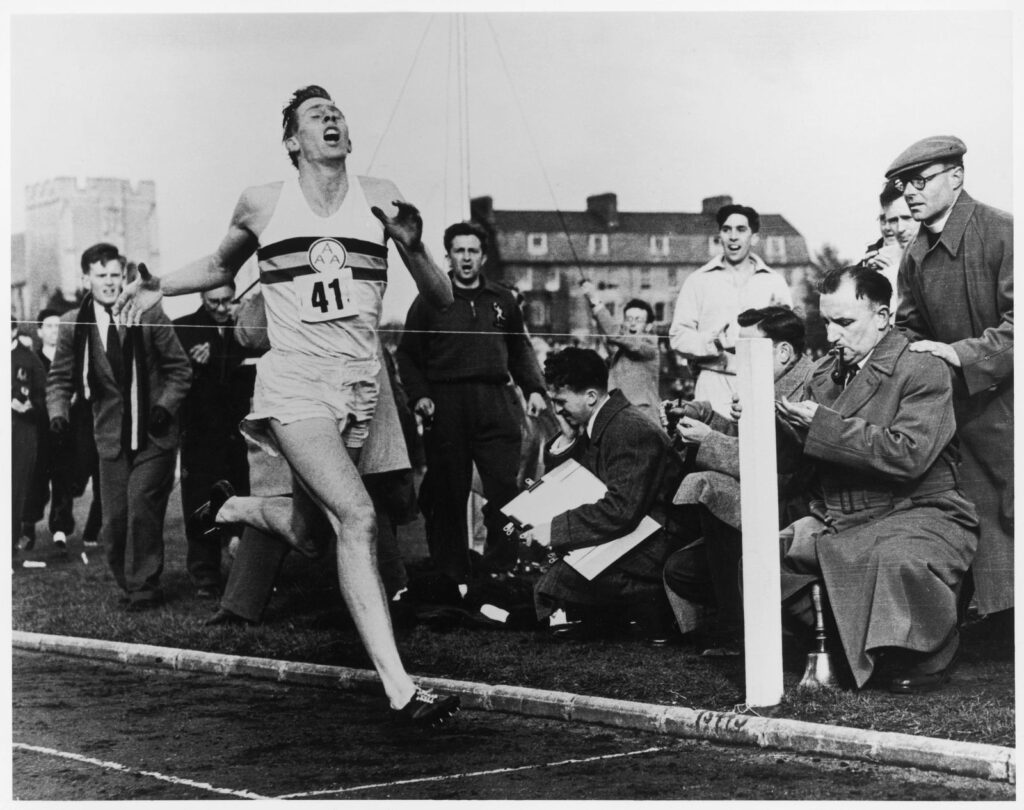
Roger Bannister at the end of his record-breaking mile run at Oxford, in 1954.
Photograph by Norman Potter
When, on a blustery day in Oxford in 1954, Roger Bannister ran the first sub-four-minute mile, measuring out the full capacity of his lungs and legs and collapsing across the finish line, he felt, as he later wrote, “like an exploded flashlight.” That was the feeling researchers were trying to evoke, recently, when they paid thirteen volunteers at Bangor University, in Wales, to pedal a stationary bike at a predetermined pace for as long as they could. Such “time to exhaustion” trials are a well-established method of measuring the limits of physical endurance, but in this case the experiment also had a hidden psychological component. As the cyclists pedalled, a screen in front of them periodically flashed images of happy or sad faces in imperceptible sixteen-millisecond bursts, ten to twenty times shorter than a typical blink. The cyclists who were shown sad faces rode, on average, twenty-two minutes and twenty-two seconds. Those who were shown happy faces rode for three minutes longer and reported less of a sense of exertion. In a second experiment, the researchers demonstrated that subliminal action words (go, lively) could boost a subject’s cycling performance by seventeen per cent over inaction words (toil, sleep).
The study, which was published last month (2013) in the journal Frontiers in Human Neuroscience, by Samuele Marcora, who heads the University of Kent’s Endurance Research Group, and two of his colleagues at Bangor, Anthony Blanchfield and James Hardy, is the latest salvo in an ongoing debate about the very nature of fatigue. According to one study, fatigue is “the inability of the contracting muscles to maintain the desired force.” But what causes it? Physiologists in the early twentieth century studied exhaustion by cutting off the hind legs of frogs and electrically stimulating the muscles over and over until they couldn’t contract anymore. In 1907, the Nobel Laureate Frederick Hopkins and one of his colleagues showed that the depleted frog muscles were bathed in lactic acid. Their experiment gave rise to an enduring-and incorrect-explanation for muscle failure; scientists now know that lactate, the form in which lactic acid occurs in the body, actually fuels muscular contraction rather than inhibiting it. Nevertheless, the view of fatigue as a mechanical breakdown has persisted. You max out your ability to pump oxygen, the acidity of your blood creeps up, and the neuromuscular signalling between your brain and your muscles gets weaker: one way or another, you hit a limit.
Marcora believes that this limit is probably never truly reached-that fatigue is simply a balance between effort and motivation, and that the decision to stop is a conscious choice rather than a mechanical failure. This, he says, is why factors that alter a person’s perception or motivation (monetary rewards, for example) can affect performance, even without any change in muscle capacity. In the subliminal experiments, the cyclists’ heart rates and lactate levels rose at the same rate no matter which faces they saw, indicating that nothing had changed from the neck down. Considerations like heat, hydration, and muscle conditioning, Marcora says, “are not unreal things, but their effect is mediated by perception of effort.” In other words, they don’t force you to slow down, as happens with the failing frog muscles in the petri dish; they cause you to want to slow down-a semantic difference, perhaps, but a significant one when it comes to testing the outer margins of human capability.
Marcora calls his theory the “psychobiological model.” It’s one of several attempts, in the past decade, to incorporate the brain into the understanding of endurance. This isn’t to say that previous generations of scientists discounted the mind’s influence on physical performance; as Michael Joyner, a physiologist at the Mayo Clinic, in Minnesota, told me, “There were people talking about this stuff in the eighteen-eighties, and coming up with very good thought experiments.” The Italian scientist Angelo Mosso, for instance, showed that the muscular endurance of two of his fellow physiology professors was diminished after they had given a series of lectures and oral exams to students. In the more than a century since, researchers have tried everything from hypnosis to curare toxin to alter the correspondence between mental effort and muscular output. But only recently have brain-imaging tools such as functional magnetic resonance imaging and electroencephalography become advanced enough to allow observation of the brain during intense exercise.
Consider, for example, the sub-two-hour marathon, which is starting to look like the contemporary equivalent of the four-minute mile. Back in 1991, Joyner published an influential paper in which he combined the upper observed limits of several aspects of running performance into a calculation of the fastest possible marathon time. He settled on 1:57:58, almost nine minutes faster than the world record at the time; a discrepancy that suggested, Joyner wrote, that “our level of knowledge about the determinants of human performance is inadequate.” At the Berlin Marathon, this September, a thirty-year-old Kenyan man named Dennis Kimetto, a former subsistence farmer who started competing internationally just three years ago, set a new world record, completing the race in a time of 2:02:57-still almost five minutes short of Joyner’s prediction.
Why does fatigue prevent athletic wonders like Kimetto from closing the five-minute gap? One possibility, proposed by Tim Noakes, a professor at the University of Cape Town, is that the brain has a subconscious safety mechanism that kicks in to prevent the body from getting too close to dangerous limits. Noakes calls this mechanism the “central governor.” In his view, fatigue is a protective emotion rather than a reflection of the body’s physiological state; its action is preëmptive and involuntary. That’s why, if you go for a run on a hot day, your pace is slower right from the start-not because you’re already overheating but because you might do so later. It’s possible, Noakes might argue, that what holds Kimetto back from a 1:57:48 marathon is hardwired self-preservation.
Some clues about how this protective circuitry may work are beginning to emerge. A study published in November by researchers at the University of Utah showed that leg exercise makes the arms tired, a brain-mediated phenomenon known as nonlocal fatigue-unless you inject the painkiller fentanyl into the spine to block nerve signals travelling upward from the legs, in which case the arms are unaffected. Other studies have shown that acetaminophen, the pain inhibitor that is used in Tylenol, can boost cycling performance by some two per cent. Last year, a group of Brazilian and international scientists used a weak electric current, directed at a region of their subjects’ brains that monitors effort and pain, to produce an improvement of around four per cent in cycling endurance. In each case, altering the brain’s ability to monitor distress signals from the body seemed to increase the level of fatigue that the central governor was willing to tolerate.
Marcora views the idea of a subconscious governor as unnecessarily complicated. He cites his subliminal-messaging study as a counterargument. Seeing a smiling face for a fraction of a second doesn’t change the fact that your pulse is, say, a hundred and eighty beats per minute and your blood-lactate concentration is seven millimoles per litre. It simply alters your conscious perception of those physiological extremes. In previous studies, Marcora has used caffeine gum, motivational self-talk, and what he calls “brain endurance training”-daily doses of cognitively challenging computer tasks-to tinker similarly with the feeling of exertion. (His initial interest in fatigue research was sparked by his mother’s struggles with unexplained fatigue after a kidney transplant, a common clinical occurrence in which perception is out of synch with physiology.)
As laboratory demonstrations of the brain’s role in endurance have accumulated, the sports world has begun its own experiments. In May, Red Bull brought four élite cyclists and triathletes and two dozen researchers, led by a team of neuroscientists from Weill Cornell Medical College and Burke Medical Research Institute, in New York, to its Santa Monica headquarters. There they explored the endurance-boosting potential of transcranial direct-current stimulation, the technique used in the Brazilian study. Members of the U.S. national BMX team are testing a program that was developed by neuroscientists at the University of California, San Diego, to encourage mindfulness. Marcora, meanwhile, is in discussion with Recon Instruments, which bills its Recon Jet as “the first heads-up display for sports”-a Google Glass-like contraption that is ideal for flashing subliminal encouragement.
Of course, coaches and athletes have long known to focus their efforts on the brain. I contacted Steve Magness, a cross-country coach at the University of Houston and the author of “The Science of Running: How to Find Your Limit and Train to Maximize Your Performance,” to ask him about Marcora’s study. It was the eve of the N.C.A.A. championships, and he was at a hotel in Indiana. “It’s intriguing that a seemingly subliminal cue could impact performance,” he told me in an e-mail. But he wasn’t surprised. “That’s what coaching is all about.” For months, Magness had been preparing his runners for the critical point in a race, the moment at which fatigue threatens to eclipse motivation. He planned to look his star runner in the eye the next morning and tell him that he was ready for the challenge. “That reinforcement from a coach, if it is genuine, I’m sure has a bigger psychological effect both consciously and subconsciously than presenting smiley faces,” he said.
Several hormones play an essential role in regulating our feelings of hunger and fullness.
Sharing original article posted by Nick Fuller, Sat 16 Dec 2023 Australian Broadcasting Corporation
Benjamin Franklin, one of the founding fathers of the United States, famously said nothing is certain except death and taxes. But I think we can include “you’ll feel hungry when you’re trying to lose weight” as another certainty.
The reason is basic biology. So how does this work — and what can you do about it?
Hormones control our feelings of hunger
Several hormones play an essential role in regulating our feelings of hunger and fullness. The most important are ghrelin — often called the hunger hormone — and leptin.
When we’re hungry, ghrelin is released by our stomach, lighting up a part of our brain called the hypothalamus to tell us to eat.
When it’s time to stop eating, hormones, including leptin, are released from different organs, such as our gut and fat tissue, to signal to the brain that we’re full.
Dieting disrupts the process
But when we change our diet and start losing weight, we disrupt how these appetite hormones function. This triggers a process that stems from our hunter-gatherer ancestors. Their bodies developed this mechanism as a survival response to adapt to periods of deprivation and protect against starvation.
The levels of hormones managing our hunger increase, making us feel hungrier to tell us to eat more, while the ones responsible for signalling we’re full decrease their levels, intensifying our feelings of hunger.
We end up increasing our calorie consumption so we eat more to regain the weight we lost. But worse, even after the kilos creep back on, our appetite hormones don’t restore to their normal levels — they keep telling us to eat more so we put on a little extra fat. This is our body’s way of preparing for the next bout of starvation we will impose through dieting.
Fortunately, there are things we can do to manage our appetite, including:
1. Eating a large, healthy breakfast every day
One of the easiest ways to manage our feelings of hunger throughout the day is to eat most of our food earlier in the day and taper our meal sizes so dinner is the smallest meal.
Research shows a low-calorie or small breakfast leads to increased feelings of hunger, specifically appetite for sweets, across the course of the day.
Another study found the same effect. Participants went on a calorie-controlled diet for two months, where they ate 45 per cent of their calories for breakfast, 35 per cent at lunch and 20 per cent at dinner for the first month, before switching to eat their largest meal in the evening and their smallest in the morning. Eating the largest meal at breakfast resulted in decreased hunger throughout the day.
Research also shows we burn the calories from a meal 2.5-times more efficiently in the morning than the evening. So emphasising breakfast over dinner is good not just for hunger control, but also weight management.
Protein-rich foods, such as eggs, leave us feeling fuller for longer.(ABC Rural: Meg Powell)
2. Prioritising protein
Protein helps contain feelings of hunger. This is because protein-rich foods such as lean meats, tofu and beans suppress the appetite-stimulating ghrelin and stimulate another hormone called peptide YY that makes you feel full.
And just as eating a breakfast is vital to managing our hunger, what we eat is important too, with research confirming a breakfast containing protein-rich foods, such as eggs, will leave us feeling fuller for longer.
But this doesn’t mean just eating foods with protein. Meals need to be balanced and include a source of protein, wholegrain carb and healthy fat to meet our dietary needs. For example, eggs on wholegrain toast with avocado.
3. Filling up with nuts and foods high in good fats and fibre
Nuts often get a bad rap — thanks to the misconception they cause weight gain — but nuts can help us manage our hunger and weight. The filling fibre and good fats found in nuts take longer to digest, meaning our hunger is satisfied for longer.
Studies suggest you can include up to 68 grams per day of nuts without affecting your weight.
Avocados are also high in fibre and heart-healthy monounsaturated fats, making them another excellent food for managing feelings of fullness. This is backed by a study confirming participants who ate a breakfast incorporating avocado felt more satisfied and less hungry than participants who ate a meal containing the same calories but with lower fat and fibre content.
Similarly, eating foods that are high in soluble fibre — such as beans and vegetables — make us feel fuller. This type of fibre attracts water from our gut, forming a gel that slows digestion.
4. Eating mindfully
When we take time to really be aware of and enjoy the food we’re eating, we slow down and eat far less. A review of 68 studies found eating mindfully helps us better recognise feelings of fullness. Mindful eating provides our brain enough time to recognise and adapt to the signals from our stomach telling us we’re full.
Slow down your food consumption by sitting at the dinner table and use smaller utensils to reduce the volume of food you eat with each mouthful.
5. Getting enough sleep
Sleep deprivation disturbs our appetite hormones, increasing our feelings of hunger and triggering cravings. So aim to get at least seven hours of uninterrupted sleep a night.
Try switching off your devices two hours before bed to boost your body’s secretion of sleep-inducing hormones like melatonin.
So take time out when you need it and set aside time for stress-relieving activities. This can be as simple as getting outdoors. A 2019 study found sitting or walking outdoors at least three times a week could reduce cortisol levels by 21 per cent.
7. Avoiding depriving ourselves
When we change our diet to lose weight or eat healthier, we typically restrict certain foods or food groups. However, this heightens activity in our mesocorticolimbic circuit — the reward system part of the brain — often resulting in us craving the foods we’re trying to avoid. Foods that give us pleasure release feel-good chemicals called endorphins and learning chemicals called dopamine, which enable us to remember — and give in to — that feel-good response.
When we change our diet, activity in our hypothalamus — the clever part of the brain that regulates emotions and food intake — also reduces, decreasing our control and judgement. It often triggers a psychological response dubbed the “what-the-hell effect”, when we indulge in something we think we shouldn’t feel guilty about and then go back for even more.
Don’t completely cut out your favourite foods when you go on a diet or deprive yourself if you’re hungry. It will take the pleasure out of eating and eventually you’ll give into your cravings.
Nick Fuller is the Charles Perkins Centre Research Program Leader at University of Sydney.
Many of us will be doing a lot of training on the rowing machine in these coming weeks, and it’s important to understand the impact of sweat and proper hydration. This article by Andy Blow, provides good insights and tips for all of us using the Concept2 to train indoors.
Gavirate Rowing Club 2020. Photo WH Chambers.
Original article by Andy Blow, BSc Honours degree in Sports and Exercise Science from the University of Bath, Precision Hydration (2020). Precision Hydration support our newsletter subscribers with 10% off all purchases, when you use the discount code; Faster10 at checkout. www.precisionhydration.com
Indoor training can be viewed as an unfortunate but necessary evil by some athletes, while others relish the opportunity to get in the ‘Pain Cave’ and log those hours on the turbo trainer or treadmill.
There’s often an impressive (and slightly dangerous) pool of sweat on the floor whenever I’ve finished an indoor training session. So, does that puddle mean I sweat more when training indoors than outdoors? Let’s find out…
The effects of heat on sweat rate
The body controls core body temperature (CBT) to keep us alive and functioning, and we sweat when our CBT rises above a certain point.
The heat given off by working muscles has the greatest influence on CBT when exercising, so how hard you’re working has a massive impact on your sweat rate and more so than body fat, weight and overall size. This was emphasised by the findings of a recent study.
So, the average indoor workout is probably more intense than an outdoor session because we generally go for ‘quality’ over ‘quantity’ (unless you really enjoy being in your ‘pain cave’ for hours and hours on end). Therefore, this results in a higher sweat loss per unit of time.
Air Flow and Temperature
Two other important factors which will impact on how sweaty you get when training indoors are Air Flow and Temperature:
Air Flow
When outdoors, you’re moving through air so you get some airflow past the skin. Air movement causes heat to be drawn away from the body’s surface more effectively (via convection and sweat evaporation) and this cools you.
On a static bike or treadmill, you lose this airflow and the sweat tends to drip off you, making you more aware of it. And as there’s no natural cooling effect, you probably actually do sweat a little more to compensate too (unless you attempt to mitigate the lack of air flow by adding a fan to your indoor ‘Pain Cave’…).
Temperature
Your body tries to offload heat to the environment when you’re training. The bigger the gradient between the air temperature, and the lower the humidity, the easier it is for heat to be evaporated away. As many places we train indoors are already quite warm and humid, the gradients for heat loss and evaporation are less pronounced than outside, and this further hinders thermoregulation and drives sweat rate up.
So, whilst you don’t necessarily sweat significantly more indoors than outdoors, there are reasons why total sweat loss might be higher some of the time.
Tips for staying hydrated during indoor training
There are five simple steps you can take to ensure that you are well hydrated for your daily indoor training session…
Before: Arrive well hydrated
As we mentioned earlier, most people’s indoor training sessions are short and intense as we go for the old ‘quality over quantity’ approach. So, it’s important to make sure you start hydrated by doing some form of preload as this will maximise your ability to thermoregulate by sweating.
Aim to drink around 500-750ml (16-25oz) of plain water mixed with a strong electrolyte drink (we recommend PH 1500) a few hours before you start your session. Use a bit of trial and error over the course of a few sessions to refine this approach.
Before: Don’t overdo your fluid intake
Having said that, there’s no need to go overboard on fluid intake in the immediate build-up to your session. Just try to stick to good hydration practices on a day-to-day basis.
Before: Add sodium
If you do find yourself low on fluid leading up to a session, it’s a good idea to add additional sodium to your drinks in the preceding hours as this maximises absorption of the fluids you do consume.
During: Drink to thirst during the session
This comes back to the ‘don’t overdo it’ point. Ultimately, don’t interfere with what you’re actually there to do (i.e. get sweaty on the turbo or treadmill) by trying to taking on unnecessary amounts of fluid.
Don’t forget to stay on top of your hydration when training indoors and following these simple steps will help keep you hydrated correctly and able to perform at your best.
Interview with James Goodwin, Head of physical performance and science for the Swiss Rowing Federation. James is responsible for ensuring the Swiss Team are strong and fit, to train and race. In this episode, James shares his expertise towards Masters Rowing. James and I discuss strength and condition strategies for Masters, and answer questions from the Masters Rowing Facebook Group.
James holds a Bachelor of Science (BSc) in Sports and Exercise Science, from Sheffield Hallam University and worked as the Strength and Conditioning Coach (GB Rowing) through the Rio Olympic cycle.
This episode is supported by Precision Hydration. You can take Precision Hydration’s free online sweat test at www.precisionhydration.com and save 10% on purchases when you use the code FASTER10 at check-out.
To listen to the podcast, click on the link to the Faster Podcast below or find the Faster Podcast in your favourite podcast player.
I have in the past experimented with monitoring HRV to understand both how I’m responding to training (stress) and recovery (rest) to optimise my training response and avoid overtraining. So far, I’m still learning and building up a baseline. I’m researching different sources of information and will share these with you.
Sharing original article found at the Oura website. Author: Oura Team February 12, 2020
Stress vs. Rest
When stressful thoughts consume your day, it can feel as though stress is strictly a mental problem. The reality is that stress materializes as both emotional and physiological symptoms—your brain and body are inseparable.
Whether you are running from a lion or preparing for a presentation at work, your brain and body share a single response system for all stressors—the autonomic nervous system (ANS).
Knowing how your body uses the ANS to react to different situations can help you build awareness and identify practices that transform your stress reaction into a reasoned response.
The ANS functions like a tug-of-war game between two subsystems: your activation (sympathetic nervous) system and your rest (parasympathetic nervous) system. Both regulate essential body functions like heart rate, respiratory rate, and digestion.
Your sympathetic nervous system is well known as the driver of your activating, fight-or-flight response, while the parasympathetic nervous system kicks in during calmer moments as your rest-and-digest network.
Both systems dial their activity up or down based on messages from your brain and spinal cord. These systems can be active at the same time, or one can take over and dominate the other.
When activated, they trigger a cascade of changes in your body:
If your fight-or-flight system starts to dominate, there are some rest-and-digest functions that stop altogether, while others simply scale back.
Your rest-and-digest system has multiple players (e.g., your heart, lungs, liver). If your fight-or-flight system dominates, some parasympathetic players quit (e.g., digestion pauses while you’re running). Others may use a different tactic; for example, as you warm up for a jog, your body will shift its temperature-regulating strategy and reroute blood from your internal organs to your skin in an effort to shed heat.
Finding Balance
Life’s stress levels naturally fluctuate. When your body remains in a stressed-out, fight-or-flight mode, it can take a serious toll on your health by slowing your recovery time, weakening your immune system, and impacting your mental state.
Our ANS was designed to help us deal with brief episodes of high-intensity stress (e.g., running from a predator), but our modern lifestyle contains multiple chronic stressors that rarely shut off (e.g., job pressure, balancing childcare and work, sleep deprivation, and constant device stimulation).
It’s all about balance. You don’t want your fight-or-flight system to be in a constant state of activation, but you also don’t want it to remain inactive—it is essential for your survival ability to respond to stress as well as maintain your body’s equilibrium.
Managing Your Stress
We are often unaware of the tug-of-war inside our ANS because it functions involuntarily and reflexively. Becoming more in tune with the physiological effects of stress can help you regulate your response or deploy strategies to bring you back into balance.
Check out these tips to identify and reverse imbalances sooner:
Become more self-aware: Techniques like meditation can help you become more in touch with how activated or relaxed your body is. Taking a moment during the day also offers an opportunity to reset imbalances when you sense them and may even improve your sleep.
Sense imbalances sooner: Consider how wearables, like Oura, can give you the opportunity to follow patterns of stress within your body and measure their impact more objectively. You can even see your body’s ANS balance and reduce stress by monitoring your heart rate variability.
Improve your resilience: Increasing your fitness level and improving your sleep both boost your body’s ability to bounce back from stressful periods. If you’re looking for ways to rest and restore, consider these ideas.
References
Stults-Kolehmainen, Matthew A., and John B. Bartholomew. “Psychological stress impairs short-term muscular recovery from resistance exercise.” Medicine and science in sports and exercise 44, no. 11 (2012): 2220-2227. (link)
Morey, Jennifer N., Ian A. Boggero, April B. Scott, and Suzanne C. Segerstrom. “Current directions in stress and human immune function.” Current opinion in psychology 5 (2015): 13-17. (link)
Slavich, George M. “Life stress and health: A review of conceptual issues and recent findings.” Teaching of Psychology 43, no. 4 (2016): 346-355. (link)
Some big lessons for rowers from the world’s top cyclists and cycling teams. Why is this important for us I hear you ask? Because like cycling, rowing is an endurance sport, and although we rowers have a big dependence on power, and our races are shorter in duration, fundamental endurance training principles cannot be ignored.
Original article by Jim Cotton, Velo News 22 July 2023.
Coaches of Tour’s ‘big two’ lift the lid on how fundamental training principles still rule in the biggest race in the world. Turns out the training principles you were taught as a junior still apply if you want to win the Tour de France.
The head coaches of Jumbo-Visma and UAE Emirates separately lifted the lid this week on the fundamental strengths and weaknesses of Jonas Vingegaard and Tadej Pogačar‘s pre-Tour training plans.
And the takeaways were as obvious as they were old school. Consistency, base miles, and accumulated load are the foundation of any aspiring maillot jaune.
Consistency is key to GC success
Vingegaard reaped the rewards of consistent ‘availability’ to train. Jumbo-Visma performance director Mathieu Heijboer told Velo that the consistent layering of load was the bedrock of Vingegaard’s 2023 training program.
“One of the key things we worked on with Jonas this year was ‘availability.’ We wanted to make sure he was always healthy and fit,” Heijboer said on a call this week. “We were so focused on it that we even cut some races from the calendar.
“What we call ‘availability’ of a rider is them being prepared every day to train, making sure they’re not losing days because of injury or sickness. In my opinion, the biggest difference from last year is there was a lot more consistency in Jonas’ training.”
One of the most taut GC battles in recent memory came to a likely end at the start of the Tour’s third week.
Pogačar flamed fast in a double-stage slam that saw Vingegaard squeeze both shoulders square into the leader’s yellow jersey. Pogačar’s trainer Iñigo San Millán conceded the obvious this week.
The weeks the Slovenian lost in training after his Liège-Bastogne-Liège crash were the first nails in his 2023 Tour de France coffin.
When Vingegaard was “available” and training on Sierra Nevada through early summer, Pogačar was cross-training or stuck on the turbo.
“I don’t know yet if [the crash] is the only reason, but it’s the main reason, that’s for sure,” San Millán told l’Equipe of Pogačar’s week-three implosion.
“Pogi” was losing endurance horsepower with every day he was on the home trainer.
“Tadej always does two big training blocks before the Tour: one at the start of the season, one in the spring,” San Millán said. “This year, his fall at Liège prevented him from doing this second block.”
Last year, Pogačar prepared to defend his second Tour title with a three-week boot camp in the thin air of the Italian Alps before he raced to victory at the Tour of Slovenia. This year, he managed just a percentage of that while he nursed a still-healing scaphoid fracture through a sticking-plaster training schedule.
“The home trainer is good, but it’s not enough,” San Millán said.
“He lost three weeks of training in May. And he was only able to do three good weeks of work in June. If we take into account the rest days, Tadej only trained properly for a fortnight before this summer.”
Base miles bake in the foundations of big wins
Pogačar’s 2022 and 2023 collapses highlight how base training and proper fuelling can’t be ignored. Even a fifth-year WorldTour pro like Pogačar can’t cut corners in training.
Slow burn “base training” builds the day-by-day, week-by-week endurance and recoverability that’s crucial to a grand tour rider. No-frills zone two miles can’t be neglected, even for racers who have been at the top of their sport for a half-decade.
UAE Emirates performance co-ordinator Jerome Swart told Velo before the grand départ that the ideal final block of Tour training would be as much focussed on hours of aerobic tapping as it was lung-burning intervals.
Pogačar just needed more miles before this Tour de France.
“I was talking about a very difficult mission before the Tour, but in truth, I don’t think any rider has ever won the Tour with less than a month of training in their legs,” Swart’s colleague San Millán said.
Vingegaard’s final weeks of Tour de France training couldn’t look any more different from those of his maillot foe.
Strava spying suggests Vingegaard and his Tour de France teammates accumulated around 80 hours and 2,400km of base-focussed training on the Sierra Nevada through May before a week of intensity at the Critérium du Dauphiné.
Heijboer said a consistent, uninterrupted layering of milage has been the cornerstone of Vingegaard’s rise.
The Dane broke out when he blasted to second in the 2021 grand boucle and charted an uninterrupted training curve ever since.
“Jonas used to have problems with his tendons and was missing training, and in 2021, he suffered badly with COVID and lost a lot of time,” Heijboer told Velo.
“We wanted to rule out all those factors so he could be totally consistent this year, and we managed that very well. We paid a lot of attention to his physical preparedness so that he was always doing his exercises, his recovery, his nutrition, all of it 100 percent right.”
Overtraining, undertraining, and getting the loading right
San Millan asserts that Pogačar didn’t do too much in spring. (Photo: Gruber Images / Velo)
Vingegaard and Pogačar’s early season in some ways reflect their personalities and racing style.
Vingegaard saw few race days in favor of structured training.
Meanwhile, his Slovenian nemesis threw it down to Wout van Aert and Mathieu van der Poel in the classics, and harvested victories at the Tour of Flanders, Amstel Gold, and La Flèche Wallonne along the way.
UAE trainer San Millán pushed back at suggestions that Pogačar tries to take on too much.
“We understood how Tadej’s body works and how it responds to different types of efforts. It is not because he reached his peak at the Tour of Flanders in April that he mortgaged his chances of winning the Tour in July,” he said.
Even a small dip into “overtraining” can ripple hard through the rest of the season.
Whether a junior racer or a WorldTour pro, doing “more” isn’t always “more.” Physiological load only beds-in with time off and adaption.
San Millán explained that he monitored Pogačar’s training load through controlled testing and a long understanding of his athlete’s data.
“After the Flandrien classics, he produced the best figures of his life,” Millan said. “Frankly, I had a hard time believing it. I even thought he had slipped into a form of overtraining.
“I spent a week with him to take lactate tests, which confirmed his progress and erased my fears. He didn’t train too much, he had simply taken an extra step, which he proved during the Ardennes.”
Simply put, an increase in training load needs careful planning and regulation.
The takeaway? Do the basics, and do them well
It doesn’t take a pro physiologist to point to Pogačar’s crash at Liège as the moment his Tour de France hopes cracked.
But insights from San Millán and Heijboer do illustrate that even the best bike racers in the world can’t avoid the sometimes boring principles of consistency, base miles, and steady progress.