Tag: Bill Chambers Rowing

  • USRowing Masters Webinar – 2 April 2022

    USRowing Masters Webinar – 2 April 2022

    USRowing has organised a full Saturday conference of masters-specific educational content offered virtually. Plenty of interesting speakers including a keynote presentation from Dr. Stephen Seiler on ‘Appropriate training for masters athletes’.

    I will be presenting two webinars at the conference, and look forward to seeing you there.

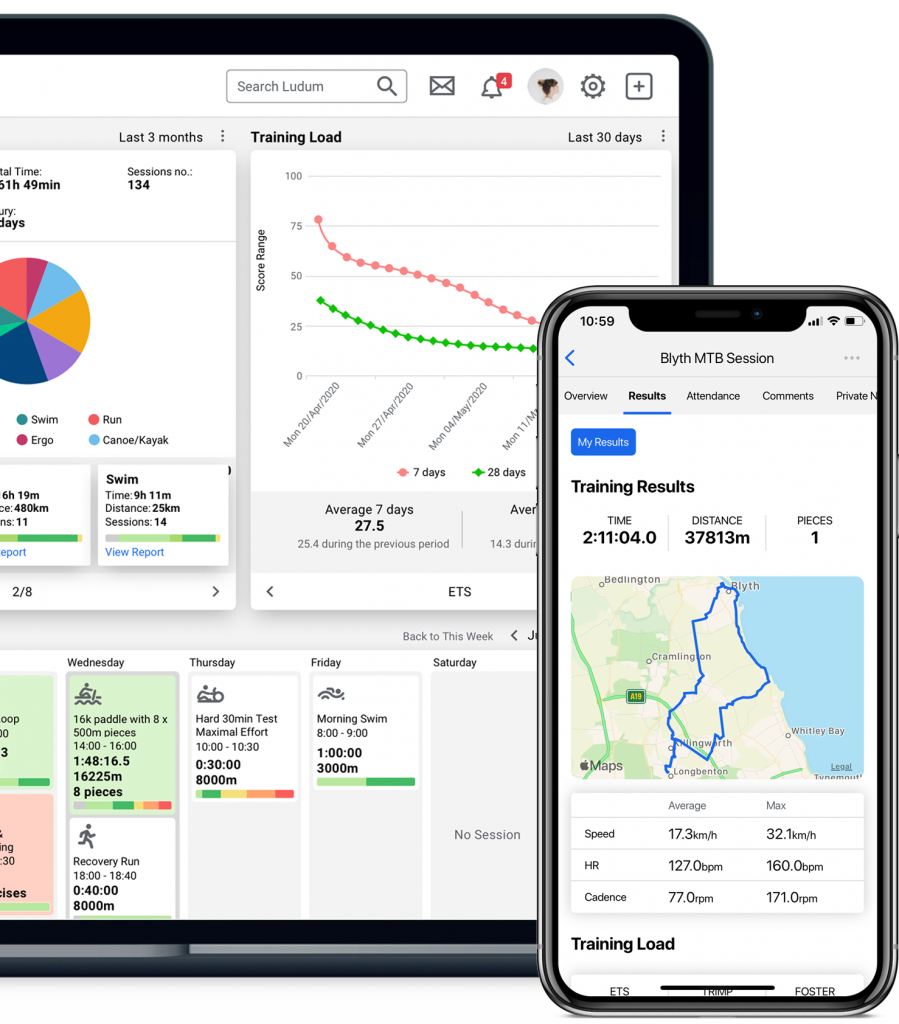
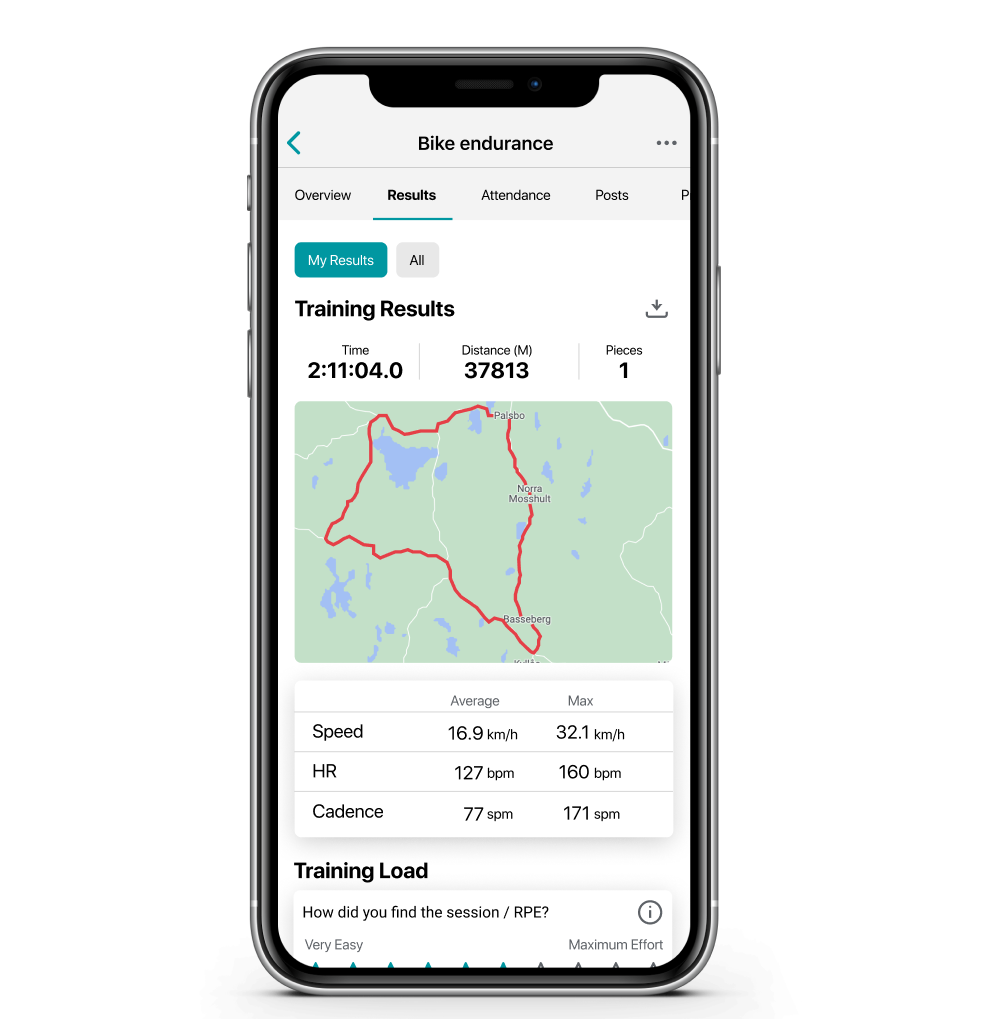
    1. How to use data to effectively plan, track and manage your training program.

    This webinar will be of interest to masters rowers that are interested in preparing for the regatta session, or simply want to understand what metrics they need to track and how to use them in order to train in a systematic way. 

    Topics covered will include:

    • How to measure and track training load. 
    • How to track progression. 
    • How to measure and monitor recovery. 
    • Sharing insights and pragmatic approaches from the world class rowing programs. 

    It will be an hour-long webinar will include a Q&A, so be sure to prepare yours in advance.

    2. How to plan your return from illness, injury or an extended time off rowing.

    This webinar will be of interest to anyone that is looking to understand different approaches to return to rowing after taking time off. I will be sharing my own personal experience in returning to rowing after a near fatal accident, along with tried and tested approaches that you can use to plan your return. 

    Topics covered will include:

    • How long will it take to get back in shape. 
    • What you need to focus on, when and for how long. 
    • How to increase your training over time to keep progressing safely. 
    • Pragmatic ways to track your progress 

    This will be an hour-long webinar will include a Q&A, so be sure to prepare yours in advance.


    Registration information from USRowing

    Individual Conference Pass ($79): This pass will get you full access to all live sessions within the conference and their recordings. This pass is intended for one person to have access to the conference.

    Boathouse Pass ($299): This pass is intended for a boathouse to gain access to the conference. After registering for this pass, account holders should email EventsTeam@usrowing.org with an excel spreadsheet of members names and email addresses that should have access to the content. There is no limit of attendees per boathouse pass.

    Individual Conference Pass with Championship Membership ($129): This pass will get you full access to all live sessions within the conference and their recordings. This pass is intended for one person to have access to the conference. This pass also includes a USRowing Championship Membership at a discounted rate. While a membership is not required for this conference, if you do intend to renew your membership, this is the time to do so to take advantage of a discounted rate!

    More information can be found at here and registration is done via Regatta Central at the following link.

  • 3 Tasty Time Saver Ergo Workouts

    3 Tasty Time Saver Ergo Workouts

    Faster Membership

    The rest of this one is for members.

    This article, both twelve-week training plans, and the full library of protocols and calculators are part of Faster Membership. CHF 129 for the year.

    See what’s inside Members log in

  • Podcast interview with Adrian Cassidy

    Podcast interview with Adrian Cassidy

    Excited to share this interview with Adrian Cassidy. Adrian has so much experience to share from rowing and high performance. Adrian rowed for Team GB winning world Championships from junior through to elite before an accident that ended his rowing career. Adrian shares his come back story from a broken neck to a career as an international rowing coach. His experiences and insights from coaching at Cambridge University Boat Club, then British Rowing, and Rowing Ireland where he was chief coach.

    Adrian shares some wonderful stories and insights into rowing and how his passion for excellence and helping others to achieve their potential led to the creation of Ludum, specialised performance management software to make life easier for rowers and rowing coaches. As well as setting up the Rowers Conference, to help advance rowing coaches skill and coaching expertise.

    Faster Podcast

  • Interview with Dual Olympian & Entrepreneur, Cameron McKenzie-McHarg

    Interview with Dual Olympian & Entrepreneur, Cameron McKenzie-McHarg

    Excited to share with you my latest podcast episode, where I interview the dual Olympian and 776BC co-founder Cameron McKenzie-McHarg.

    Cameron has a great story to tell. From growing up in a small country town, to discovering rowing at school. The attraction of other sports like Australian Football and being so good he was recruited by the Western Bulldogs in 1999.

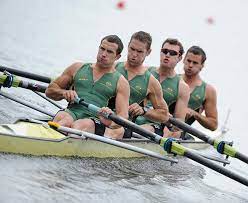
    Cameron returned to rowing in 2001 with the goal of representing Australia at the Olympic Games, and rowed for Victoria and Australia for over 12 years, winning multiple World Cup and World Championships medals. Cameron has also represented Australia at two Olympic Games; Beijing 2008 and London 2012, with his career highlight claiming Silver in the Men’s Four at the Beijing Olympics.

    Now an entrepreneur and co-founder 776BC Cameron shares some great insights and lessons learnt from high performance sport that translate to business and life. 

    Rowing Career Highlights

    • 2012 London Olympic Games: 6th Men’s Eight
    • 2010 World Championships: Bronze Medal Men’s Eight
    • 2009 World Championships: Silver Medal Men’s Four
    • 2008 Beijing Olympic Games: Silver Medal Men’s Four
    • 2008 Lucerne World Cup: Gold Medal Men’s Four
    • 2006 Poznan World Cup: Gold Medal Men’s Eight

    Instagram https://www.instagram.com/776bc/?hl=en Tag @776bc #776BC #RealAthletes

    Upcoming podcast interview – Live with Adrian Cassidy – 22 Dec @ 15:00 CET 

  • Workout of the week

    Workout of the week

    Endurance Builder

    This weeks workout is aimed at those that want to improve their aerobic base. Improving your aerobic base, requires spending time exercising at or just below your aerobic threshold. For most rowers, this will be at 75% of peak heart rate.

    90 minute endurance session

    • 15 minutes on the erg bike
    • 30 minutes on the ergo. Alternate between 5 min at SR 18 & 5 min at SR 20
    • 15 minutes on the erg bike
    • 30 minutes on the ergo. Alternate between 5 min at SR 18 & 5 min at SR 20

    Focus on generating as much power and acceleration whilst getting enough recovery at the low rate to keep the heart rate at 75%. Alternate on the bike erg to break up the session. Maintain the heart rate on the bike. No bike? Do something else like a short jog outside.

    Strength & Conditioning

    This week’s workout from James Goodwin, is the kneeling overhead press with a resistance band. This will strengthen your shoulders, back and core. Can be done easily at home with a rubber band.

    James is the head of performance sport for Swiss Rowing.

  • All about the right fit with Bont Rowing

    All about the right fit with Bont Rowing

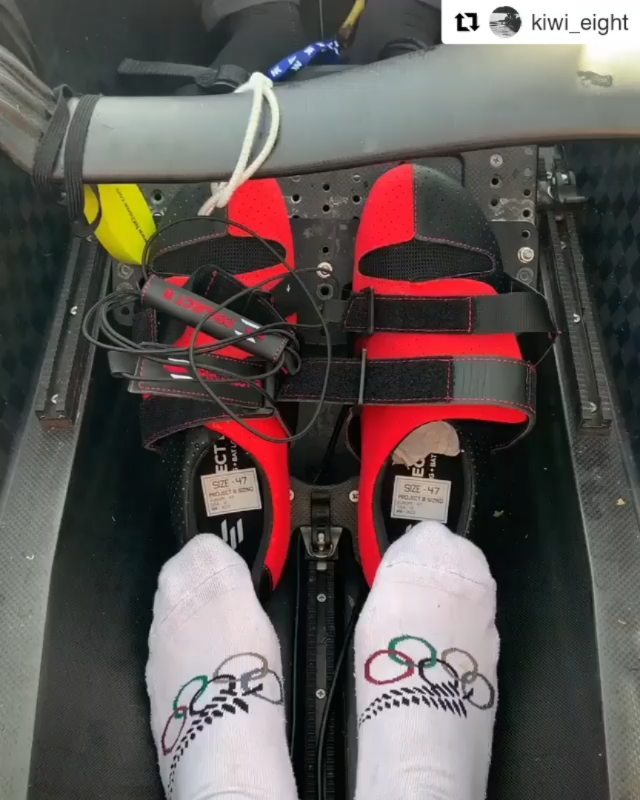
    Listen to my conversation with Istvan Nemeth, Managing Director of Bont Shoes and Bont Rowing, as we discuss the importance of having the right fit and connection through the feet, from the drive and through the recovery. Istvan will cover some of the key points you need to pay attention to when choosing your shoe along with the latest developments from Bont Rowing.

    Istvan and the team at Bont have a long history in creating shoes for cycling and rowing. With top World Tour Cycling, Olympic cycling and National Rowing crews using Bont shoes.

    You can find out more on Bont Rowing.

    This episode is a recording of the exclusive Live event for the Masters Rowing Group and my newsletter subscribers. For more information and to subscribe to my newsletter, go to www.whchambers.com and subscribe.

    Listen to Faster Podcast

  • Workout of the week

    Workout of the week

    The workout of the week is from Anne-Marie Howald. Head junior & U23 coach for the Swiss Federation. When Ian Wright was the head coach of Switzerland, apparently the Ladder Of Death (LOD) was one of the squads favourites. Word of advice. Make sure you are well warmed up, and don’t do this every day.

    The Ladder of Death

    • 8 x 30 on 10 off at SR 36
    • 6 x 40 on 15 off at SR 34
    • 3 x 60 on 20 off at SR 32
    • 1 x 100 on 20 off at SR 30
    • 3 x 60 on 20 off at SR 32
    • 6 x 40 on 15 off at SR 34
    • 8 x 30 on 10 off at SR 36

    Strength & Conditioning

    This week’s S&C workout from James Goodwin, is the shoulder press. The shoulder press is one of the best exercises for strengthening your shoulders and upper back.

  • Analysis of Tokyo Olympics results

    Analysis of Tokyo Olympics results

    Analysis provided by expert guest contributor, Dr Valery Kleshnev, Biorow.

    Radical changes were observed in the race strategy, which is now much more even. The winners were among the slowest at the first 100-150m after start, but significantly faster than their competitors during the middle of the race.

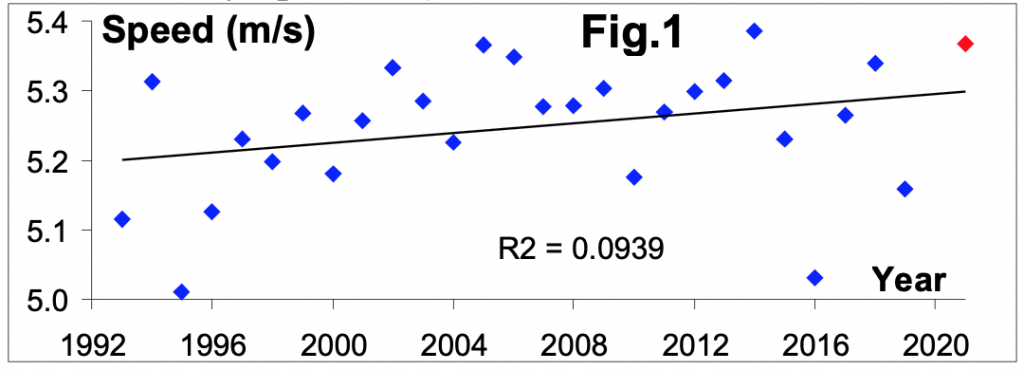
    A strong cross-tail wind allowed for quick times on Tokyo’s Sea Forest Waterway, despite fairly rough water. Six World best times were set (W8+ ROU, W2- NZL, LW2x ITA, LM2x IRL, W4x CHN in FA, M4x NED in FA), all on Wednesday 28th July. This made it the second fastest World regatta since 1993, only 0.3% slower than Worlds- 2014 (Amsterdam).

    Fig.1, the average speed in 13 consistent Olympic boats. (Kleshnev 2021)

    The linear trend during 1993-2021 grows by 0.065 %/year (0.0035 ms-1/y). W8+ continues to show the highest speed increase (0.18%/y), significantly higher than in the next M8+ (0.13%/y) and LW2x (0.10%/y). The lowest trend (Table 1) was found in women sculling boats (0.03%/y).

    Table 1. Growth of winners’ speed during 1993-2021 (Kleshnev 2021)

    More detailed analysis in scrolling decades (RBN 2020/08) also shows continuous growth during the last two decades (Fig.2) with the latest value +0.045 %/y.

    Speed Growth (%/year) (Kleshnev 2021)

    The average stroke rate in the 12 Olympic boat types (Table 2) was 39.0spm, which is 0.6spm higher than in the previous Worlds-2019 in Linz and similar to Worlds-2018 in Plovdiv. This is possibly weather-related: faster speed allows for a higher stroke rate.

    Table 2. Average stroke rate in finals A in 12 Olympic events in Tokyo-2021 (missing data for M2x and M4-)

    The differences in the rate between finalists were insignificant: only ±0.2spm within the first four place- takers, though 8 out of 12 winners showed lower average stroke rate than their silver competitors.

    (Kleshnev 2021)

    Radical changes were observed in the race strategy, which is now much more even. Two years ago in Linz the average variation of 500m splits in A finals was 2.56% (+3.5%, -1.6%, -2.1%, +0.3%), but now (Tab.3) it is more than two times lower 1.14% (+0.8%,-1.2%,- 0.7%,+1.2%). The first 500m split was the fastest in all previous regattas, but now the last section is the fastest. As before, the winners had the most even distribution of efforts during the race (Tab.3), except the 6th place-takers.

    Table 3. Speed at each 500m as % difference to the average over 2000m in finals A in 14 Olympic events. (Kleshnev 2021)

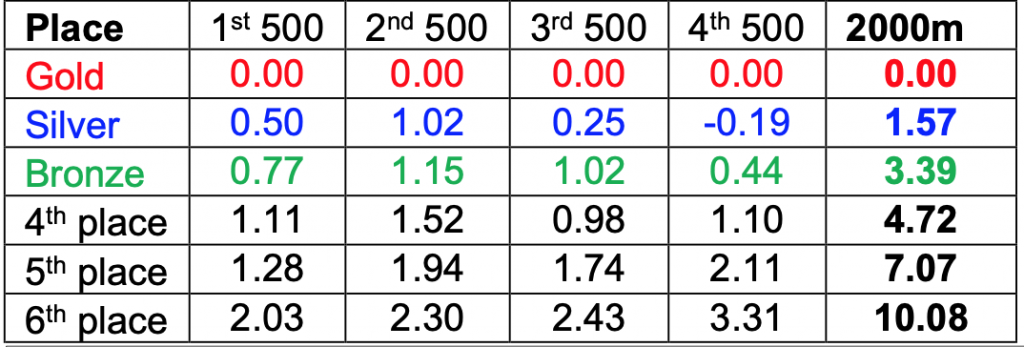
    Analysing the absolute splits (Tab.4), the winners were faster than other finalists at each section, except the last 500m, where silver medallists were 0.19s faster. As before, the main advantage was taken by the winners at the second 500m, where they were about 1.0s faster than their closest competitors.

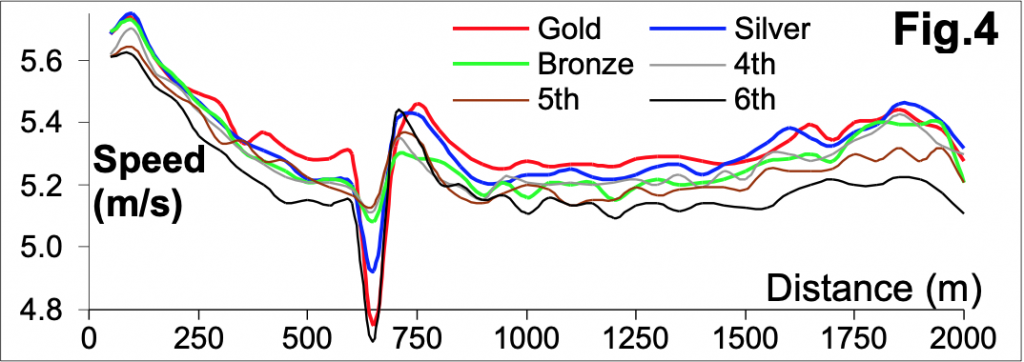
    Fig.4 confirms the above conclusion with average data (12 boats) at each 50m section taken from GPS (the glitch at 650m appears to be the shielding of the GPS signal by the bridge). The winners were among the slowest at the first 100-150m after start, but significantly faster than their competitors during the middle of the race.

    ©2021 Dr. Valery Kleshnev www.biorow.com

  • Wendy Miller’s experience at the Head of The Charles – Faster Podcast Episode

    Wendy Miller’s experience at the Head of The Charles – Faster Podcast Episode

    My guest today, is Wendy Miller, from Mosman Rowing Club in Sydney Australia. Wendy competed in the 2019 Head of The Charles regatta, and gained 3rd place in her first attempt in the single sculls event.

    I first met Wendy in 2019, as she was travelling through Europe on holidays on her way to Boston. She gave me a call to ask if she could drop by Switzerland, (as you do:-) to do a spot of training with me, before heading over to race in the US. Wendy has a great story to share, with her journey through Europe, training on a yacht whilst sailing down the Italian coast, her ingenuity to source boats, blades and boathouses to use, staying with wonderful hosts in different cities, and finding races to sharpen up before the big event. Nothing stopped Wendy on her way to racing in the 2019 Head of The Charles regatta and having a great adventure along the way. I hope you enjoy listening to her journey as much as I did.

    Head of The Charles Training Plans

    If you are a Masters Rowers, and interested in training for the Head of The Charles Regatta, I have prepared training plans especially for Masters Rowers. Whether you are planning to race in Boston, or compete virtually, these plans will help you to be at your best. The plans are designed by the most successful Masters Rowers, specifically for the Head of The Charles, and for Masters with 6 hours a week all the way to 12 hours of training a week. Click on the link to check out the programs. HOCR Training Plan

    Faster Podcast

  • Latest podcast episode – Head of The Charles Regatta with Blair Crawford (Chair) Board of Directors

    Latest podcast episode – Head of The Charles Regatta with Blair Crawford (Chair) Board of Directors

    Since its inception in 1965, The Head Of The Charles Regatta, also known as HOCR, is a rowing head race held on the penultimate complete weekend of October each year on the Charles River, which separates Boston and Cambridge, Massachusetts. I thought it would be interesting to find out from the organisers, and rowers, what makes the HOCR so special, and what attracted them to fly half way around the world to race on the Charles River. Over the next weeks, I will be releasing episodes where I chat with crews from around the world, to share insights into what makes this regatta so special.

    In this first episode, I speak with Blair Crawford (Chair) of the HOCR Board of Directors, to understand more about the regatta, how it all started, and how the regatta has evolved into what it is today.

    Head of The Charles Training Plans

    If you are a Masters Rowers, and interested in training for the Head of The Charles Regatta, I have prepared training plans especially for Masters Rowers. Whether you are planning to race in Boston, or compete virtually, these plans will help you to be at your best. The plans are designed by the most successful Masters Rowers, specifically for the Head of The Charles, and for Masters with 6 hours a week all the way to 12 hours of training a week. Click on the link to check out the programs. HOCR Training Plan