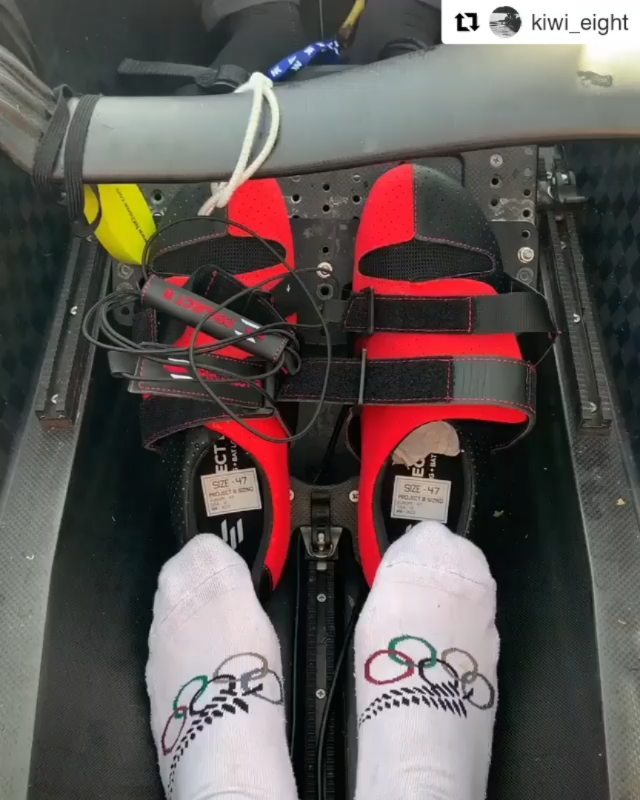
Listen to my conversation with Istvan Nemeth, Managing Director of Bont Shoes and Bont Rowing, as we discuss the importance of having the right fit and connection through the feet, from the drive and through the recovery. Istvan will cover some of the key points you need to pay attention to when choosing your shoe along with the latest developments from Bont Rowing.
Istvan and the team at Bont have a long history in creating shoes for cycling and rowing. With top World Tour Cycling, Olympic cycling and National Rowing crews using Bont shoes.
This episode is a recording of the exclusive Live event for the Masters Rowing Group and my newsletter subscribers. For more information and to subscribe to my newsletter, go to www.whchambers.com and subscribe.
The workout of the week is from Anne-Marie Howald. Head junior & U23 coach for the Swiss Federation. When Ian Wright was the head coach of Switzerland, apparently the Ladder Of Death (LOD) was one of the squads favourites. Word of advice. Make sure you are well warmed up, and don’t do this every day.
The Ladder of Death
8 x 30 on 10 off at SR 36
6 x 40 on 15 off at SR 34
3 x 60 on 20 off at SR 32
1 x 100 on 20 off at SR 30
3 x 60 on 20 off at SR 32
6 x 40 on 15 off at SR 34
8 x 30 on 10 off at SR 36
Strength & Conditioning
This week’s S&C workout from James Goodwin, is the shoulder press. The shoulder press is one of the best exercises for strengthening your shoulders and upper back.
Analysis provided by expert guest contributor, Dr Valery Kleshnev, Biorow.
Radical changes were observed in the race strategy, which is now much more even. The winners were among the slowest at the first 100-150m after start, but significantly faster than their competitors during the middle of the race.
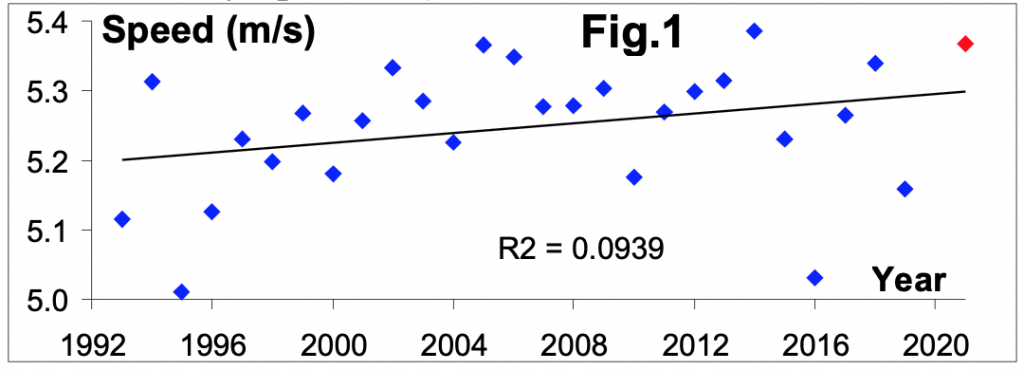
A strong cross-tail wind allowed for quick times on Tokyo’s Sea Forest Waterway, despite fairly rough water. Six World best times were set (W8+ ROU, W2- NZL, LW2x ITA, LM2x IRL, W4x CHN in FA, M4x NED in FA), all on Wednesday 28th July. This made it the second fastest World regatta since 1993, only 0.3% slower than Worlds- 2014 (Amsterdam).
Fig.1, the average speed in 13 consistent Olympic boats. (Kleshnev 2021)
The linear trend during 1993-2021 grows by 0.065 %/year (0.0035 ms-1/y). W8+ continues to show the highest speed increase (0.18%/y), significantly higher than in the next M8+ (0.13%/y) and LW2x (0.10%/y). The lowest trend (Table 1) was found in women sculling boats (0.03%/y).
Table 1. Growth of winners’ speed during 1993-2021 (Kleshnev 2021)
More detailed analysis in scrolling decades (RBN 2020/08) also shows continuous growth during the last two decades (Fig.2) with the latest value +0.045 %/y.
Speed Growth (%/year) (Kleshnev 2021)
The average stroke rate in the 12 Olympic boat types (Table 2) was 39.0spm, which is 0.6spm higher than in the previous Worlds-2019 in Linz and similar to Worlds-2018 in Plovdiv. This is possibly weather-related: faster speed allows for a higher stroke rate.
Table 2. Average stroke rate in finals A in 12 Olympic events in Tokyo-2021 (missing data for M2x and M4-)
The differences in the rate between finalists were insignificant: only ±0.2spm within the first four place- takers, though 8 out of 12 winners showed lower average stroke rate than their silver competitors.
(Kleshnev 2021)
Radical changes were observed in the race strategy, which is now much more even. Two years ago in Linz the average variation of 500m splits in A finals was 2.56% (+3.5%, -1.6%, -2.1%, +0.3%), but now (Tab.3) it is more than two times lower 1.14% (+0.8%,-1.2%,- 0.7%,+1.2%). The first 500m split was the fastest in all previous regattas, but now the last section is the fastest. As before, the winners had the most even distribution of efforts during the race (Tab.3), except the 6th place-takers.
Table 3. Speed at each 500m as % difference to the average over 2000m in finals A in 14 Olympic events. (Kleshnev 2021)
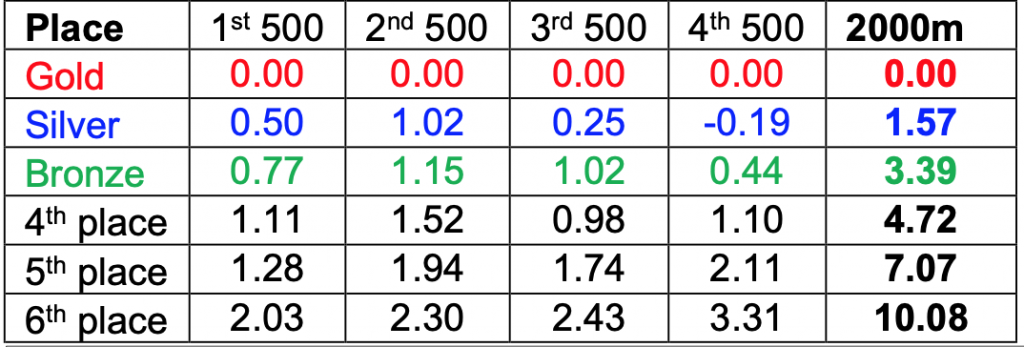
Analysing the absolute splits (Tab.4), the winners were faster than other finalists at each section, except the last 500m, where silver medallists were 0.19s faster. As before, the main advantage was taken by the winners at the second 500m, where they were about 1.0s faster than their closest competitors.
Average margins (s) from the winners in 14 finals A in Tokyo-2021. (Kleshnev 2021)
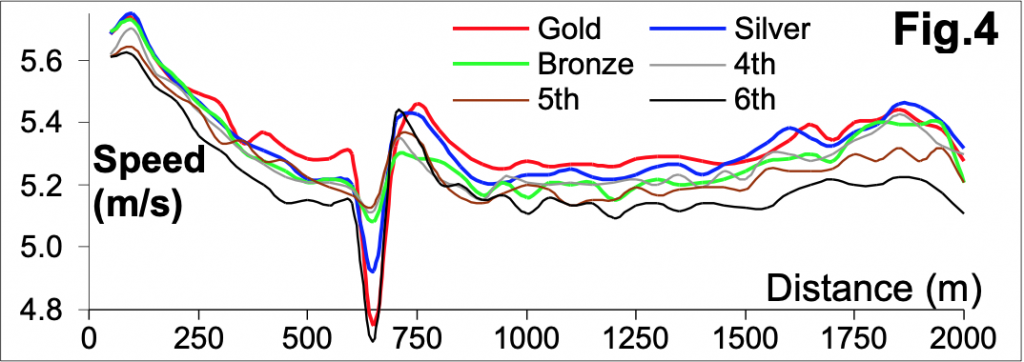
Fig.4 confirms the above conclusion with average data (12 boats) at each 50m section taken from GPS (the glitch at 650m appears to be the shielding of the GPS signal by the bridge). The winners were among the slowest at the first 100-150m after start, but significantly faster than their competitors during the middle of the race.
Dr Dan was the head physiologist at New Zealand Rowing, and responsible for designing the training sessions for the likes of the Kiwi Pair.
8 x 4 min at 103% to 105% of your Critical Power or in Zone 4 (93-95% of max heart rate) with 2 min recovery between intervals. You want to achieve at least 30 min of work in Zone 4.
Strength & Conditioning with James Goodwin
James is the head of sports performance for the Swiss Rowing Federation. In this short video, James demonstrates the Bulgarian split squat.
Bulgarian split squat, demonstrated by James Goodwin
Over head squats with a bucket of water in each hand. Fill the buckets with water, and do 4 x (8-10) squats without getting wet. Anne-Marie Boule, Swiss Rowing Federation Coach. Check out more from Anne-Marie in our podcast episode together by clicking here.
On the water or ergo
Strength endurance session. Total duration 90-minutes in zone 2 (LT1) with 30-minutes rowing/sculling with a bungee cord for resistance. For this on the ergo, substitute the bungee with fan setting 10.
Faster podcast with Bill Chambers and Dr Charlie Simpson. 29 March 2021.
Charlie is a Senior Lecturer in Sport and Exercise Science at Oxford Brookes University and well known for his publications on Rowing. The Complete Guide to Indoor Rowing and Advanced Rowing.This Master Class, will present attendees with interesting information about the relationship between common rowing training practices and their effects on performance measures (e.g. aerobic function; lean body mass). Any discussion of training responses is incomplete without consideration of the dietary intake of an athlete, but rather than review generic aspects of a healthy diet, the presentation will provide evidence about the potential diet changes known to contribute to health and performance (particularly rowing performance).
The Master Class will use pre-planned interactive opportunities to provide you with opportunity to actively engage with the session content, while also reflecting upon your approaches to training and diet. This approach makes it possible for willing attendees to share their views and practices as active session participants. After completing this session, attendees should be able to make informed decisions about the value of making specific changes to training approaches and diet.
17 April 2021 @ 20:00 Zürich 15:00 Boston
90-minutes Live on Zoom
Interactive presentation
Q&A time with Charlie
Session recorded for playback after Master Class
Reserve your place and purchase your ticket, by clicking here.
Listen to the conversation with Bill & Dr Simpson by clicking here.
In the preparation period of my annual plan, I focus on building strength and developing my aerobic base. This period starts after a break over November and unstructured training through December. January through February is a big block of aerobic work in zone 2 (70-75% peak heart rate), and in March I start to introduce some longer threshold work at least once a week.
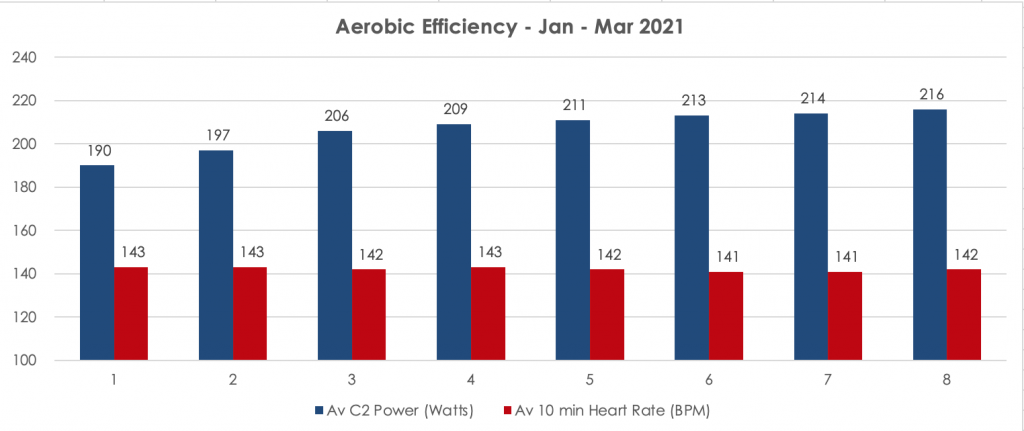
I like to track the development of my aerobic base, and do so with a simple protocol on the Concept2 ergo. Every 2-weeks I ‘check-in’ on how my aerobic base is developing from a duration perspective, and efficiency, through monitoring the power output (watts). I did 8 tests between January and March, and over this period saw an average test to test improvement of +1.6% watts for the same heart rate. Over the 12-week same period, I saw a +13.7% improvement in watts for the same heart rate. See the graphic below.
I have noticed similar improvements in power and efficiency, with Masters Rowers that really focus on developing their aerobic base, and have the discipline to work in their zone 2, progressively over time, before introducing higher intensity work. It is hard work to stay focussed, day in, day out, grinding away on the machine or on the water. Yet the benefits to your health and performance can be amazing. This is the ‘hard work’ that many Masters Rowers don’t do, because it is so easy to be seduced into the high intensity ‘go hard or go home’ approach. Yet if your’e interested in a tried, tested and proven way to build the foundations for a great season, give it a try.
We are running a series of Master Classes this April, with world class instructors to help Masters Rowers to learn more about how to go Faster. Dr Charlie Simpson, and expert in training intensity and nutrition, will be sharing his insights into how to train and eat. Click here to go to the Master Class page to find out more.
In this episode, I talk with Prof Samuele Marcora about how the brain regulates performance, and what we can do about this to go Faster.Prof Marcora is well known in the world of sports science and considered an expert in this subject.He has a Bachelor in Physical Education from the Higher Institute of Physical Education of Lombardy (Italy). A MSc in Human Performance at the University of Wisconsin-La Crosse (USA), and a PhD in Exercise Physiology at the University of Wales-Bangor (UK). He has taught at the Bangor University (UK) and the University of Kent (UK) , where he was made an honorary Professor.Prof Marcora’s research integrates exercise physiology with motivation psychology and cognitive neuroscience to better understand fatigue, endurance performance and physical activity behaviour. He is the author of Sport and the Brain: The science of preparing, enduring and winning, and has over 185 scientific articles, being cited over 10,000 times. He has been a consultant for many organisations including British Ministry of Defence, Juventus, MAPEI Sport and ASICS, and in 2018 he began his post at the University of Bologna, where he teaches applied physiology and training methodology.
What we cover in depth
How the brain regulates performance
What is the difference between pain and fatigue
How his model differs from the classic understanding of fatigue, e.g central governor theory
What’s going on ‘inside’ when we are racing at the limit and we ‘hear’ the voice inside saying counter productive messages
Recommendations for masters rowers to prepare to do their best in a maximum test/race
Interventions to maintain/increase performance when feeling fatigued
How would you incorporate the application and training plan design
How to integrate brain endurance training with traditional training sessions
Advice to masters rowers looking to integrate this… a lot of science
How brain endurance ties into recovery strategy, role of sleep and the role of meditation
The most effective primers to ward off fatigue
Recommended visual and audible cues
Fatigue mediation/mitigation strategies, any good stories from power/endurance sports?
Samuele recommends the following books
Endure by Alex Hutchinson
Sport and the Brain: The science of preparing, enduring and winning
Super excited to announce today, the live sessions with our world-class instructors. More information will be released later this week, so be sure to join the newsletter to be the first to find out.
Training & Nutrion For Masters Rowers
Instructor: Dr Charles Simpson, Author and Senior Lecturer in Sport and Exercise Science. Sport. Faculty of Health and Life Sciences, Oxford Brookes University.
Biomechanics For Fast & Efficient Rowing
Instructor: Dr Valery Kleshnev, Rowing Biomechanist, Author, Inventor, Olmpic Silver medalist and USSR Single Sculls Champion.
Strength & Conditioning For Masters Rowers
Instructor: James Goodwin, Head of Strength & Conditioning and High Performance, Swiss Rowing Federation.
Rowing Technique To Move The Boat Fast.
Instructor: Noel Donaldson, former head of Australian Rowing, New Zealand Rowing. Coach of the Oarsome Foursome & the Kiwi Pair.
After demolishing Team INEOS, 7-1 in the Prada Cup Challenger series, Luna Rossa’s James Spithill wasn’t gloating in the victory, he came across humble and focussed.
“No doubt going through real racing, I think we’ve taken a good step forward. But it’s not enough…”
Sharing this short article I came across, to inspire and challenge you with insights from the world’s very best competitors.
Original article published in the New Zealand Herald, 22 February 2021.
America’s Cup 2021: Luna Rossa co-helmsman Jimmy Spithill’s surprising claim ahead of Team New Zealand showdown.
Jimmy Spithill admits Luna Rossa have a lot of work to do before being able to compete with Team New Zealand in the America’s Cup match – a daunting task he equates to facing the All Blacks in a Rugby World Cup final.
The Luna Rossa co-helmsman was relatively understated in his celebrations following the Italian syndicate’s 7-1 demolition of Ineos Team UK last Sunday, perhaps looking ahead to his toughest challenge of his America’s Cup campaign in the shape of the defenders Team NZ.
Spithill was pleased with the progress made by his team – from middling challengers early in the Prada Cup round robins to a near sweep in the final – but says they’re still behind the defenders.
“No doubt going through real racing, I think we’ve taken a good step forward. But it’s not enough,” Spithill told NZME. “We’ve really got to utilise this time now between the match to try and bridge that gap. Because those guys (Team NZ), in my mind, are ahead at the moment.
“I think the whole package is very, very good. I think we’ve got a great package at the bottom end for the wind conditions, but we need to improve in the middle and upper end of the ranges.”
To do that, Spithill says he will be enlisting all the help he can get from his friends among the fallen challengers.
“We spoke to the American guys after racing them in the semifinals. I’ll definitely be touching base with Ben [Ainslie] and Giles [Scott]. We’ve got a lot of friends in Ineos Team UK; a lot of guys who worked with Oracle in the last couple of campaigns. We’ll be looking for knowledge and ways to grow stronger from here from amongst all the challengers.”
When asked how he’s going to wind up New Zealanders – like he did when Oracle came from behind to beat Team NZ in 2013 – Spithill laughed it off and simply spoke about the “privilege” of being able to challenge the Kiwis on home soil.
“I think they seem to do a really good job of that themselves,” he said in jest. “I’m just really honoured to get a shot at the best team in the world. To be able to race Team New Zealand on home waters, it’s a lot like a rugby player getting to go on the rugby field against the All Blacks at Eden Park at a Rugby World Cup final. What an incredible privilege that is.”
Spithill also made sure to pay tribute to his co-helmsman and partner in crime Francesco Bruni, who unlike the Australian, showed significantly more emotion after clinching the Prada Cup.
“I’m so proud of ‘Ceco’. What an incredible journey he’s had. I know that Sicilian blood, that energy has just been bubbling there waiting. Man he’s just done an amazing job. An incredible series he’s raced. I was really pumped that we could get it done.”
The two-time America’s Cup winner also praised the unique culture of the team, something he hopes will help them shock the world against the Kiwis next month.
“The Italian culture is really amazing. It’s a really big family type of culture: very passionate, very emotional, a lot of energy and very hard workers.
“One thing we’ve really worked on a lot is composure – just trying to sort of regulate, whether it’s been a good day or a bad day, we’re just trying to learn as much as we can.
“I’ve been so impressed with the team from where we’ve come from. We’ve developed a fantastic culture in the team. It’s something now we’ve got to put in to play over this next week or two.”