The workout of the week is from Anne-Marie Howald. Head junior & U23 coach for the Swiss Federation. When Ian Wright was the head coach of Switzerland, apparently the Ladder Of Death (LOD) was one of the squads favourites. Word of advice. Make sure you are well warmed up, and don’t do this every day.
The Ladder of Death
8 x 30 on 10 off at SR 36
6 x 40 on 15 off at SR 34
3 x 60 on 20 off at SR 32
1 x 100 on 20 off at SR 30
3 x 60 on 20 off at SR 32
6 x 40 on 15 off at SR 34
8 x 30 on 10 off at SR 36
Strength & Conditioning
This week’s S&C workout from James Goodwin, is the shoulder press. The shoulder press is one of the best exercises for strengthening your shoulders and upper back.
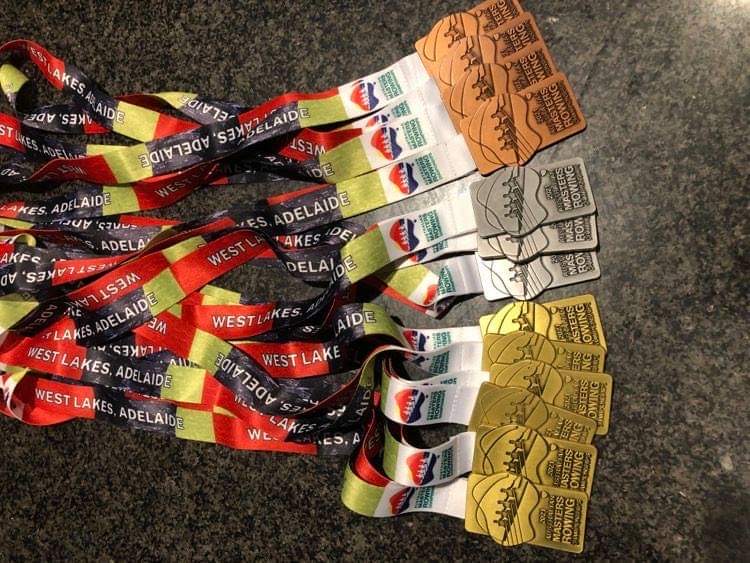
Craig is the head of rowing at Caulfield Grammar School, Victoria, Australia, and the holder of the impressive haul of Masters medals from this years Australian Masters Championships.
On the Erg. Aerobic intervals. Sets of 500m on 1 min off at T2. Rate 27-29. Do them in sets of 10 and accumulate 12-15km worth of 500s. I challenge the masters to do 1 for every year of age.
Strength & Conditioning with James Goodwin
James is the head of sports performance for the Swiss Rowing Federation. In this short video, James demonstrates a real favourite of mine, the bent over row.
“Time Contracter” is 60 mins with 6 mins easy pace (e.g. UT2 and 4 mins moderate effort (UT1/AT) until the clock hits zero (so six intervals of 4 mins by the end)….If doing on the erg, during the final 2 mins of both the 6min easy and 4 mins moderate…..flick the monitor to watts and aim to keep a high stroke to stroke consistency such that every stroke is +/- 3 watts of the target value for the section….For example, if the target UT2 pace is 200 watts….then every stroke in the final 2 mins of the 6 min section should be between 197 and 203……It’s easy enough to count the number of missed target strokes …..a goal is to keep this to no more than 3 missed strokes per minute…
Charlie is the Senior Lecturer in Sport and Exercise Science and Global Partnership Lead for Faculty of Health and Life Sciences at Oxford Brooks University, and the co-author of Advanced Rowing and Indoor Rowing.
Strength & Conditioning with James Goodwin
James is the head of sports performance for the Swiss Rowing Federation. In this short video, James demonstrates the goblet squat.
James Goodwin, is the Head of physical performance and science for the Swiss Rowing Federation. James is responsible for ensuring the Swiss Team are strong and fit, to train and race.
This episode is an extract from the Live Strength & Conditioning Masterclass held earlier this year (2021), where James is presenting strategies and approaches to strength training for Masters Rowers.
Subscribe to the Faster newsletter, to get free access to the weekly workout from James, and much more.
Dr Dan was the head physiologist at New Zealand Rowing, and responsible for designing the training sessions for the likes of the Kiwi Pair.
8 x 4 min at 103% to 105% of your Critical Power or in Zone 4 (93-95% of max heart rate) with 2 min recovery between intervals. You want to achieve at least 30 min of work in Zone 4.
Strength & Conditioning with James Goodwin
James is the head of sports performance for the Swiss Rowing Federation. In this short video, James demonstrates the Bulgarian split squat.
Bulgarian split squat, demonstrated by James Goodwin
My guest today, is Wendy Miller, from Mosman Rowing Club in Sydney Australia. Wendy competed in the 2019 Head of The Charles regatta, and gained 3rd place in her first attempt in the single sculls event.
I first met Wendy in 2019, as she was travelling through Europe on holidays on her way to Boston. She gave me a call to ask if she could drop by Switzerland, (as you do:-) to do a spot of training with me, before heading over to race in the US. Wendy has a great story to share, with her journey through Europe, training on a yacht whilst sailing down the Italian coast, her ingenuity to source boats, blades and boathouses to use, staying with wonderful hosts in different cities, and finding races to sharpen up before the big event. Nothing stopped Wendy on her way to racing in the 2019 Head of The Charles regatta and having a great adventure along the way. I hope you enjoy listening to her journey as much as I did.
Head of The Charles Training Plans
If you are a Masters Rowers, and interested in training for the Head of The Charles Regatta, I have prepared training plans especially for Masters Rowers. Whether you are planning to race in Boston, or compete virtually, these plans will help you to be at your best. The plans are designed by the most successful Masters Rowers, specifically for the Head of The Charles, and for Masters with 6 hours a week all the way to 12 hours of training a week. Click on the link to check out the programs. HOCR Training Plan
Since its inception in 1965, The Head Of The Charles Regatta, also known as HOCR, is a rowing head race held on the penultimate complete weekend of October each year on the Charles River, which separates Boston and Cambridge, Massachusetts. I thought it would be interesting to find out from the organisers, and rowers, what makes the HOCR so special, and what attracted them to fly half way around the world to race on the Charles River. Over the next weeks, I will be releasing episodes where I chat with crews from around the world, to share insights into what makes this regatta so special.
In this first episode, I speak with Blair Crawford (Chair) of the HOCR Board of Directors, to understand more about the regatta, how it all started, and how the regatta has evolved into what it is today.
Head of The Charles Training Plans
If you are a Masters Rowers, and interested in training for the Head of The Charles Regatta, I have prepared training plans especially for Masters Rowers. Whether you are planning to race in Boston, or compete virtually, these plans will help you to be at your best. The plans are designed by the most successful Masters Rowers, specifically for the Head of The Charles, and for Masters with 6 hours a week all the way to 12 hours of training a week. Click on the link to check out the programs. HOCR Training Plan
Faster podcast with Bill Chambers and Dr Charlie Simpson. 29 March 2021.
Charlie is a Senior Lecturer in Sport and Exercise Science at Oxford Brookes University and well known for his publications on Rowing. The Complete Guide to Indoor Rowing and Advanced Rowing.This Master Class, will present attendees with interesting information about the relationship between common rowing training practices and their effects on performance measures (e.g. aerobic function; lean body mass). Any discussion of training responses is incomplete without consideration of the dietary intake of an athlete, but rather than review generic aspects of a healthy diet, the presentation will provide evidence about the potential diet changes known to contribute to health and performance (particularly rowing performance).
The Master Class will use pre-planned interactive opportunities to provide you with opportunity to actively engage with the session content, while also reflecting upon your approaches to training and diet. This approach makes it possible for willing attendees to share their views and practices as active session participants. After completing this session, attendees should be able to make informed decisions about the value of making specific changes to training approaches and diet.
17 April 2021 @ 20:00 Zürich 15:00 Boston
90-minutes Live on Zoom
Interactive presentation
Q&A time with Charlie
Session recorded for playback after Master Class
Reserve your place and purchase your ticket, by clicking here.
Listen to the conversation with Bill & Dr Simpson by clicking here.
In the preparation period of my annual plan, I focus on building strength and developing my aerobic base. This period starts after a break over November and unstructured training through December. January through February is a big block of aerobic work in zone 2 (70-75% peak heart rate), and in March I start to introduce some longer threshold work at least once a week.
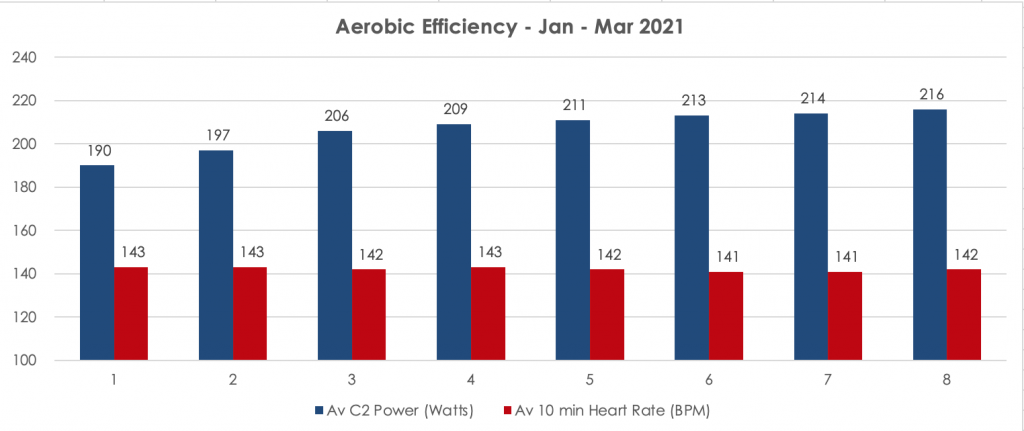
I like to track the development of my aerobic base, and do so with a simple protocol on the Concept2 ergo. Every 2-weeks I ‘check-in’ on how my aerobic base is developing from a duration perspective, and efficiency, through monitoring the power output (watts). I did 8 tests between January and March, and over this period saw an average test to test improvement of +1.6% watts for the same heart rate. Over the 12-week same period, I saw a +13.7% improvement in watts for the same heart rate. See the graphic below.
I have noticed similar improvements in power and efficiency, with Masters Rowers that really focus on developing their aerobic base, and have the discipline to work in their zone 2, progressively over time, before introducing higher intensity work. It is hard work to stay focussed, day in, day out, grinding away on the machine or on the water. Yet the benefits to your health and performance can be amazing. This is the ‘hard work’ that many Masters Rowers don’t do, because it is so easy to be seduced into the high intensity ‘go hard or go home’ approach. Yet if your’e interested in a tried, tested and proven way to build the foundations for a great season, give it a try.
We are running a series of Master Classes this April, with world class instructors to help Masters Rowers to learn more about how to go Faster. Dr Charlie Simpson, and expert in training intensity and nutrition, will be sharing his insights into how to train and eat. Click here to go to the Master Class page to find out more.
In this episode, I talk with Prof Samuele Marcora about how the brain regulates performance, and what we can do about this to go Faster.Prof Marcora is well known in the world of sports science and considered an expert in this subject.He has a Bachelor in Physical Education from the Higher Institute of Physical Education of Lombardy (Italy). A MSc in Human Performance at the University of Wisconsin-La Crosse (USA), and a PhD in Exercise Physiology at the University of Wales-Bangor (UK). He has taught at the Bangor University (UK) and the University of Kent (UK) , where he was made an honorary Professor.Prof Marcora’s research integrates exercise physiology with motivation psychology and cognitive neuroscience to better understand fatigue, endurance performance and physical activity behaviour. He is the author of Sport and the Brain: The science of preparing, enduring and winning, and has over 185 scientific articles, being cited over 10,000 times. He has been a consultant for many organisations including British Ministry of Defence, Juventus, MAPEI Sport and ASICS, and in 2018 he began his post at the University of Bologna, where he teaches applied physiology and training methodology.
What we cover in depth
How the brain regulates performance
What is the difference between pain and fatigue
How his model differs from the classic understanding of fatigue, e.g central governor theory
What’s going on ‘inside’ when we are racing at the limit and we ‘hear’ the voice inside saying counter productive messages
Recommendations for masters rowers to prepare to do their best in a maximum test/race
Interventions to maintain/increase performance when feeling fatigued
How would you incorporate the application and training plan design
How to integrate brain endurance training with traditional training sessions
Advice to masters rowers looking to integrate this… a lot of science
How brain endurance ties into recovery strategy, role of sleep and the role of meditation
The most effective primers to ward off fatigue
Recommended visual and audible cues
Fatigue mediation/mitigation strategies, any good stories from power/endurance sports?
Samuele recommends the following books
Endure by Alex Hutchinson
Sport and the Brain: The science of preparing, enduring and winning