“Time Contracter” is 60 mins with 6 mins easy pace (e.g. UT2 and 4 mins moderate effort (UT1/AT) until the clock hits zero (so six intervals of 4 mins by the end)….If doing on the erg, during the final 2 mins of both the 6min easy and 4 mins moderate…..flick the monitor to watts and aim to keep a high stroke to stroke consistency such that every stroke is +/- 3 watts of the target value for the section….For example, if the target UT2 pace is 200 watts….then every stroke in the final 2 mins of the 6 min section should be between 197 and 203……It’s easy enough to count the number of missed target strokes …..a goal is to keep this to no more than 3 missed strokes per minute…
Charlie is the Senior Lecturer in Sport and Exercise Science and Global Partnership Lead for Faculty of Health and Life Sciences at Oxford Brooks University, and the co-author of Advanced Rowing and Indoor Rowing.
Strength & Conditioning with James Goodwin
James is the head of sports performance for the Swiss Rowing Federation. In this short video, James demonstrates the goblet squat.
In this podcast episode, I chat with the amazing masters crew that set the masters record at the Head of The Charles Regatta (HOCR). The Wallingford crew of Mike Edge, Pete King, Steve Pearson and stroke, Richard Smith – coxed by Sara Ball, won the 2016 regatta by 30-seconds, with a new course record of 17mins 5 secs.
From right to left; Mike Edge, Pete King, Steve Pearson and stroke, Richard Smith – cox Sara Ball
The crew share how they trained and prepared for the race. Everything from engaging a new coach, and partnering with an amazingly talented cox. How they used YouTube to get used to the bends and bridges, to mapping the race distance and course on their local stretch of water in Wallingford, Oxford.
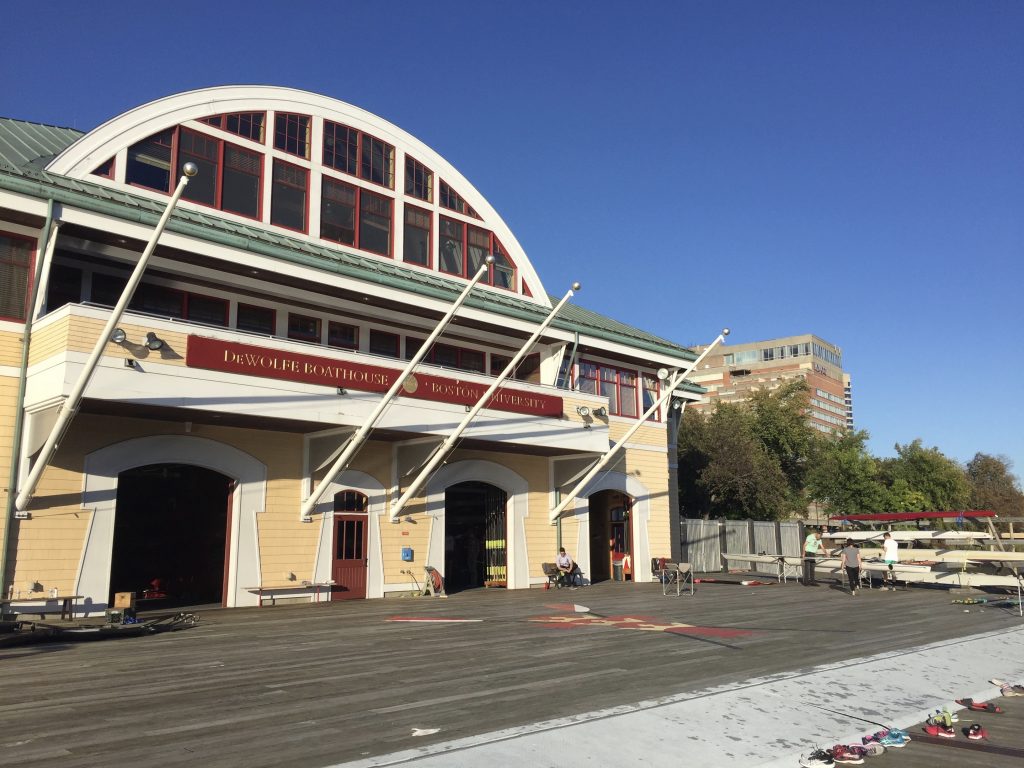
Boat used was a Filippi coxed four out of Boston University.
If you are a Masters Rowers, and interested in training for the Head of The Charles Regatta, I have prepared training plans especially for you. Whether you are planning to race in Boston, or compete virtually, these plans will help you to be at your best. The plans are designed by the most successful Masters Rowers, specifically for the Head of The Charles, and for Masters with 6 hours a week all the way to 12 hours of training a week. Click on the link to check out the programs. HOCR Training Plan
Personal favourite of mine. I call this le canibale session, because you feel like you are on the attack! This is designed for developing anaerobic capacity.
Strength & Conditioning with James Goodwin
James is the head of sports performance for the Swiss Rowing Federation. In this short video, James demonstrates the single arm row, with both feet on the ground.
James Goodwin, is the Head of physical performance and science for the Swiss Rowing Federation. James is responsible for ensuring the Swiss Team are strong and fit, to train and race.
This episode is an extract from the Live Strength & Conditioning Masterclass held earlier this year (2021), where James is presenting strategies and approaches to strength training for Masters Rowers.
Subscribe to the Faster newsletter, to get free access to the weekly workout from James, and much more.
Analysis provided by expert guest contributor, Dr Valery Kleshnev, Biorow.
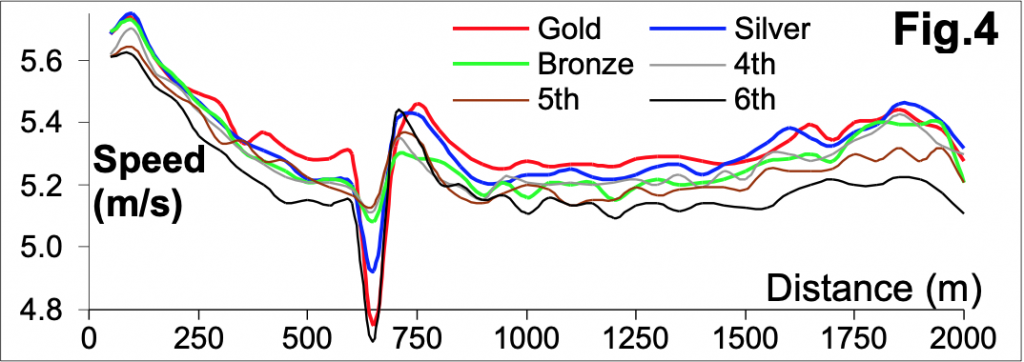
Radical changes were observed in the race strategy, which is now much more even. The winners were among the slowest at the first 100-150m after start, but significantly faster than their competitors during the middle of the race.
A strong cross-tail wind allowed for quick times on Tokyo’s Sea Forest Waterway, despite fairly rough water. Six World best times were set (W8+ ROU, W2- NZL, LW2x ITA, LM2x IRL, W4x CHN in FA, M4x NED in FA), all on Wednesday 28th July. This made it the second fastest World regatta since 1993, only 0.3% slower than Worlds- 2014 (Amsterdam).
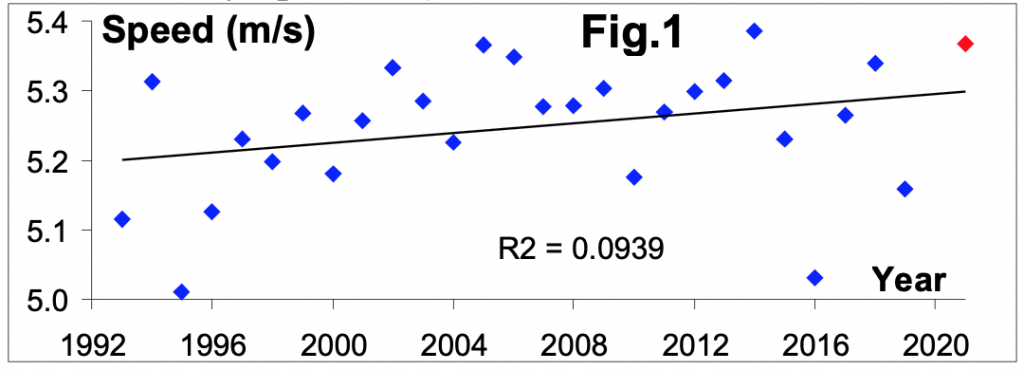
Fig.1, the average speed in 13 consistent Olympic boats. (Kleshnev 2021)
The linear trend during 1993-2021 grows by 0.065 %/year (0.0035 ms-1/y). W8+ continues to show the highest speed increase (0.18%/y), significantly higher than in the next M8+ (0.13%/y) and LW2x (0.10%/y). The lowest trend (Table 1) was found in women sculling boats (0.03%/y).
Table 1. Growth of winners’ speed during 1993-2021 (Kleshnev 2021)
More detailed analysis in scrolling decades (RBN 2020/08) also shows continuous growth during the last two decades (Fig.2) with the latest value +0.045 %/y.
Speed Growth (%/year) (Kleshnev 2021)
The average stroke rate in the 12 Olympic boat types (Table 2) was 39.0spm, which is 0.6spm higher than in the previous Worlds-2019 in Linz and similar to Worlds-2018 in Plovdiv. This is possibly weather-related: faster speed allows for a higher stroke rate.
Table 2. Average stroke rate in finals A in 12 Olympic events in Tokyo-2021 (missing data for M2x and M4-)
The differences in the rate between finalists were insignificant: only ±0.2spm within the first four place- takers, though 8 out of 12 winners showed lower average stroke rate than their silver competitors.
(Kleshnev 2021)
Radical changes were observed in the race strategy, which is now much more even. Two years ago in Linz the average variation of 500m splits in A finals was 2.56% (+3.5%, -1.6%, -2.1%, +0.3%), but now (Tab.3) it is more than two times lower 1.14% (+0.8%,-1.2%,- 0.7%,+1.2%). The first 500m split was the fastest in all previous regattas, but now the last section is the fastest. As before, the winners had the most even distribution of efforts during the race (Tab.3), except the 6th place-takers.
Table 3. Speed at each 500m as % difference to the average over 2000m in finals A in 14 Olympic events. (Kleshnev 2021)
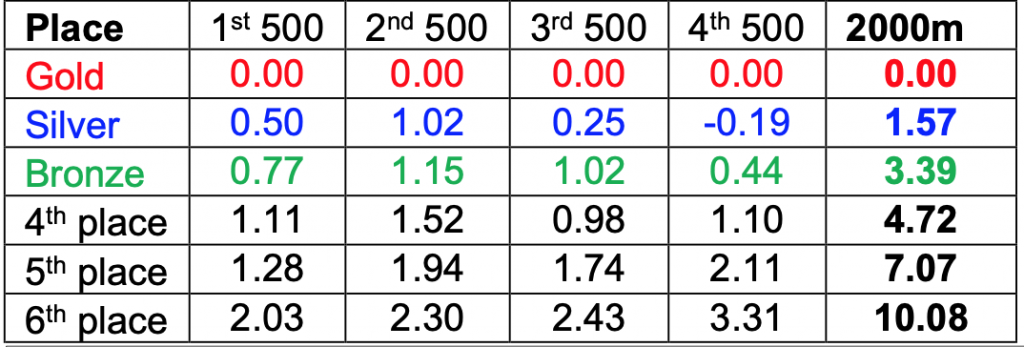
Analysing the absolute splits (Tab.4), the winners were faster than other finalists at each section, except the last 500m, where silver medallists were 0.19s faster. As before, the main advantage was taken by the winners at the second 500m, where they were about 1.0s faster than their closest competitors.
Average margins (s) from the winners in 14 finals A in Tokyo-2021. (Kleshnev 2021)
Fig.4 confirms the above conclusion with average data (12 boats) at each 50m section taken from GPS (the glitch at 650m appears to be the shielding of the GPS signal by the bridge). The winners were among the slowest at the first 100-150m after start, but significantly faster than their competitors during the middle of the race.
My guest today, is Wendy Miller, from Mosman Rowing Club in Sydney Australia. Wendy competed in the 2019 Head of The Charles regatta, and gained 3rd place in her first attempt in the single sculls event.
I first met Wendy in 2019, as she was travelling through Europe on holidays on her way to Boston. She gave me a call to ask if she could drop by Switzerland, (as you do:-) to do a spot of training with me, before heading over to race in the US. Wendy has a great story to share, with her journey through Europe, training on a yacht whilst sailing down the Italian coast, her ingenuity to source boats, blades and boathouses to use, staying with wonderful hosts in different cities, and finding races to sharpen up before the big event. Nothing stopped Wendy on her way to racing in the 2019 Head of The Charles regatta and having a great adventure along the way. I hope you enjoy listening to her journey as much as I did.
Head of The Charles Training Plans
If you are a Masters Rowers, and interested in training for the Head of The Charles Regatta, I have prepared training plans especially for Masters Rowers. Whether you are planning to race in Boston, or compete virtually, these plans will help you to be at your best. The plans are designed by the most successful Masters Rowers, specifically for the Head of The Charles, and for Masters with 6 hours a week all the way to 12 hours of training a week. Click on the link to check out the programs. HOCR Training Plan
Excited to share my conversation with Tom Bishop, Olympian (1976) and multiple winner of the Head of The Charles Regatta (2017, 18, 19). Tom shares some amazing stories about his persistence in being selected in the quad, and the challenges he overcame to represent his country. Being coached by Mike Spracklin, and what it takes to prepare for and win the Head of The Charles in the 70+ age group.
Tom has an amazing track record of success, when ever he puts his hands on a boat, no matter what boat class. Tom has paired up with some amazing rowers over the last 15 years, Tom Potts, Colin Cusack, Sean Morris and Charles Parry, to win in all boat classes, from doubles, quad, four and eights that are unstoppable.
I hope you enjoy listening to Tom and hearing his approach to preparing to win and have fun along the way.
Head of The Charles Training Plans
If you are a Masters Rowers, and interested in training for the Head of The Charles Regatta, I have prepared training plans especially for Masters Rowers. Whether you are planning to race in Boston, or compete virtually, these plans will help you to be at your best. The plans are designed by the most successful Masters Rowers, specifically for the Head of The Charles, and for Masters with 6 hours a week all the way to 12 hours of training a week. Click on the link to check out the programs. HOCR Training Plan
Since its inception in 1965, The Head Of The Charles Regatta, also known as HOCR, is a rowing head race held on the penultimate complete weekend of October each year on the Charles River, which separates Boston and Cambridge, Massachusetts. I thought it would be interesting to find out from the organisers, and rowers, what makes the HOCR so special, and what attracted them to fly half way around the world to race on the Charles River. Over the next weeks, I will be releasing episodes where I chat with crews from around the world, to share insights into what makes this regatta so special.
In this first episode, I speak with Blair Crawford (Chair) of the HOCR Board of Directors, to understand more about the regatta, how it all started, and how the regatta has evolved into what it is today.
Head of The Charles Training Plans
If you are a Masters Rowers, and interested in training for the Head of The Charles Regatta, I have prepared training plans especially for Masters Rowers. Whether you are planning to race in Boston, or compete virtually, these plans will help you to be at your best. The plans are designed by the most successful Masters Rowers, specifically for the Head of The Charles, and for Masters with 6 hours a week all the way to 12 hours of training a week. Click on the link to check out the programs. HOCR Training Plan
Faster podcast with Bill Chambers and Dr Charlie Simpson. 29 March 2021.
Charlie is a Senior Lecturer in Sport and Exercise Science at Oxford Brookes University and well known for his publications on Rowing. The Complete Guide to Indoor Rowing and Advanced Rowing.This Master Class, will present attendees with interesting information about the relationship between common rowing training practices and their effects on performance measures (e.g. aerobic function; lean body mass). Any discussion of training responses is incomplete without consideration of the dietary intake of an athlete, but rather than review generic aspects of a healthy diet, the presentation will provide evidence about the potential diet changes known to contribute to health and performance (particularly rowing performance).
The Master Class will use pre-planned interactive opportunities to provide you with opportunity to actively engage with the session content, while also reflecting upon your approaches to training and diet. This approach makes it possible for willing attendees to share their views and practices as active session participants. After completing this session, attendees should be able to make informed decisions about the value of making specific changes to training approaches and diet.
17 April 2021 @ 20:00 Zürich 15:00 Boston
90-minutes Live on Zoom
Interactive presentation
Q&A time with Charlie
Session recorded for playback after Master Class
Reserve your place and purchase your ticket, by clicking here.
Listen to the conversation with Bill & Dr Simpson by clicking here.
In the preparation period of my annual plan, I focus on building strength and developing my aerobic base. This period starts after a break over November and unstructured training through December. January through February is a big block of aerobic work in zone 2 (70-75% peak heart rate), and in March I start to introduce some longer threshold work at least once a week.
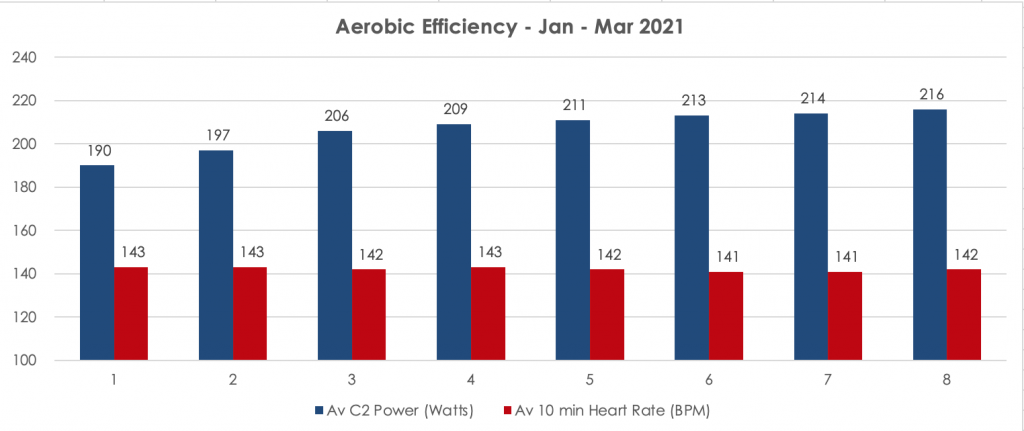
I like to track the development of my aerobic base, and do so with a simple protocol on the Concept2 ergo. Every 2-weeks I ‘check-in’ on how my aerobic base is developing from a duration perspective, and efficiency, through monitoring the power output (watts). I did 8 tests between January and March, and over this period saw an average test to test improvement of +1.6% watts for the same heart rate. Over the 12-week same period, I saw a +13.7% improvement in watts for the same heart rate. See the graphic below.
I have noticed similar improvements in power and efficiency, with Masters Rowers that really focus on developing their aerobic base, and have the discipline to work in their zone 2, progressively over time, before introducing higher intensity work. It is hard work to stay focussed, day in, day out, grinding away on the machine or on the water. Yet the benefits to your health and performance can be amazing. This is the ‘hard work’ that many Masters Rowers don’t do, because it is so easy to be seduced into the high intensity ‘go hard or go home’ approach. Yet if your’e interested in a tried, tested and proven way to build the foundations for a great season, give it a try.
We are running a series of Master Classes this April, with world class instructors to help Masters Rowers to learn more about how to go Faster. Dr Charlie Simpson, and expert in training intensity and nutrition, will be sharing his insights into how to train and eat. Click here to go to the Master Class page to find out more.