Tag: valery kleshnev

  • Analysis of Tokyo Olympics results

    Analysis of Tokyo Olympics results

    Analysis provided by expert guest contributor, Dr Valery Kleshnev, Biorow.

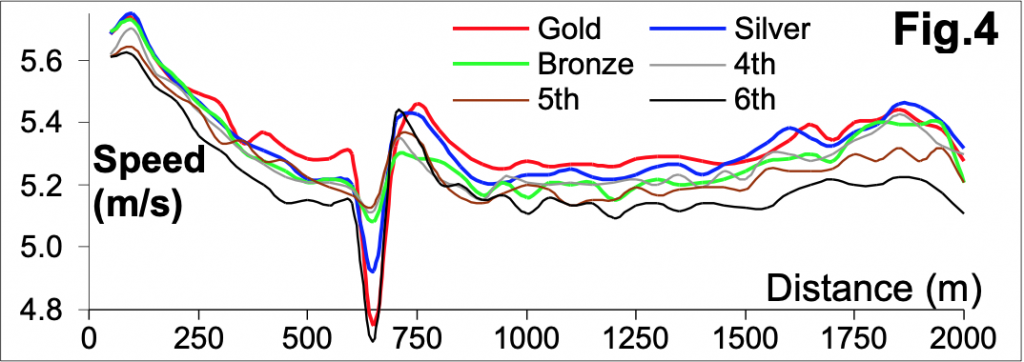
    Radical changes were observed in the race strategy, which is now much more even. The winners were among the slowest at the first 100-150m after start, but significantly faster than their competitors during the middle of the race.

    A strong cross-tail wind allowed for quick times on Tokyo’s Sea Forest Waterway, despite fairly rough water. Six World best times were set (W8+ ROU, W2- NZL, LW2x ITA, LM2x IRL, W4x CHN in FA, M4x NED in FA), all on Wednesday 28th July. This made it the second fastest World regatta since 1993, only 0.3% slower than Worlds- 2014 (Amsterdam).
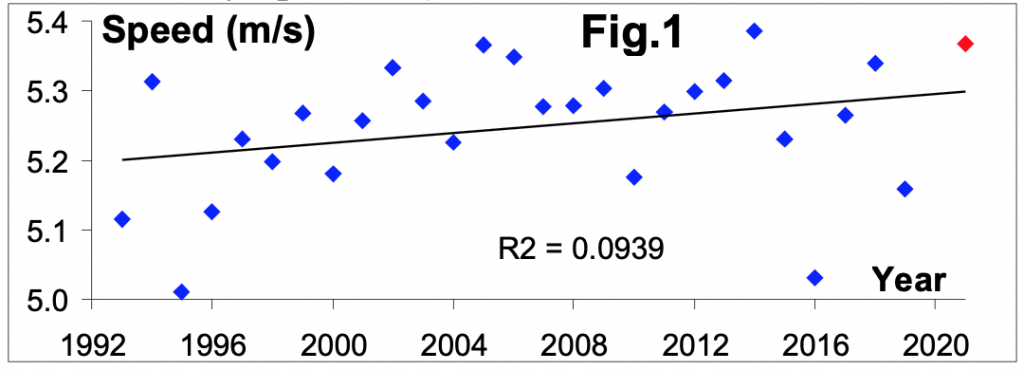
    Fig.1, the average speed in 13 consistent Olympic boats. (Kleshnev 2021)

    The linear trend during 1993-2021 grows by 0.065 %/year (0.0035 ms-1/y). W8+ continues to show the highest speed increase (0.18%/y), significantly higher than in the next M8+ (0.13%/y) and LW2x (0.10%/y). The lowest trend (Table 1) was found in women sculling boats (0.03%/y).

    Table 1. Growth of winners’ speed during 1993-2021 (Kleshnev 2021)

    More detailed analysis in scrolling decades (RBN 2020/08) also shows continuous growth during the last two decades (Fig.2) with the latest value +0.045 %/y.

    Speed Growth (%/year) (Kleshnev 2021)

    The average stroke rate in the 12 Olympic boat types (Table 2) was 39.0spm, which is 0.6spm higher than in the previous Worlds-2019 in Linz and similar to Worlds-2018 in Plovdiv. This is possibly weather-related: faster speed allows for a higher stroke rate.

    Table 2. Average stroke rate in finals A in 12 Olympic events in Tokyo-2021 (missing data for M2x and M4-)

    The differences in the rate between finalists were insignificant: only ±0.2spm within the first four place- takers, though 8 out of 12 winners showed lower average stroke rate than their silver competitors.

    (Kleshnev 2021)

    Radical changes were observed in the race strategy, which is now much more even. Two years ago in Linz the average variation of 500m splits in A finals was 2.56% (+3.5%, -1.6%, -2.1%, +0.3%), but now (Tab.3) it is more than two times lower 1.14% (+0.8%,-1.2%,- 0.7%,+1.2%). The first 500m split was the fastest in all previous regattas, but now the last section is the fastest. As before, the winners had the most even distribution of efforts during the race (Tab.3), except the 6th place-takers.

    Table 3. Speed at each 500m as % difference to the average over 2000m in finals A in 14 Olympic events. (Kleshnev 2021)

    Analysing the absolute splits (Tab.4), the winners were faster than other finalists at each section, except the last 500m, where silver medallists were 0.19s faster. As before, the main advantage was taken by the winners at the second 500m, where they were about 1.0s faster than their closest competitors.
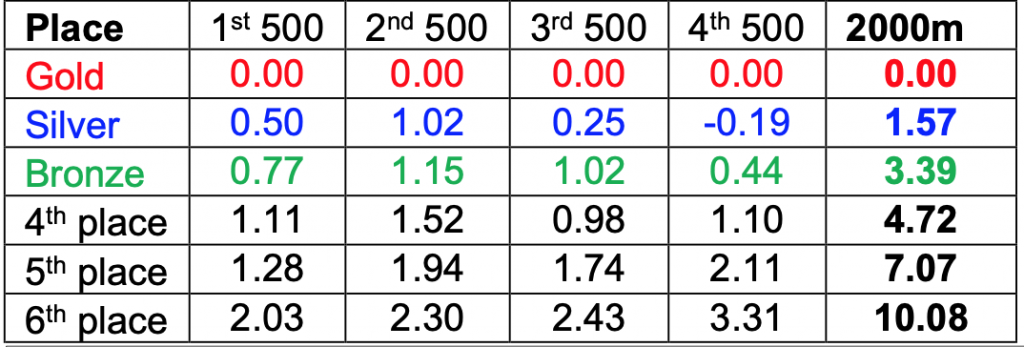
    Fig.4 confirms the above conclusion with average data (12 boats) at each 50m section taken from GPS (the glitch at 650m appears to be the shielding of the GPS signal by the bridge). The winners were among the slowest at the first 100-150m after start, but significantly faster than their competitors during the middle of the race.

    ©2021 Dr. Valery Kleshnev www.biorow.com

  • Observations from the Final Olympic Qualifying Regatta and World Cup II – Lucerne, Switzerland

    Observations from the Final Olympic Qualifying Regatta and World Cup II – Lucerne, Switzerland

    I am very lucky to live only 2 hours drive away from Lucerne and what the locals call ‘God’s Lake’ the Rotsee. So when World Rowing came to town, twice, it was a great opportunity to go and watch what the world’s best row, and share some observations from the two weekends of great racing.

    Great organisation around weather & viruses

    Moving the finals at the FOCR. The finals were planned for the Monday, always a strange arrangement, yet the weather conspired to bring the finals forward to the Sunday. Superb collaboration between the Lucerne regatta organisation and the Meteo team. The predicted weather that would’ve resulted in unfair racing early on, they debated, decided and took the decision fast. Unlucky for the TV crews that were unable to set up a day in advance, yet superb organisation for the athletes and teams.

    The COVID-19 plan was clear to all attending and well executed. Athletes and teams were in front of the rowing centre with uninterrupted access to the water. The entire area was cordoned off, with all athletes requiring their accreditation to enter the area, and a laser temperature scan at the two entry points. Unfortunately for locals that wanted to watch, there were no big screens and no food stalls. That said, the Rotsee is an ideal place for a picnic and most spectators were watching the action on their phone up until 750m to go and then it was full HD Live action in front! Nice commentary from Martin Cross.


    Boats & Equipment

    Over the course of watching all the heats and finals, and after peering through the security fence into the boat yard, I was surprised to only see three different makes of boats in the finals. Filippi, Empacher and Hudson. I only saw one Hudson boat over the regatta (maybe I missed another) used to great effect to finish 2nd in the woman’s single scull final A. Empacher appears to be the choice by most nations for the eights, however more and more nations are choosing Filippi, with 104 boats, 61% of boats used in World Cup II and 69% of total medals (31) with crews rowing in a Filippi.

    I noticed more and more stroke coaches being used by different a crew members in the boat. No longer reserved for the cox or the stroke, you can see the stroke coach strapped the the stroke man’s rear wing rigger for the bowman in the Romanian men’s pair, and just in front of the coxswain in the Dutch eight.

    Riggers

    Rigger set up in the men’s eight final (what a race), the German & Netherlands crews were using the rear carbon wing and the winning crew, GB using a front carbon wing, with rear carbon support. The GB crews used the same set up in both their fours. Surprisingly, the Italian men’s four decided on a front aluminium wing set up, the only boat in the race to do so. On closer inspection in the boat park, Filippi are making a big statement with their new carbon wing design. This new design looks to be thinner and very aerodynamic. 

    Integrated cables

    The newer boats appear to be integrating cables and rudder mechanisms under the deck. Looks very tidy and must help with aerodynamics, and save the cables catching on boat trailers and storage racks. It looks like boat manufacturers are following the lead of road bike manufacturers, with tighter cable management and integration. Would make sense.

    Shoes

    Boat manufacturers are taking on the BOA fixation system, first started by Bont Rowing and borrowing from cycling technology, now with Empacher bringing out their own version (made in Italy) and soon Filippi. This makes sense to me, as the BOA system helps to secure the foot in place, more so than laces or Velcro, and designed correctly, the release system is very effective. 

    Fins

    Most of the crews were using the classical aluminium fin, and not the thinner elliptical fin. This fascinated me, as the Rotsee is known for its calm and fast following conditions with very little waves. According to the Australian Boatman, Mr Urs Graff, some of the crews were feeling the effects of the side wash from the returning TV crew boats and umpire boats. The wash was disturbing them, hence the choice to swap out the elliptical dagger fin for the more conventional aluminium fin.


    Blades

    Didn’t see many crews using the new Comp Blades from Concept2. In fact these blades we the unicorns at both regatta. It looked like most crews were sticking to the tried an tested Crocker oars or Concept2 blades, with a high proportion or crews using the skinny shaft option. Reviewing Dr Kleshnev’s data on the wind resistance of regular oar shafts vs. the wind cheating skinny’s, (see below) the advantage over 2,000m is about 2-3 seconds with the Skinny shaft.

  • Live Master Class Sessions & Instructors

    Live Master Class Sessions & Instructors

    Super excited to announce today, the live sessions with our world-class instructors. More information will be released later this week, so be sure to join the newsletter to be the first to find out.

    Training & Nutrion For Masters Rowers

    Instructor: Dr Charles Simpson, Author and Senior Lecturer in Sport and Exercise Science. Sport. Faculty of Health and Life Sciences, Oxford Brookes University.

    Biomechanics For Fast & Efficient Rowing

    Instructor: Dr Valery Kleshnev, Rowing Biomechanist, Author, Inventor, Olmpic Silver medalist and USSR Single Sculls Champion.

    Strength & Conditioning For Masters Rowers

    Instructor: James Goodwin, Head of Strength & Conditioning and High Performance, Swiss Rowing Federation.

    Rowing Technique To Move The Boat Fast. 

    Instructor: Noel Donaldson, former head of Australian Rowing, New Zealand Rowing. Coach of the Oarsome Foursome & the Kiwi Pair.