Tag: empacher

  • What the best do to constantly improve. Are you planning for 2023 now?

    What the best do to constantly improve. Are you planning for 2023 now?

    Success loves preparation, and it’s not uncommon to see athletes heading into the last months of the year, without a clear goal for the next year, and an understanding of what they need to do to achieve their goals. With the off season in Europe and America and with at least 6-months to racing in most of the world, we have an opportunity, to reflect on results from 2022, what went well and what can be improved for next year. Question is, will you take time to reflect and plan?

    I thought I’d share the approach I use, along with the approaches from super successful masters athletes and coaches, with the intention of inspiring and even challenging you, in your approach to setting up, and preparing for the year ahead.

    First, take some time off

    Many rowers feel that they shouldn’t take a break at the end of the season. I like to take at least 3-weeks off, and sometimes 4-weeks. Rest the body and mind. Build up an appetite to get back in the boat, gym and ergo, to train through the off season. I use this time to build up my reserves, and to reflect what I need to do to go faster next year.

    Review the year

    Take some time to reflect on the year to date. What did you do this year, and how has it worked out?

    What I review

    • Total training hours vs. prior year
    • Total annual training stress score (TSS) and total TSS in the last 8-weeks leading to a target race vs. plan vs. prior year
    • Percentage of time spent in high vs. low intensity vs. target
    • Number of strength sessions and progression in power to weight
    • Online and actual regattas, how’d you go? What were your results?
    • What blocked you and what would you do differently in hindsight?
    • New things you tried out during the year. Technique or equipment, how’d it go?
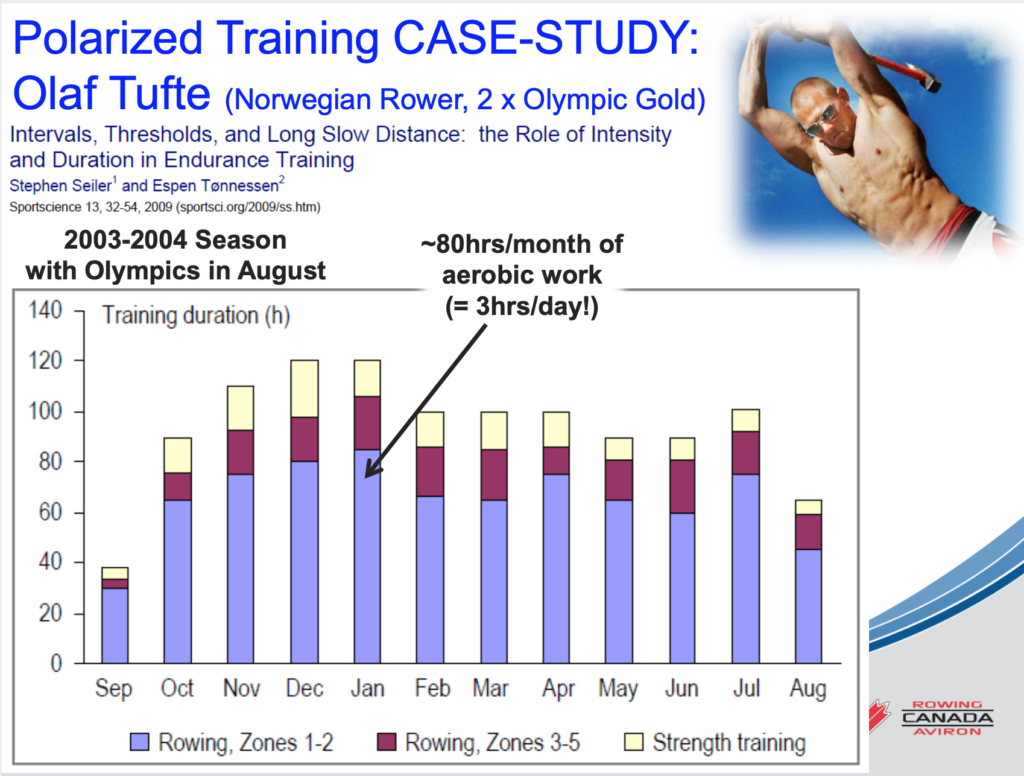
    S Seiler & E Tonnessen (2009)

    Some points to consider in reviewing the year

    • How did you do on the basics; sleep, nutrition and training consistency?
    • Did you complete all the sessions you planned, or did you miss some due to injury, fatigue or work etc…
    • Did you advance your technique (ergo & boat) to go faster? It’s noticeable at all intensities/power output, when rowers improve their technique. How’d you go? Are you getting the right advice? Have you consulted someone to help you? Are you focusing on the improvement or did you just go through the motions.
    • Did your aerobic efficiency improve over time? e.g. more power (watts) at your aerobic threshold. Did you measure this?
    • Did you improve your power at your anaerobic threshold?
    • Did your power and strength improve with training? Is this something you track and manage?

    So What! Identify areas for improvement

    Now that you have the what identified, i.e. data points from the season, a good question to consider is, so what? With good data from the year, you can start making informed decisions, on where to focus in the year ahead.

    In my interview with multiple HOCR winner, Greg Benning, this is what he had to say about planning the year.

    Goal #1: Do it better every year

    Accretive:  Start with prior year, try new stuff, keep best ideas

    Incremental Gains: Keeping a list of strengths, weaknesses, measuring

    Faster podcast interview with Greg Benning (2020)
    • If your power fades and you can’t last in a race, you may need to spend time building your aerobic base?
    • If you find that your power to weight has decreased, it will be time to get into the gym and build the strength over the months of Nov – Jan.
    • You have good times on the ergo yet this doesn’t translate to speed on the water in comparison to your peers. Time to get some technical advice and engage a coach.

    Use the off season to invest

    I use the time now to plan forward for next year, with a strong focus on what I need to do in the off season, to be ready for the base training in 4-months time.

    • Systems and tools to help me track and analyse performance
    • Getting crystal clear on the main target events, and how these fit around family and work
    • Identify clearly the gaps I need to close and the plan to close them
    • Planning out the main training phases.
    • Complete a strength and power block. Targeting an increase in lean muscle mass, before the high volume endurance work starts
    • Close the gaps in weak areas. For example, I may want to work on a specific area for strength improvement or flexibility.

    Review and Plan are key aspects of success in life, business and sport. I hope that some of the points I have raised, challenge and inspire you, to review what you have done, and identify areas that will help you to go faster.

  • Observations from the Final Olympic Qualifying Regatta and World Cup II – Lucerne, Switzerland

    Observations from the Final Olympic Qualifying Regatta and World Cup II – Lucerne, Switzerland

    I am very lucky to live only 2 hours drive away from Lucerne and what the locals call ‘God’s Lake’ the Rotsee. So when World Rowing came to town, twice, it was a great opportunity to go and watch what the world’s best row, and share some observations from the two weekends of great racing.

    Great organisation around weather & viruses

    Moving the finals at the FOCR. The finals were planned for the Monday, always a strange arrangement, yet the weather conspired to bring the finals forward to the Sunday. Superb collaboration between the Lucerne regatta organisation and the Meteo team. The predicted weather that would’ve resulted in unfair racing early on, they debated, decided and took the decision fast. Unlucky for the TV crews that were unable to set up a day in advance, yet superb organisation for the athletes and teams.

    The COVID-19 plan was clear to all attending and well executed. Athletes and teams were in front of the rowing centre with uninterrupted access to the water. The entire area was cordoned off, with all athletes requiring their accreditation to enter the area, and a laser temperature scan at the two entry points. Unfortunately for locals that wanted to watch, there were no big screens and no food stalls. That said, the Rotsee is an ideal place for a picnic and most spectators were watching the action on their phone up until 750m to go and then it was full HD Live action in front! Nice commentary from Martin Cross.


    Boats & Equipment

    Over the course of watching all the heats and finals, and after peering through the security fence into the boat yard, I was surprised to only see three different makes of boats in the finals. Filippi, Empacher and Hudson. I only saw one Hudson boat over the regatta (maybe I missed another) used to great effect to finish 2nd in the woman’s single scull final A. Empacher appears to be the choice by most nations for the eights, however more and more nations are choosing Filippi, with 104 boats, 61% of boats used in World Cup II and 69% of total medals (31) with crews rowing in a Filippi.

    I noticed more and more stroke coaches being used by different a crew members in the boat. No longer reserved for the cox or the stroke, you can see the stroke coach strapped the the stroke man’s rear wing rigger for the bowman in the Romanian men’s pair, and just in front of the coxswain in the Dutch eight.

    Riggers

    Rigger set up in the men’s eight final (what a race), the German & Netherlands crews were using the rear carbon wing and the winning crew, GB using a front carbon wing, with rear carbon support. The GB crews used the same set up in both their fours. Surprisingly, the Italian men’s four decided on a front aluminium wing set up, the only boat in the race to do so. On closer inspection in the boat park, Filippi are making a big statement with their new carbon wing design. This new design looks to be thinner and very aerodynamic. 

    Integrated cables

    The newer boats appear to be integrating cables and rudder mechanisms under the deck. Looks very tidy and must help with aerodynamics, and save the cables catching on boat trailers and storage racks. It looks like boat manufacturers are following the lead of road bike manufacturers, with tighter cable management and integration. Would make sense.

    Shoes

    Boat manufacturers are taking on the BOA fixation system, first started by Bont Rowing and borrowing from cycling technology, now with Empacher bringing out their own version (made in Italy) and soon Filippi. This makes sense to me, as the BOA system helps to secure the foot in place, more so than laces or Velcro, and designed correctly, the release system is very effective. 

    Fins

    Most of the crews were using the classical aluminium fin, and not the thinner elliptical fin. This fascinated me, as the Rotsee is known for its calm and fast following conditions with very little waves. According to the Australian Boatman, Mr Urs Graff, some of the crews were feeling the effects of the side wash from the returning TV crew boats and umpire boats. The wash was disturbing them, hence the choice to swap out the elliptical dagger fin for the more conventional aluminium fin.


    Blades

    Didn’t see many crews using the new Comp Blades from Concept2. In fact these blades we the unicorns at both regatta. It looked like most crews were sticking to the tried an tested Crocker oars or Concept2 blades, with a high proportion or crews using the skinny shaft option. Reviewing Dr Kleshnev’s data on the wind resistance of regular oar shafts vs. the wind cheating skinny’s, (see below) the advantage over 2,000m is about 2-3 seconds with the Skinny shaft.

  • Wendy Miller’s experience at the Head of The Charles – Faster Podcast Episode

    Wendy Miller’s experience at the Head of The Charles – Faster Podcast Episode

    My guest today, is Wendy Miller, from Mosman Rowing Club in Sydney Australia. Wendy competed in the 2019 Head of The Charles regatta, and gained 3rd place in her first attempt in the single sculls event.

    I first met Wendy in 2019, as she was travelling through Europe on holidays on her way to Boston. She gave me a call to ask if she could drop by Switzerland, (as you do:-) to do a spot of training with me, before heading over to race in the US. Wendy has a great story to share, with her journey through Europe, training on a yacht whilst sailing down the Italian coast, her ingenuity to source boats, blades and boathouses to use, staying with wonderful hosts in different cities, and finding races to sharpen up before the big event. Nothing stopped Wendy on her way to racing in the 2019 Head of The Charles regatta and having a great adventure along the way. I hope you enjoy listening to her journey as much as I did.

    Head of The Charles Training Plans

    If you are a Masters Rowers, and interested in training for the Head of The Charles Regatta, I have prepared training plans especially for Masters Rowers. Whether you are planning to race in Boston, or compete virtually, these plans will help you to be at your best. The plans are designed by the most successful Masters Rowers, specifically for the Head of The Charles, and for Masters with 6 hours a week all the way to 12 hours of training a week. Click on the link to check out the programs. HOCR Training Plan

    Faster Podcast

  • New Features For 2021 Filippi Boat Range

    New Features For 2021 Filippi Boat Range

    Faster Membership

    The rest of this one is for members.

    This article, both twelve-week training plans, and the full library of protocols and calculators are part of Faster Membership. CHF 129 for the year.

    See what’s inside Members log in

  • You’re getting priority!

    You’re getting priority!

    My next course is about to open for enrolment.

    I’m really excited to let you know, my flagship course, How to Create Your Annual Training Plan, is ready to go live! I have opened the course exclusively to you, before it opens to the public on Friday, 6th of November. The course will be open for a limited time, and for a limited number of people, so get your spot before the course officially opens. 
    Click here to purchase the course. Special coupon code EARLYBIRD30

    In addition to the course materials and downloadable tools, there will be three Live Zoom classes with Bill and former students from the Faster Alumni, exclusively for course delegates.

    Here’s what’s included in the course;

    • Exclusive access to the Faster Alumni Group on Facebook, to share ideas and cover questions with past students. This group is only open to Faster students
    • Three Live Zoom Classes to review the course together with the course community. Classes will be recorded for playback
    • Access to all the online learning modules via the Teachable platform
    • Downloadable tools and protocols on how to test your performance
    • Dynamic and Maximum strength plans
    • Access to Tips & Tricks – Ideas & Inspiration from our advisory panel of experts
    • PDF downloads of studies on the best approaches to training 
    • Guidance on how to train from the world’s best coaches, scientists and masters athletes – period!

    Access to the entire course and all the online learning modules is $287, but I’m giving you 30% off when you enrol before the course opens on November 6th. Just use one of the limited the coupon codes EARLYBIRD30 at the checkout, and you’ll receive your discount.

    Click here to purchase the course. Special coupon code EARLYBIRD30

    Here’s what one student shared about his experience in the course.

    “What I learnt from this course opened my eyes to what I was truly capable of and transformed the way I now train and prepare. I used to go fast, yet never knew if I was really training the right way. Since I have done the course, I now KNOW what I need to do to reach my potential. I don’t train any more than I used to, yet I am going faster on the ergo and on the water. I can better plan my training to achieve balance with my family and the business that I own and operate. I highly recommend this course to anyone that wants to train smart vs. just training harder all the time.” 

    J Van Vulpen, The Netherlands

    Click here to purchase the course. Special coupon code EARLYBIRD30

    If you’ve been waiting to see what you’re capable of, today’s a great day to begin. Hope to see you inside,

    Bill and the FASTER Team

  • Conversation with Noel Donaldson – Faster Podcast

    Conversation with Noel Donaldson – Faster Podcast

    Insights into how rowing has evolved over the decades

    Really excited to share with you, my conversation with Noel Donaldson. Noel is widely recognised, as one of the world’s most successful rowing coaches. He has held posts as the head coach at the Victorian Institute of sport winning countless King’s Cup races, Elite Development, Head Coach and high-performance director at Rowing Australia, as well as the head coach for Australia and then New Zealand Rowing.

    Perhaps best known as the coach of the “Oarsome Foursome” from Australia winning gold medals at both the 1992 and 1996 Olympics and coach of the outstanding ‘Kiwi Pair’ to three consecutive Gold medals, including a double gold in 2014 in the M2- and M2+.

    With so much experience and building winning teams, and crews over the years, I thought it would be nice to have a conversation with Noel and get his insights into how rowing has evolved over the years, across some different themes.

    1. Technique
    2. Approach to training and preparation
    3. Equipment

    Join Noel and I, as we talk about how rowing has evolved over the decades. Click on the button to go to the Faster podcast. Like and subscribe, so you never miss an episode.

  • THE DAY BEFORE RACE DAY

    THE DAY BEFORE RACE DAY

    Being fresh with good form before a race is important – you need to get your mind and body primed and ready to race.

    The primary goal in the final day before a race is to prime the body to perform at its peak level. Making sure all the body’s interconnected systems are functioning as efficiently and effectively as possible. The neuromuscular system is sending signals back and forth quickly between the muscles and the brain. The muscles are full of glycogen and able to activate the maximum percentage of their fibres and fire them forcefully, and your heart is ready to pump oxygen-rich blood where it’s needed.

    In the days before a race, the gains you’ve made from training will stick around for some time, where in contrast, the neuromuscular system (the communication system between your brain and your muscles) requires constant stimulation because the growth and recovery cycle of the neuromuscular system is very short. The best way to optimise rowing specific neuromuscular communication, is to do a short row/erg, the day before your race with some short bursts at or near race pace. 

    What to do

    The final day before the race, row/ergo for 30-45 minutes. When you have warmed up, include two to three 10-15 stroke bursts at race pace to facilitate optimal neuromuscular coordination on race day. Allow for a 5-minute easy paddle between bursts.

    Avoid spending any unnecessary time on your feet today and get a good night’s sleep.

    Eating

    Eat a well-balanced and natural carbohydrate based meal for lunch and dinner the day before race day to maximise  muscle glycogen stores. The best time to start replenishing glycogen stores is right after your short, fast workout, when your muscles are most receptive to glucose. Keep well hydrated and sip water as desired.

    For the pre-race meal, check out my Race Day Breakfast here.

    Image from World Championship 2019, © Detlev Seyb/MyRowingPhoto.com