Excited to share this episode of the Faster Podcast, this time with Dr Charlie Simpson.
Charlie is a Senior Lecturer in Sport and Exercise Science at Oxford Brookes University and well known for his publications. The Complete Guide to Indoor Rowing and Advanced Rowing.
In this episode, Charlie and I cover the following topics and a lot more…
Defining training intensity
The holy trinity in training intensity; heart rate, RPE and power
Key training zones to pay attention to
Lactate testing
How to set up your season and week for training
Nutrition and hydration strategies
The Big 5 supplements that can make a real impact on performance
It’s a long episode (99-mins) and perfect for a long indoor endurance session.
The Complete Guide to Indoor Rowing, is the first comprehensive book to focus on this unique form of strength-endurance training. It is aimed at serious athletes, outdoor rowers and normal gym users.
Advanced Rowing , brings together a selection of leading experts in the sport of rowing, including international head coaches from New Zealand, Norway, Switzerland, and Denmark, who have all coached crews to World and Olympic medals. Distinguished club and university coaches contribute from across the United States, Great Britain, and Australia. Between them, these coaches work with the top national level athletes in their countries and specialize in preparing them to an international competitive standard.
Books recommended by Charlie
Wanted rowing coach by Brad Lewis
Assault on Lake Casitas by Brad Lewis
Thinking Fast and Slow by Daniel Kahneman
The God Delusion by Richard Dawkins
Guns, Germs and Steel by Jared Diamond
Thank you to our Faster podcast supporters: Precision Hydration, Bont Rowing, Filippi Boats and Citius Remex seat pads. These companies want to support Masters Rowers to go Faster and offer exclusive benefits to my newsletter subscribers. To gain access to exclusive bonus offers, ensure you subscribe to my newsletter.
Former head of high performance at British Rowing Mark Homer offers his expert guidance. Original article published on Cycling Weekly, December 12, 2020.
The opportunities to excel in more than one sport are few and far between, and in this age of increased professionalism and specialisation, such chances are becoming rarer. But there is one sporting switch that seems to be eminently possible and, in many cases, extremely successful. A swelling number of elite athletes are making the switch from rowing to cycling. The question is, why? What makes rowing and cycling apparently so complementary?
Male and female athletes alike have transitioned from boat to bike very successfully, suggesting that years spent rowing can contribute to cycling excellence. Having worked as an exercise physiologist at British Rowing for 12 years, I have a solid understanding of rowing — and now I want to find out why being good with a pair of oars can equip you well for a career in the saddle, supporting or even enhancing your cycling performance.
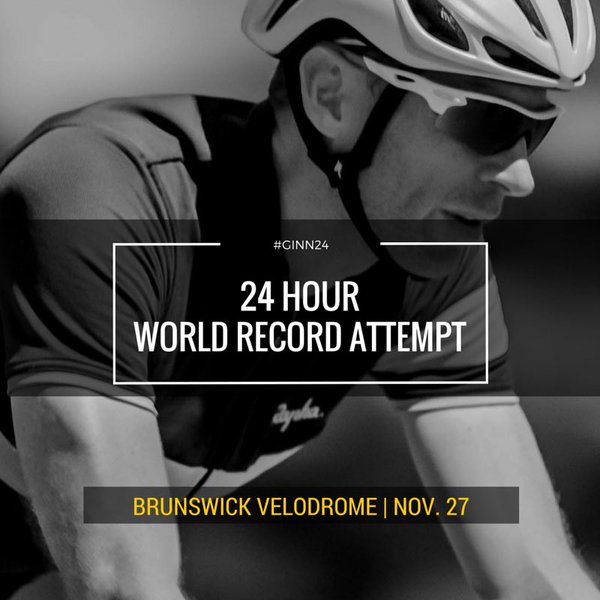
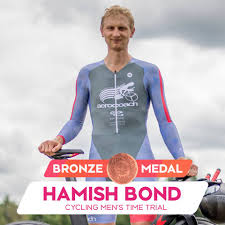
Hamish Bond’s national velodrome 4,000m pursuit record and gold medal, following his switch from time trialling (he won TT bronze at the 2018 Gold Coast Commonwealth Games) to the track, was another exciting twist in the double Olympic rowing champion’s athletic career. Previously half of New Zealand’s dominant men’s coxless pair — undefeated for eight years — the 32-year old has now decided to return to the boat in an attempt to qualify for the Tokyo Olympics.
Bond is not the only example of the successful rowing-to-cycling transition at the highest level. After winning a silver medal at the Athens 2004 Olympics and World Championship gold the following year in the women’s quadruple sculling event, Rebecca Romero won the individual pursuit cycling title at the Beijing Games in 2008.
With rowing events always taking place during the first week of the Olympics, rowers can spend the second week soaking up the atmosphere and enjoying other sports as spectators. It was here Romero was reintroduced to cycling. “The atmosphere in the velodrome was wild,” she recalls watching Bradley Wiggins race in 2004. “A contact of my [now] husband suggested I would be good at the pursuit.”
What happened next?
“Following the 2005 rowing World Championships, I was out of the boat with a long-standing back injury, and I’d fallen out of love with the sport so I made the decision to leave rowing.”
British Cycling got wind of Romero’s interest in track cycling, and the coach tasked with developing a women’s squad for the Beijing Games called her and invited her to Manchester to get tested — the rest is history.
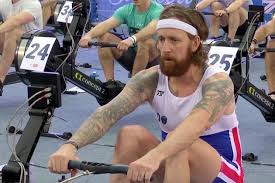
Other talent transfers include Olympic silver medallists Chris Bartley and Katie Greaves who ride for the Athlete Services Test Team; Rosamund Bradbury who sculled at the London 2012 Olympics and recently won the inaugural British Cycling Zwift eRacing Championships (and her brother Edmund, who rowed at Cambridge, now rides for JLT-Condor). An honorary mention too, to Cycling Weekly’s own Michael Hutchinson, who competed as a lightweight rower while studying. Some coaches have also made the crossover, with Team Sky coach Tim Kerrison competing and coaching rowing in his pre-cycling days. Of course, we can’t ignore the high-profile attempt by Wiggins to make the switch: he finished 21st at the 2017 British Rowing Indoor Championships. However, Wiggins abandoned the idea of rowing in Tokyo, citing other commitments.
All of this evidence points towards the possibility that rowing is a good background for a cyclist — and the follow-on suggestion that it might be an effective cross-training activity. Are there lessons that cyclists can learn from rowing? And could adding rowing to your training help improve your cycling?
Why do rowers make good riders? First up, physiology. Rowing is classified as a strength-endurance sport, and rowers, like cyclists, possess some of the highest aerobic capacities in elite sport. Absolute VO2max values as high as seven litres per minute are not unusual. Adjusted for weight, the values are less impressive, naturally — rowers are relatively heavy. Being heavier doesn’t much matter in rowing — you’re fighting the drag of water, not gravity. Lightweight rowers with VO2max values in close to 80ml/kg/min are not uncommon. The high-volume nature of training to improve aerobic capacity prepares rowers well for the rigours of cycling.
Having to overcome water resistance, and needing the ability to ‘change gear’ during a race, rowers must be powerful. Whoever can complete 240 power-clean repetitions with the most weight will win. This highlights the high-strength demands of the sport. Training for track cycling is similar — with time spent in the gym alongside high mileage on the road and intensity work on the track.
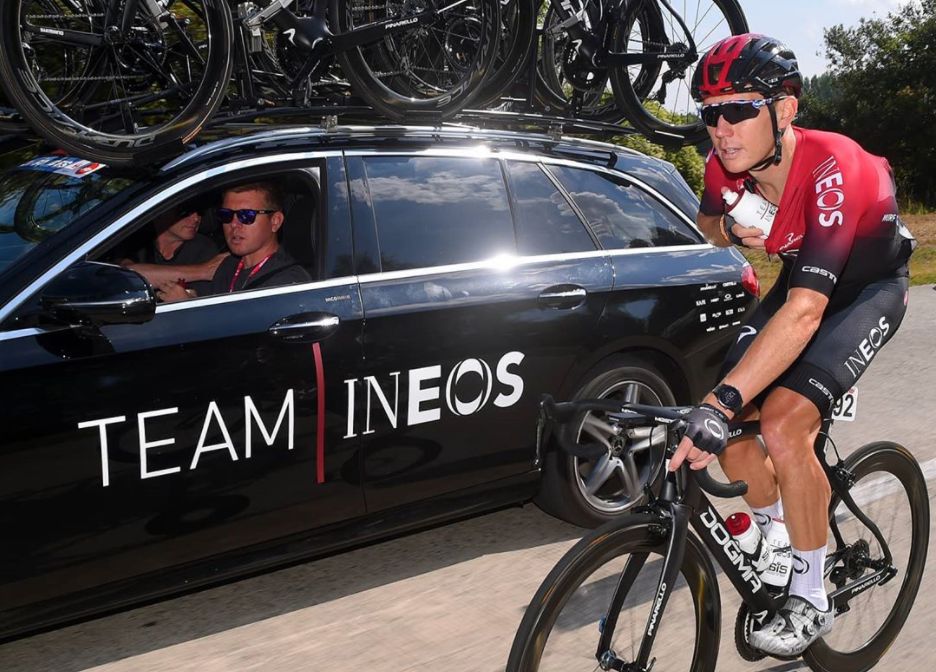
Only lightweight rowers have a realistic chance of making a successful switch to road cycling. With a maximum weight of 70kg for men and 57kg for women, these athletes are trained to produce high power outputs from relatively low body weight. Australian Cameron Wurf rowed lightweight at Athens 2004 before riding for the Cannondale road team, then switching to triathlon [and spend the past season riding with Team Ineos]. Chris Bartley retired from rowing in 2016, having won silver at London 2012 in the Lightweight Men’s coxless four — and last year he finished second in the British 25-mile TT championships.
Development and technique
The main reason why rowers find the switch to cycling more straightforward than vice versa is the technical demands of the sport. I mentioned the 240-repetition power-clean demand, but that was too simple. Imagine having to execute that set of repetitions on the deck of a wobbling boat, balancing a loaded tea tray on either end of the weights bar, synchronised with up to seven team-mates. Balance, timing, and ‘feel’, among other factors, require several years of dedicated practice — but can be picked up surprisingly quickly.
Rowing has a unique development pathway: while many rowers learn at school or as youths within the club system, many — including several Olympic champions — came to the sport as adults, taking up the sport at university. Double Olympic champion Helen Glover started rowing in 2008 aged 22 and in 2012 became one of the first British women to win an Olympic rowing gold medal. Glover competed at football, hockey and cross-country running before rowing but was considered highly ‘coachable’ and ‘trainable’ in her early rowing days.
Romero likewise competed in several different sports before finding rowing. A varied, multi-skilled background may make it possible for rowers to quickly apply their fitness to a new sport. Cyclists tend to be purists, spending many years solely riding their bikes. Rowers seem to be better equipped to transfer their skills.
Rowing training at elite level is very different from cycling training. Cycling is low-impact and a low-force/high-cadence exercise, so high-volume training is essential. Rowers have to overcome greater resistance in water, absorbed by the back, ribs and forearms. While textbook form and technique will reduce the risk of injury, fatigue and loss of form are hazardous. Hence, rowers rarely train for longer than two hours (including the occasional rest). Rowing training is supplemented with non-specific cross training — and cycling is the number one choice. Many national programmes include a weekly low-intensity long bike ride and winter training camps.
Can rowing boost cycling?
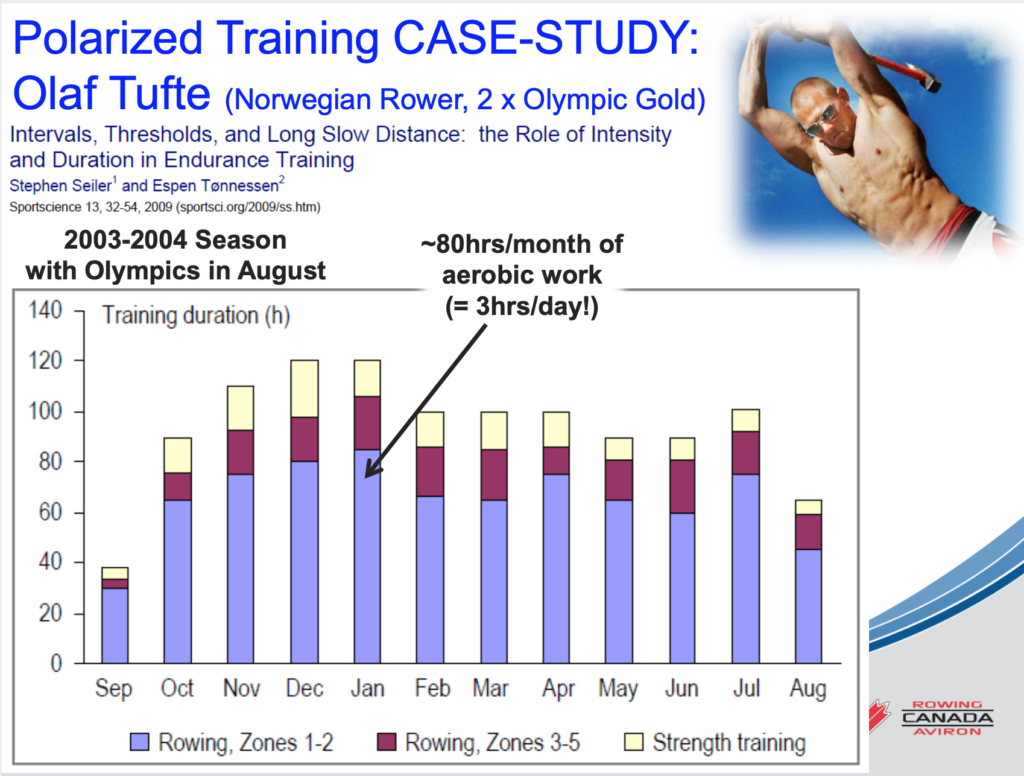
The successful transition of rowers into track cycling suggests that rowing training may have some tricks to offer to cyclists. Despite the relatively short event distance and times, rowing training has evolved to comprise high volumes of low-intensity training, combined with short, sharp intensity, roughly following an 80:20 polarised intensity distribution. International-level rowers train approximately 20-25 hours per week and clock 5,000-6,000km per season. Over the course of a four-year Olympiad, this equates to approximately 7,600 strokes in training for every single stroke of an Olympic final!
The unavoidably flat nature of lakes and rivers is comparable to the velodrome: it is consistent, and effort can be precisely measured (weather conditions aside). Rowers, therefore, programme training sessions with clear single training zone targets. Long steady-state rowing or ergometer sessions are the norm in international squads, with a tight range of intensity based on heart rate or blood lactate responses.
Whereas cyclists often include multiple efforts of different zones of work within a single training ride, rowing programmes timetable up to four shorter
In-your-face stats: there’s nowhere to hide on the indoor rower sessions in a day (including resistance training and core stability). The intensity-based ‘race-preparation’ sessions include isolated efforts to ensure quality.
The strength-endurance demands within rowing performance requires athletes to complete up to three weight training sessions per week, particularly during the winter months. Making improvements in strength and power alongside endurance is difficult, owing to the ‘interference effect’, where gains in strength are lessened by endurance work. Rowing coaches alleviate this by programming resistance training as the final session of a given day, to maximise strength adaptations.
Correct nutrition helps to maximise the effect of such strength training with emphasis placed on protein intake before, during and after such sessions. While strength training for track cycling is well established, and its use for road athletes is increasing, most cyclists would benefit from more weight training to improve their economy, with corresponding improvements in nutrition. Rowers are famous for their high-calorie intake. While macronutrient status has little effect on a six- to eight-minute race, meeting the demands of high-volume preparation means consuming up to 6,000kcal per day. As covered in these pages, many cyclists under-fuel in an attempt to lose weight and stay lean, putting their bone health at risk. Core stability is also critical to maintaining good form and effective rowing. Rowing places high force through the trunk, and common injuries include lumbar spine and rib problems, often caused by poor stability. Producing power on a bike requires a stable base too, so this is another way in which cyclists could benefit from training more like rowers.
As we have seen, rowers tend to switch quite easily to cycling because they’ve already been used to cycling as a cross-training activity. Cross-training is highly valued in many endurance sports but is often neglected in cycling. Of course, cycling is low-impact and relatively non-intense, so cross-training might not seem vital, but mixing things up can have a powerful effect.
Will doing some rowing help your riding?
It’s tempting to keep your training specific and only ever train on the bike — but you might be missing out with many clubs offering taster sessions. The technical nature of the sport takes time to develop, and it is difficult to register meaningful physical training during this time. A quicker and more convenient solution is indoor rowing. The stability and reduced technical demands mean you are quickly rewarded for your efforts and, in short, yes — there may be some advantages to including some rowing in your training programme.
Rowing is a whole-body exercise, so with correct technique, your legs, trunk and arms are subjected to an aerobic training stimulus. The quads, glutes and hamstrings should contribute the most to each stroke. If your training is mostly cycling, there is no harm in taking some of the pressure off the well-used muscle groups and involving the upper body too. Keeping the resistance low will allow more of a low-force/high-cadence approach, targeting the cardiovascular system rather than strength.
Dr Nicky Keay, who has published several studies investigating bone density in athletes, believes rowing is an excellent spine-loading exercise for those at risk of low bone density, whether through past under-fuelling or the lack of weight-bearing from cycling alone.
As previously mentioned, rowers need a strong and stable core, and good rowing drills and sequencing should enable you to sit stronger on your saddle too. It is easy to lose shape, but with a constant reminder of your split and effort on the screen on a rowing machine, the influence of technique on speed is clear. You can work hard, but a weak position will mean you leak power and quickly slow down.
Finally, rowing provides an experience that cycling cannot: a level of teamwork rarely called for in cycling. I am told the feeling of team cohesion and rhythm when you are part of a crew moving a single hull in perfect synchronicity is unbeatable. Like a team time trial without the option of losing a man, the whole really is greater than the sum of its parts.
This feature originally appeared in the print edition of Cycling Weekly. https://www.cyclingweekly.com/news/latest-news/why-do-so-many-elite-cyclists-have-a-background-in-rowing-486088
In this episode I cover the metrics that I track during a rowing season, to monitor and manage. This episode ought to be useful for anyone seeking to understand what training metrics and devices are best to improve their performance in rowing.
This episode of the Faster Podcast, will help you to better understand the Oar range from Concept2.
Meredith and Kevin explain all there is to know about the different blades, oar shaft and grips from Concept2. We discuss how Concept2 started to where they are today. Key differences between the different blade shapes and oar shaft. How to set up the boat with different oars. How to care and maintain the equipment. To ideas and best practice on how to test which set of oars/scull are the best for you.
Meredith Breiland
Meredith started rowing in high school. She quickly fell in love with early morning practices, erg tests, blisters, and track bite. She continued her rowing career at Cornell University. After graduation, she switched her focus to running and triathlon.
At Concept2, Meredith is a member of the marketing team. Her passion is working to diversity the sport through social justice initiatives. She currently rows with Green Mountain Rowing, a sculling club founded by her husband. They stay active with rowing, running, skiing and chasing after their two daughters.
Kevin Stevenson
Kevin is a mechanical engineer at Concept2, having worked on rowing oar and ergometer development for 13 years. A collegiate rower and graduate of Hobart College, Dartmouth College, and the University of Vermont, he’s a Vermont native, and work at Concept2 allows him to combine his love for product development and rowing while taking advantage of all the area has to offer. When not rowing he can be found with his wife and three kids skiing, biking, tinkering, or maple sugaring in the spring.
Speed Testing Oars – Concept2 Testing Protocol
Conducting the Test
Peter and Dick use the following procedure when conducting speed testing:
During testing, row at least six pieces, switching between the two oars or sets of sculls for each piece. Do as many pieces as possible to see if a pattern evolves.
Do not change anything other than the oars being tested. If you change other factors during a test, you will not know which change made the difference.
Row all pieces at maximum effort, because it is easier to be consistent. Avoid testing with longer pieces, as they require pacing and other factors that could skew your testing results.
Timing accuracy is critical, and timing a fixed number of strokes (versus timing a distance) is the most accurate method. Set the speed meter so that you have 10 strokes to get up to speed, then start recording speed data for the next 40 strokes.
If you choose to time a distance, make sure it’s at least 500m. This minimizes the effects that result from differences as to when a piece begins and ends relative to the stroke cycle.
Do not look at any results until all pieces are complete, as knowing the results during the test may affect your performance. Cover the speed portion of the display with a piece of tape during testing.
Only test during calm conditions, and row all pieces in the same wind direction. Changes in a tailwind have less effect than a headwind.
Evaluating Results
Peter and Dick use the following principles to evaluate results:
Graph the results and calculate the difference in speed as a percentage.
Because day-to-day variation is too great, stick to comparing trials that were done on the same day.
Test the same variable several days before making a conclusion.
Keep in mind that test results only apply directly to the crew doing the testing.
Success loves preparation, and it’s not uncommon to see athletes heading into the last months of the year, without a clear goal for the next year, and an understanding of what they need to do to achieve their goals. With the off season in Europe and America and with at least 6-months to racing in most of the world, we have an opportunity, to reflect on results from 2022, what went well and what can be improved for next year. Question is, will you take time to reflect and plan?
I thought I’d share the approach I use, along with the approaches from super successful masters athletes and coaches, with the intention of inspiring and even challenging you, in your approach to setting up, and preparing for the year ahead.
First, take some time off
Many rowers feel that they shouldn’t take a break at the end of the season. I like to take at least 3-weeks off, and sometimes 4-weeks. Rest the body and mind. Build up an appetite to get back in the boat, gym and ergo, to train through the off season. I use this time to build up my reserves, and to reflect what I need to do to go faster next year.
Review the year
Take some time to reflect on the year to date. What did you do this year, and how has it worked out?
What I review
Total training hours vs. prior year
Total annual training stress score (TSS) and total TSS in the last 8-weeks leading to a target race vs. plan vs. prior year
Percentage of time spent in high vs. low intensity vs. target
Number of strength sessions and progression in power to weight
Online and actual regattas, how’d you go? What were your results?
What blocked you and what would you do differently in hindsight?
New things you tried out during the year. Technique or equipment, how’d it go?
S Seiler & E Tonnessen (2009)
Some points to consider in reviewing the year
How did you do on the basics; sleep, nutrition and training consistency?
Did you complete all the sessions you planned, or did you miss some due to injury, fatigue or work etc…
Did you advance your technique (ergo & boat) to go faster? It’s noticeable at all intensities/power output, when rowers improve their technique. How’d you go? Are you getting the right advice? Have you consulted someone to help you? Are you focusing on the improvement or did you just go through the motions.
Did your aerobic efficiency improve over time? e.g. more power (watts) at your aerobic threshold. Did you measure this?
Did you improve your power at your anaerobic threshold?
Did your power and strength improve with training? Is this something you track and manage?
So What! Identify areas for improvement
Now that you have the what identified, i.e. data points from the season, a good question to consider is, so what? With good data from the year, you can start making informed decisions, on where to focus in the year ahead.
In my interview with multiple HOCR winner, Greg Benning, this is what he had to say about planning the year.
Goal #1: Do it better every year
Accretive: Start with prior year, try new stuff, keep best ideas
Incremental Gains: Keeping a list of strengths, weaknesses, measuring
Faster podcast interview with Greg Benning (2020)
If your power fades and you can’t last in a race, you may need to spend time building your aerobic base?
If you find that your power to weight has decreased, it will be time to get into the gym and build the strength over the months of Nov – Jan.
You have good times on the ergo yet this doesn’t translate to speed on the water in comparison to your peers. Time to get some technical advice and engage a coach.
Use the off season to invest
I use the time now to plan forward for next year, with a strong focus on what I need to do in the off season, to be ready for the base training in 4-months time.
Systems and tools to help me track and analyse performance
Getting crystal clear on the main target events, and how these fit around family and work
Identify clearly the gaps I need to close and the plan to close them
Planning out the main training phases.
Complete a strength and power block. Targeting an increase in lean muscle mass, before the high volume endurance work starts
Close the gaps in weak areas. For example, I may want to work on a specific area for strength improvement or flexibility.
Review and Plan are key aspects of success in life, business and sport. I hope that some of the points I have raised, challenge and inspire you, to review what you have done, and identify areas that will help you to go faster.
Nick Lloyd is the woman’s coach at the Swiss Rowing Federation, and the assistant coach to Ian Wright. Growing up in Sydney Australia, Nick has been involved in and led the coaching of some of the most successful school crews in Australia and New Zealand. Now assisting Head Coach Ian Wright in the Swiss programme, Nick shares his thoughts on what it takes to bring a crew together as one to go fast, and his approach to technique.