
Faster Membership
The rest of this one is for members.
This article, both twelve-week training plans, and the full library of protocols and calculators are part of Faster Membership. CHF 129 for the year.

Faster Membership
The rest of this one is for members.
This article, both twelve-week training plans, and the full library of protocols and calculators are part of Faster Membership. CHF 129 for the year.

As the winter start to bite here in Switzerland, our crews are doing what they think think they need to do to prepare for the racing season that starts in May. Many are taking the approach of ‘no pain no gain’ yet I have always questioned this approach. At this time of year, I believe one should be focussing on building the aerobic foundation to leverage in the coming months when the bodies systems can leverage off this large base.
When I talk to some of the most successful and healthy athletes around the world, most actually spend these preparatory months patiently building their aerobic base and working at heart rates of <75% of max. By developing the aerobic system first, they are getting faster and developing a more efficient aerobic system and network of mitochondria without the wear and tear – and injury – that often accompanies anaerobic training. Seiler underscores this in his paper that presents numerous gold medalists spending 80-85% of their training time at <75% of max.
Nothing new here, think of Emile Zatopek, the famous trainer Arthur Lydiard or the published and proven science from Sephen Seiler on training intensities and distribution, they all followed the same methodology. Perhaps in our digital age we have overlooked what has already been proven?
My thoughts today are, how to help my athletes to inform themselves, to challenge the no pain no gain dogma and investing in the aerobic base .
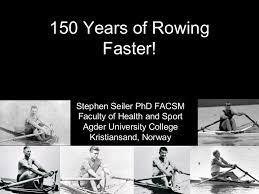
By Stephen Seiler PhD, Agder University College, Faculty of Health and Sport, Kristiansand 4604, Norway.
An excellent summary of factors influencing rowing performance, and ideas for why rowing times have improved so dramatically over the past 150 years.

Hi there,
Thanks for all the great questions and feedback from my recent post on how always training in the middle can be costly. I have summarised most of the questions and feedback below.
Thanks to all that have enrolled and completed the course on ‘how to create your heart rate zones for rowing.’ Please forward the course link to a friend. Course Link
In the coming days I’ll be sending out information on my new course, ‘How to create your training plan’. I will be launching this in late May and welcome suggestions on topics you’d like to see covered.
Q Do I count the sessions of the time spent in low vs. high intensity?
A I count the number of sessions training in low intensity vs. high intensity. For example, I train 5-days a week, I spend 4 days training at low intensity and one day where I focus on training at high intensity. When my squad do say 7 sessions a week, they will do two high intensity sessions that week.
Q How long is the time required to fully reset aerobic base? During the reset period, should I be aiming for an 80:20 ratio (80% zone 2: 20% zone 4/5) or some other ratio?
A Between 8-12 weeks depending on the individual. My annual plan is very similar to a classical periodized plan in that I prescribe at least 8-weeks of aerobic foundation at the start of the season. During the ‘re-set’ I focus my clients on 100% zone 2 (<75% heart rate peak) until I start to see some improvement in their aerobic condition, i.e. improvement in pace or power for the same effort. After I start to see some improvement I may include one high intensity session a week.
Q I used to train for bike racing and used my HR zones almost exclusively so as to focus on effort and not hills or wind that affects speed. I would like to start doing that with rowing, but need to re-establish my HR zones as I haven’t done that in 10 years – on the bike. My questions are 1) what is the best way to do that for rowing 2) I want to train by HR for on the water rowing as well as erg – I’m on the water more than erg anyway.
A First establish your heart rate peak on the ergo for 2k, or on the water with a 6-minute Vo2max test. From there you can set your heart rate zones from this peak and use this as a guide to your training intensity on the water, ergo or bike.
Q If ratio is 80:20, does it matter if I mix in some zone 4/5 with zone 2 workouts, or should they be done on separate days? Thanks
A They should be done exclusively on separate days.
Q I feel my 2k erg pace (which also needs to be redone) is not a good marker as I’m likely not working hard enough in that test. Thoughts?
A The 2k test should be your maximal effort. To really get motivated and to push an all out effort, re-do the test with some friends cheering you on.
Q Is there guidance around about HR geared workouts as opposed to pace? Almost everything I see is based upon your “2k erg pace”.
A The 2k test is there to establish your heart rate peak. Once you have your heart rate peak, you can set up your training zones and train accordingly.
Q Hi Bill, I am a follower of polarization training for over 4 years. I am happy with the long 18k-26k around 75% HR sculling/erging. What I am struggling about is the 10-15% red zone training. I cannot manage it without greater percent of yellow zone. What type of intervals do you use to achieve the preferable percentage? Many thanks for your help.
A So what we do (masters squad) and what I do is as follows: look at the intensity of the session first of all and count these as either low or high intensity. For the high intensity I aim to accumulate between 30 – 45 minutes in zone 4 through different interval variations. My objective is to get into zone 4 as fast as possible and therefore only transition through zone 3. ntervals are a variation of 2:1 work to rest ratio. I let the squad pick and mix to keep the varsity yet a favourite is 5 x 8 minutes with 4 minutes rest between intervals. This is comfortably hard.
Hi Bill. Just read your post on base training. I’ve just completed a solid 4 week blockof it. Two comparative workouts 4 weeks apart. 2nd one at same wattage but HR 20 beats lower. (Craig)
Great case study Bill Chambers. Have you, or are you considering submitting this formally? There’s a real dearth of rowing specific research out there relative to other sports.
Thanks this is a very good post, and spooky as well – we were just talking about this as a team. I can attest that the single biggest improvement in my 2k time was doing the long, boring sessions at 65-75% HR. Audible helps!
Thanks for this. Improvements in aerobic capacity, not limiting carbs, is what leads to efficiency in burning fat for fuel.
I’ve been training mainly in the middle for the last 4 seasons and last year I started feeling my shape was going under. No recover between sessions, more fatigue more pain in the body. When I started rowing at home in March I saw a video from a British rower claiming the benefits of training below AT2. After that, my club coach shared with me your Course about adjusting the training zones. Since then I’m focusing on working below AT2 as a base training.
With no pressure from regattas to train for sprints, I’m catching up on a couple of lost autumns’ UT2 endurance work. At 71, I’m sticking to 120bpm @ 18spm – for 10k up to HM. 200k out of 260k (75%+) so far in April. Need to do another couple of months of this!! Money in the bank!! 👍

In the pursuit of excellence whether in business, sport or my personal life, I like to continuously challenge where my real or perceived limits are. I often find that when I explore a limit, I find an edge. This edge is where I start to explore, understand and challenge the belief that is defining the ‘limit’.
Exploring where the edge can be uncomfortable. It generally challenges an existing belief, yet my desire to improve, my pursuit of excellence, drives me forward to find, explore and push this limit. I won’t find the limit unless I push the limit, push to find the edge, move with it, learn from it and find a way through it.
An example is in preparation for the 2019 rowing season, I have challenged the Masters Rowing Squad to train differently to how they have in the past. Together we challenged the belief in the “no pain no gain” approach to athletic improvement. (Side note; see Seiler’s Hierarchy of Endurance Training Needs 2016) On exploring what the best in the world do to go fast. we identified the key themes that define success and the supporting tactics. Some of these themes challenged general beliefs and concepts, yet instead of going with what everyone else is doing or the dogma of failed strategies, we are focusing on building up the season in a healthy, intelligent and personalised way that has proven to be successful.
Although the squad knows the approach works, it challenges their beliefs. Together, we need to be consciously aware of what we are doing and why we are doing what we are doing. We need to be aware that our approach is challenging our belief systems and the beliefs of others around us. We need to pay attention to our thoughts and fortitude to stay the course. Simple questions like; “whats the purpose of this session”? help to bring the awareness to what we are doing and why.
Another example may be when challenging an organisation in transformation to examine existing organisational beliefs. The old quote of ‘this is how we do things around here’ or in excusing leadership beliefs and or behaviour that are not working as ‘The Organisation’s DNA‘ need to be consciously put on the table for discussion.
Leaders need to explore and understand how successful teams have navigated through change. The default norm of ‘telling’ people what to do and being directive simply is not as successful or effective as empowering teams with clear direction, with trust in the organisation to work it out. This may challenge existing beliefs on what it meant to be a leader and may place leaders at the edge of their beliefs and along with the ambiguity, doubt.
“We cannot solve our problems with the same thinking we used when we created them.”
Albert Einstein
Like the rowing squad, leaders that acknowledge they need to work differently and consciously pay attention to their behaviour generally do. It feels different, yet when supported, leaders can gain strength in exploring the edge through cooperating and collaborating together.
So what you say? Well in the pursuit of excellence I’m constantly looking for the edge, understanding what I need to do differently or optimising the ‘same‘ to achieve my personal and professional goals. I’m paying attention to what is making me uncomfortable and why. I’m getting feedback from close counsel on what I may need to do differently or pay attention to. I’m challenging my beliefs. I’m finding the edge…
Excellence. The quality of being outstanding or extremely good.
Oxford dictionary, 2019